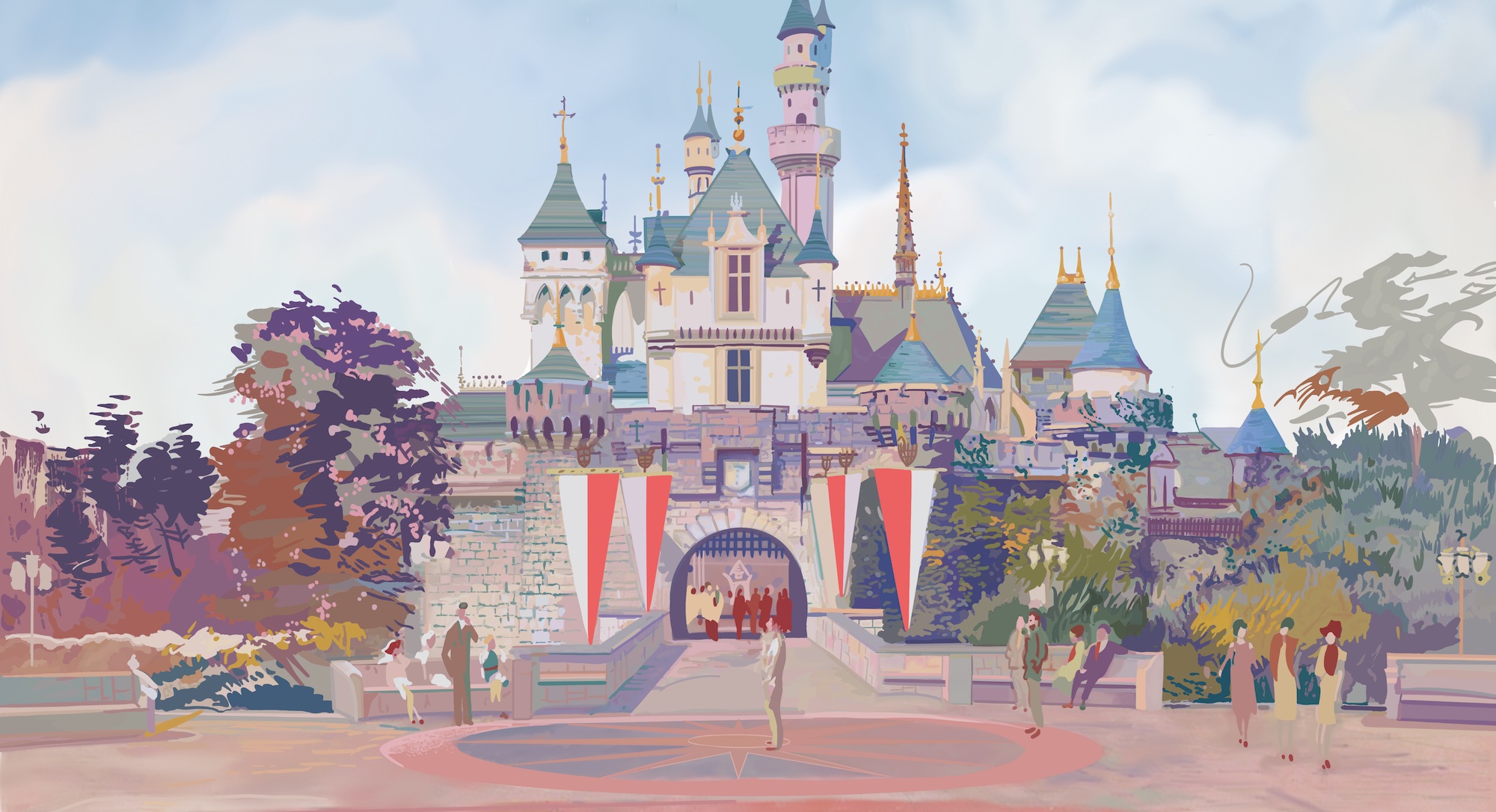


Once upon a time, a living legend prowled the woods of Williamsburg… Like the fairytales carried from the Old Country to the New World, the legend that lurked in the misty, moonlit forests of Virginia is today spoken about in whispers, surviving only as stories passed from one generation to the next… But trust anyone who grew up calling “the world’s most beautiful theme park” home: the Big Bad Wolf was real.
Like the legendary lupine it was named for, Busch Gardens Williamsburg’s Big Bad Wolf was a mysterious, barely-seen fairytale figure that managed to loom large in the minds of children for generations… It was a ride infused with equal parts mayhem and magic; a genuine classic; a ferocious family coaster that served as the first “big” coaster for decades of visitors, swinging through the forest at “the speed of fright.”
Then, at what felt like the height of its popularity, it vanished…

There’s perhaps no coaster so universally beloved and continuously mourned as this one – a perfect entry for Park Lore’s in-depth collection of Lost Legends, exploring the stories behind long-lost rides. But maybe just as interestingly, the story of the Big Bad Wolf is only the first chapter in a wider story of how Busch Gardens Williamsburg has brought the dark and mysterious folk tales of Germany to life… (Chapter Two and Chapter Three are yours to explore…) For now, though, there’s one place to start… And an unlikely one at that…
And before we head off, remember that you can unlock rare concept art and audio streams in this story, access over 100 Extra Features, and recieve an annual Membership card and postcard art set in the mail by supporting this clickbait-free, in-depth, ad-free theme park storytelling site for as little as $2 / month! Become a Park Lore Member to join the story! Until then, let’s start at the beginning…
The Beer behind the Beast
You might expect that the tale of the Big Bad Wolf begins with three little pigs or a little girl in a red hooded cloak or at least with the very real Black Forest in Germany where such stories are often said to have been born… But this Big Bad Wolf’s story begins with beer. (Bear with us – it’ll all come together.)

To make quick work of painting the backstory here, you probably know that in the early 20th century, Americans began to sour on alcohol. Led by so-called “dry” politicians, countless pieces of legislation were slowly enacted across the nation on a platform of temperance (abstinence from imbibing alcohol), swirling together laws and ethics in a fight against the moral “menace” of intoxication.
Especially after the start of World War I in 1914, a hatred of all things German washed across the nation. Temperance organizers latched onto the narrative, establishing in the public consciousness that drinking beer and spirits was akin to supporting the Kaiser; that even domestic breweries (many started by German immigrants) were intentionally wasting resources like coal, grain, and gasoline to hurt the U.S. war effort.

That crescendoed with the passing of the 18th Amendment in 1920, officially making illegal the manufacture, transport, and sale of alcoholic beverages across the nation (and thus, igniting the age of bootlegging and speakeasies the 1920s remain known for) – an era known as “Prohibition.” (By the way, the 18th Amendment is still part of the Constitution; it’s simply rendered powerless by the 21st Amendment, which explicitly canceled out the 18th and ended Prohibition when it passed thirteen years later, in 1933.)
With Prohibition in the past, World War II saw alcohol reframed not as a stain of immorality, but as a means to comfort, entertain, and even nourish (with Vitamin B!) deployed service members. Newly consigned as an essential industry in the war effort, U.S. breweries were instructed to allocate 15% of their output to servicemen – opening an opportunity for brewers to frame their efforts as inherently patriotic, and public support of beer as deeply American. So by the dawn of the 1950s, beer was back… and growing.
The ’60s and ’70s saw an era of consolidation, when local brewers began to amass into larger corporations. One of them – the century-old Anheuser Busch, started by Eberhard Anheuser and his son-in-law Adolphus Busch in 1860 – quickly arose as a national leader. That success was partially thanks to AB’s innovative approach to growing: establishing massive regional breweries.

One of those facilities opened in Williamsburg, Virginia in 1972. But it wasn’t alone for long. In keeping with the blueprint laid out via its brewery in Tampa, Florida, Busch’s plans for their presence in the region had always included a tourist-friendly, purpose-built leisure garden and amusement attraction adjacent to the property.
Given that Florida’s gardens had framed its exotic animal collection into an homage to African settings, it only made sense that the emerging Virginia theme park – now born into a post-Disney-World economy, and thus envisioned as a proper theme park from the start – should have its own unifying cultural theme: Europe.


On its face, that may seem like an odd choice for a park embedded in the heart of colonial America, the “Historic Triangle” formed by Williamsburg, Jamestown, and Yorktown. Indeed, visitors from across the nation and globe descended onto Williamsburg to learn about early American history and the shapers of the nation’s origin. But think about it: casting the 1975 park as “The Old Country” was meant to serve as a complement to the earnest 18th century history and patriotism of Colonial Williamsburg; a paired cultural destination celebrating the prologue to colonial immigrants and the traditions, foods, histories, and legends they brought with them… The stories the park would tell would be those of the “Old World,” highlighting the precursor to the American heritage of the region’s colonial attractions.
Busch Gardens Williamsburg opened in 1975 as Busch Gardens: The Old Country. From the start, the Virginia park was truly a themed park, made up of elegant “hamlets” representing storybook-style villages plucked from around Europe: originally, England, Scotland, France, New France (that’s Canada), and Germany. Fittingly, the focus was on food, entertainment, architecture, gifts, and culture. Warm, thoughtful, and stylized, these lands would benefit from the park’s placement among the densely forested hillsides of Virginia, set into naturally rolling terrain of Virginia with bridges, waterfalls, rivers, and gardens galore. In many ways, it was shortly after the park opened that one ride paved the way for the park we know today…
Legends

In 1975 – coincidentally, the very same year Busch Gardens Williamsburg opened – the fate of the thrill ride was changed forever. That summer, Knott’s Berry Farm in Buena Park, California unveiled Corkscrew. Designed and built by Californian ride manufacturer Arrow Development (who’d literally invented the steel coaster just fifteen years earlier and a few miles away with Disneyland’s Matterhorn Bobsleds), Corkscrew did the unthinkable: it turned riders head over heels. In fact, Corkscrew wasn’t just the first modern coaster with an inversion; it managed to flip riders twice in two consecutive, elongated maneuvers that gave that ride its name.
Suffice it to say: Corkscrew wasn’t just a hit; it was a sensation. Overnight, Arrow became the go-to name in then-modern coaster industry. To this day, Arrow coasters are considered classics at each of the parks they inhabit, be it in the form of the simple looping and corkscrewing creations of the ’70s, the ultra-intense multi-loopers of the ’80s, or the family mine trains of the ’90s. But arguably, those original, spiraling corkscrews remain among Arrow’s most iconic. No less than twelve identical copies of Knott’s Berry Farm’s Corkscrew came online between 1975 and 1979 alone – two per year!

As it happens, one of those clones happened to fall to the Anheuser Busch family. In 1976, the African-themed Tampa Bay park (then problematically named Busch Gardens: The Dark Continent) debuted Python – a slithering, serpentine, sleek copy of Corkscrew perfectly at home in its tropical setting. The first coaster at Busch Gardens in Tampa, Python was just the hit Anheuser Busch expected. So it’s no surprise that a European counterpart was quickly greenlit for Virginia.
Though not the first roller coaster in Williamsburg, 1978’s Loch Ness Monster was certainly the park’s first signature thrill ride. Rather than a direct clone of Corkscrew, the Arrow classic opted not for corkscrews, but for the world’s first interlocking loops. While it was a bare steel coaster in the midst of an otherwise historic park, Loch Ness Monster captured the imagination of a generation. It was quite literally a legend brought to life, diving along forested ravines, dipping along the Rhine River, and twisting through hidden caves.

Loch Ness Monster was a success. But more importantly, it established a winning formula for Busch Gardens in Williamsburg. The park could retain its charming hamlets; its focus on culture, food, and entertainment; but now, it would use thrill rides to bring the legends of “The Old Country” to life…
In 1980, the pendulum of expansion swung back to Tampa, which opened Scorpion – a classic coaster from manufacturer Schwarzkopf (whose rides – increasingly rare today – are known for their circular loops, rather than the clothoid, or teardrop-shaped, vertical loops in Arrow’s designs and modern engineering). Given the pattern started by Python and Loch Ness Monster, you might’ve expected the Virginia park to open a Schwarzkopf coaster soon after… and as the story goes, that was the plan…

In fact, the German manufacturer Schwartzopf was reportedly hard at work as far back as the mid-1970s developing what they hoped would be a landmark new style of roller coaster meant to debut in Williamsburg. Schwarzkopf’s “Flugbahn” (“Flying Coaster”) would turn the still-young medium of the steel roller coaster upside down in an entirely new way. The “Flugbahn” would see passenger vehicles that rode not on top of steel tracks…

… but were hanging beneath. Patents for the unusual and innovative ride system indicated that these suspended sleds wouldn’t just dangle from an overhead track, but would also be able to swing forward and back relative to the direction of the ride. In other words, these shock-absorbing vehicles would respond to acceleration by swinging back, providing a lift-and-fall sensation as they navigated a ride’s course, spiraling and gliding around the hefty support towers required to cantilever track out over open air.
Reportedly, Schwarzkopf’s groundbreaking “flying coaster” was initially expected to debut a traveling model at the real Oktoberfest in the company’s homeland of Germany, with a permanent installation in Busch Gardens’ German-themed Oktoberfest simultaneously… It’s believed that Schwarzkopf had even poured concrete footings and installed initial supports for a full-sized mock-up prototype of the ride system at their testing grounds in Münsterhausen, Germany.
However, when Schwarzkopf filed for bankruptcy in 1980, any trace of the under-construction prototype was (literally) scrapped, as was any hope for the cutting edge ride system to make its debut in Virginia. The concept, however, lived on…
I think you need to update the article to include information about The Wolf’s Revenge, the B&M family invert made as a spiritual successor to the original.