
“Welcome to the world of digital humans,” promises the New Zealand-based tech start-up “Soul Machines” without an apparent hint of unease or embarrassed reluctance.
Listen. Plenty has been written about artificial intelligence (AI) – technology that has been a part of our daily lives for decades, but now uniformly presents itself via retro-starred “language learning model assistants” baked inescapably into social media sites, search engines, and home assistants. And yes, it’s objectively disconcerting that such “LLMs” have variously driven people to suicide and murder, called for the extermination of minorities, and ushered in an era of “digital loneliness” all while consuming vast amounts of water. But at least according to Soul Machines, the future of AI rests even further beyond the LLM horizon – in a world where AI appears to us as a friend.

The next stop for AI might just have to do with all the data collected through Snapchat and TikTok filters – AI that manifests in physical form as a person who looks familiar, but never existed and never will. Appearing nearly as “real” as any of us, the “digital humans” Soul Machines is working on proudly sport individual eyelashes, acne scars, eyebrow hairs in need of a pluck, imperfect teeth, and a shine on the eyes to rival any “real world” loved one, best friend, or confidante. Their heads tilt subtly as they speak their “learned language” aloud; they make eye contact; they emote and express like we do.
And yet, there is something about them that’s… not quite right.
Such are the inhabitants of the uncanny valley. Less a physical place than a data modeling one, the “uncanny valley” is a concept in psychology and aesthetics that describes the relationships between an object’s degree of resemblance to a human and observers’ emotional response to the object.
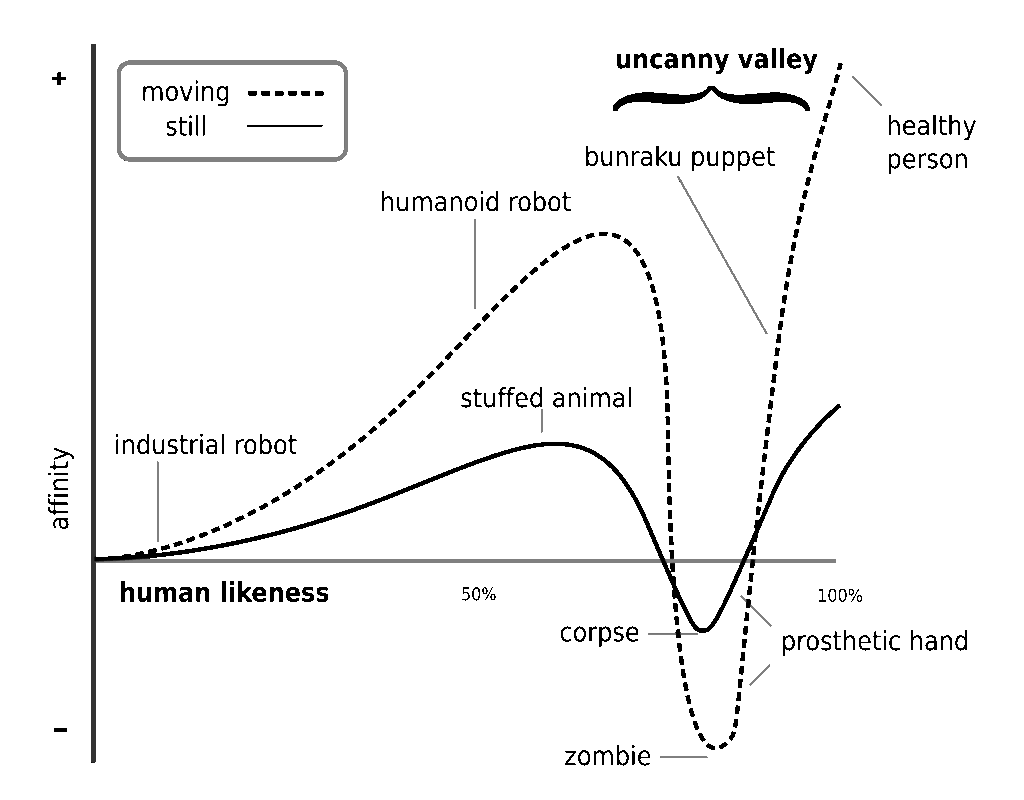
First proposed by robotics engineering professor Masahiro Mori in his 1971 book Bukimi No Tani, the concept basically posits that the more human-like something looks, the more positive and empathetic human observers’ response to it… until you reach a certain degree of humanness, at which point observers’ emotional response and empathy drop precipitously to the negative. Especially if the human-like thing is moving, our affinity toward it reaches new heights… and equally, new lows.
Why? A number of theories have been proposed. Among them, that we are humans engage in “automatic appraisals” of other humans, subconsciously but instantaneously judging a range of criteria to determine, for example, who to mate with and who to avoid. A product of evolution and adaptation, this view asserts that we are inherently and physiologically “repulsed” by certain visible features that indicate poor health; that we feel instinctive “disgust” and “alarm” at things that look almost – but not quite – like healthy, typical humans.

Given that Walt Disney and his designers were among the first to ever create “humanoid robots,” it’s surprising to consider how beautifully they seemed to innately understand this then-unknown, then-unnamed phenomenon. Think about it…
The very first of Disney’s humanoid robots came in the simultaneous debuts of what we know today as the Carousel of Progress and Great Moments With Mr. Lincoln – both premiering at the 1964 New York World’s Fair. Though these figures were unthinkable to audiences of the 1960s, it would be fair to describe them as “rudimentary” in comparison to the figures who top our list of the world’s best animatronics today. Though each genuinely carried the show and held up under multiple minutes of direct observation by an audience, none of the robotic cast could fall into the “uncanny valley.”
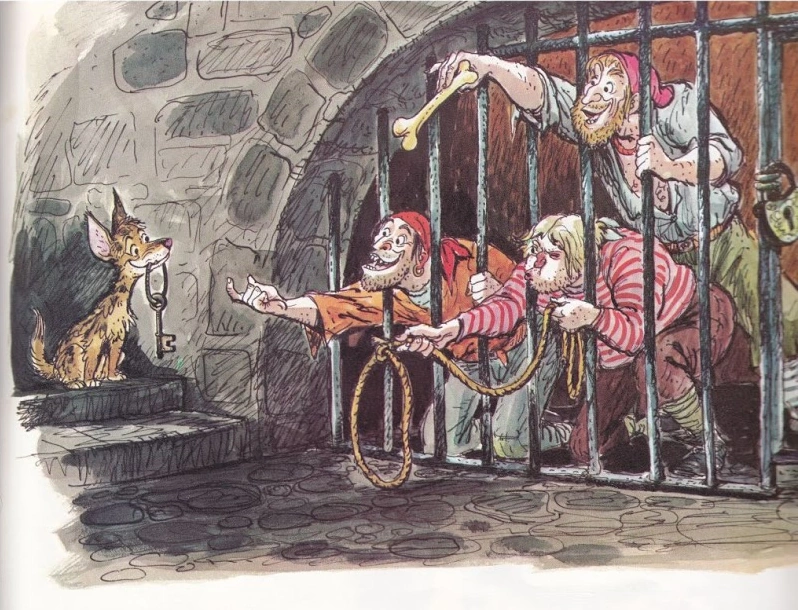
It’s probably no coincidence that as Disney’s experimentation in the emerging field of humanoid Audio-Animatronics grew and became more lifelike, designers subtly compensated for the increased “human likeness” by dialing up the stylization.
By time we reach the largest and most prolific Audio-Animatronics cast of Walt’s time – the inhabitants of Pirates of the Caribbean – we see characters whose designs border on caricature thanks to the incredible animation work of Disney Legend Marc Davis. Perfectly attuned to both the “wide shot” and the “close-up,” these figures paired their increasingly-“realistic” motion with caricatured features that communicated their less-than-humanity; according to Mori’s uncanny valley concept, a subconscious workaround to the drop-off.
Stylized figures remained the norm in follow-ups like the Haunted Mansion, Country Bear Jamboree, and Jungle Cruise additions (as well as further, unrealized Marc Davis concepts, like the Possibilitylands: Western River Expedition and the Enchanted Snow Palace). In the ’80s and ’90s, the “Ride the Movies” era brought us plenty of Star Wars Droids, dancing and singing animals, oversized Buzz Lightyears, and murderous aliens, but only the occasional humanoids.
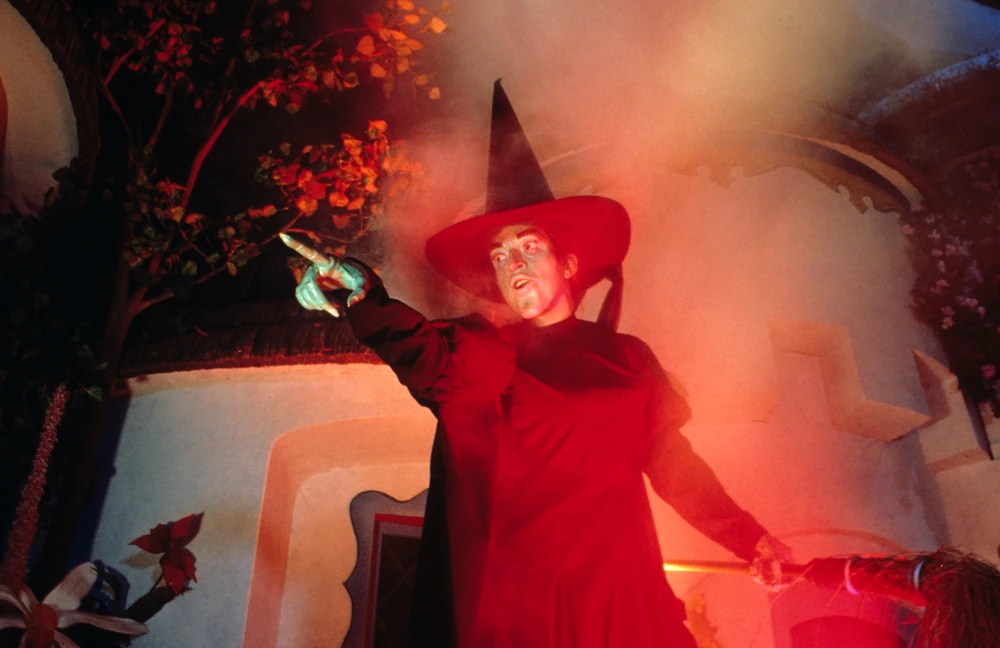
It was the Lost Legend: The Great Movie Ride that introduced Disney’s “A-100” animatronics in the form of The Wizard of Oz’s Wicked Witch of the West – more humanlike in its movements than ever, gesturing and gesticulating with the fluidity and precision that can only come from the introduction of electric actuators (versus the cumbersome hydraulic pressure-based motion of older models) – but still inhuman enough through stylization and association to avoid falling over the cliff.
Today, the power of the all-electric “A-1000” model of Audio-Animatronic leaves Disney with technology that sometimes teeters on the valley’s edge.
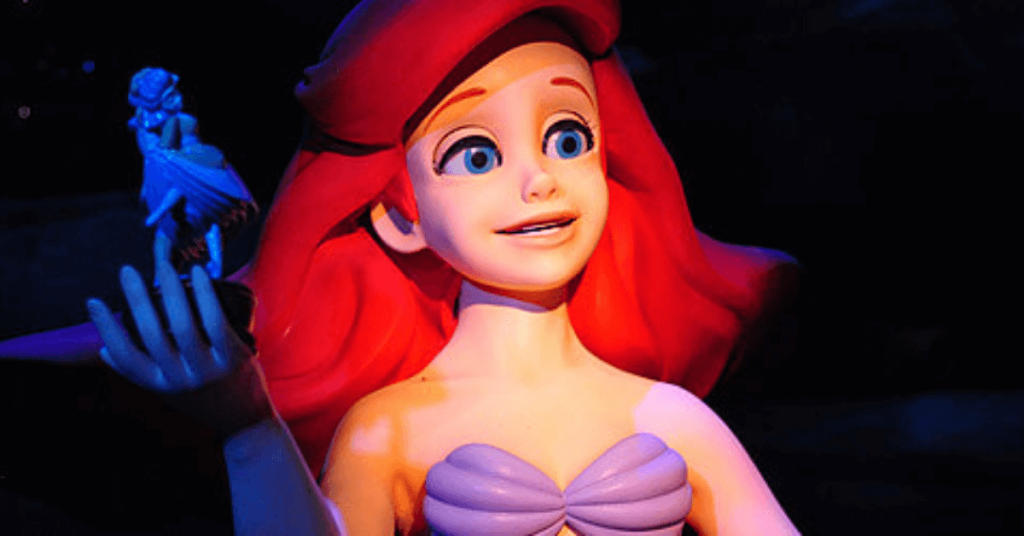
The first reactions marked by discomfort or unease probably began in earnest with the pair of dark rides themed to The Little Mermaid that premiered at Disney California Adventure and Magic Kingdom in 2011 and 2012, respectively. That ride’s figures recreating the titular Ariel certainly begin to take their place on the downward slope into the valley…
And it’s at least worth looking at these Audio-Animatronics Ariels through that lens of “automatic appraisal.” Ariel here moves like a human; she gestures, and lip-syncs, and blinks, and sways with the music. Yet translating this character to three dimensions has resulted in oversized, doll-like eyes that lack human “shine”; an upturned, squat nose with blocked nostrils; a mouth that stretches from pupil-to-pupil with a block of formless teeth; and a form that’s human-shaped, but proportionally shrunk to stand maybe four feel tall. (It’s especially surprising considering Ariel translated beautifully to an on-model, three dimensional figure in Kingdom Hearts.)
In other words, the “automatic appraisal” theory would suggest that this moving Ariel reads to our brain as something almost human, but clearly misshapen or ill, triggering our brains to feel disgust or revulsion. It’s not a conscious judgement, the theory proposes, but a deeply engrained, evolutionary one. “Something isn’t quite right with that person, and I don’t like it, so I’ll avoid it.”
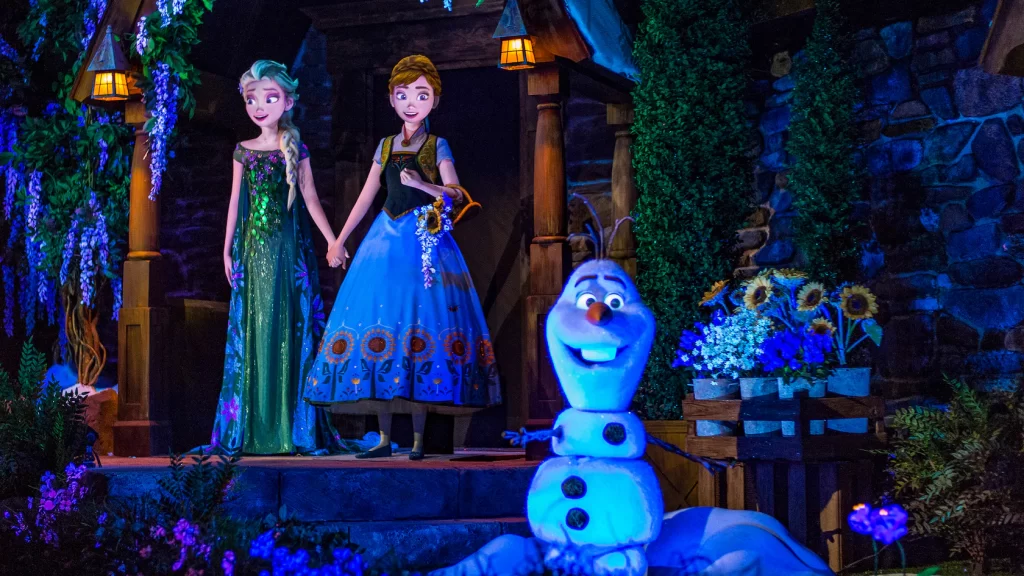
Arguably, Disney found a way to “fix” this with the ride’s spiritual successor – 2016’s Frozen Ever After: they simply said, “We won’t build a face at all.” Sure, in retrospect, these interior-projected faces earn the scorn of the Disney Parks fan community for being “cop-outs.”
But lest we forget that when the first videos of Frozen Ever After hit the web in 2016, people pretty uniformly decreed that the incredible motion of the ride’s A-1000 figures paired with the projected faces created a cast of Animatronics surely among the best in the world; true embodiments of the animated characters that looked as if they’d leapt right off the screen and into three dimensions in a way Ariel surely didn’t.
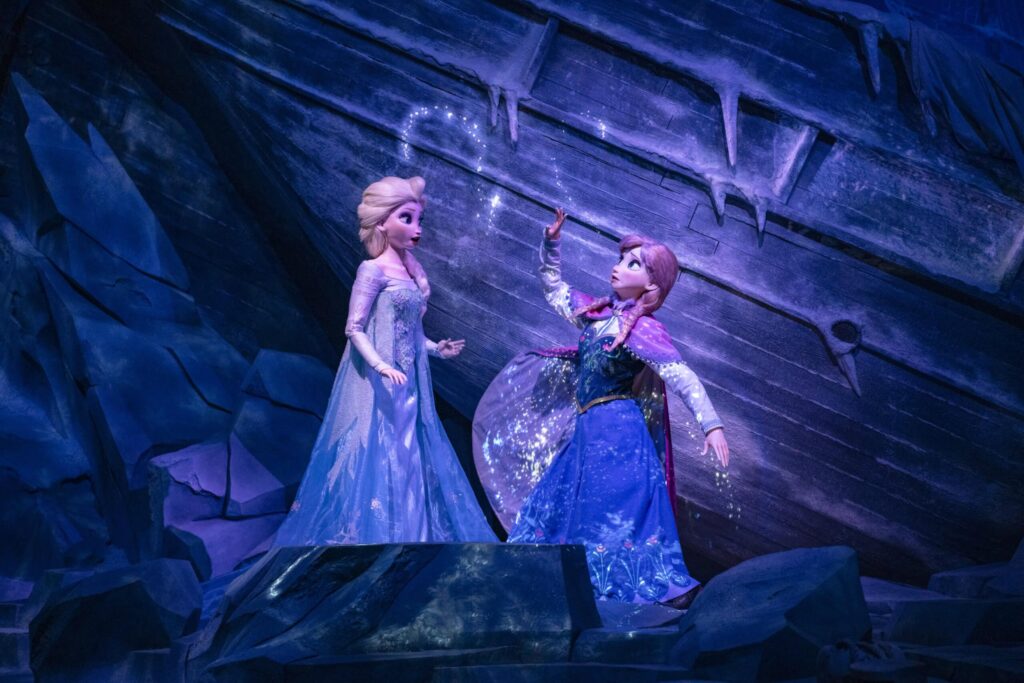
Now obviously, a decade and three more Frozen rides later, we can be grateful that future incarnations of Anna and Elsa in the Animatronics medium have figured out how to turn those faces physical and – in so doing – return us in some ways to the artistry of Pirates of the Caribbean: figures that are humanlike, but caricatured through stylization in such a way that they elicit empathy without tipping into the uncanny valley.
Which perhaps explains why the top ten slots of our 25 Best Animatronics on Earth countdown is majority-occupied by humanoid figures that are all broadly either animated characters brought to life with their on-screen stylization, “human-adjacent” (i.e. aliens and monsters) enough to remain fantastical, or – for the rare human-humans, crucially – masked. Because as the concept of the uncanny valley sees it, the more realistic the figure’s scale and motion and expression become (and we know that Disney, Universal, and their vendors have that capacity) the easier it becomes to tilt over the peak and nosedive into discomfort.
Which perhaps brings us to a major test for us as observers…

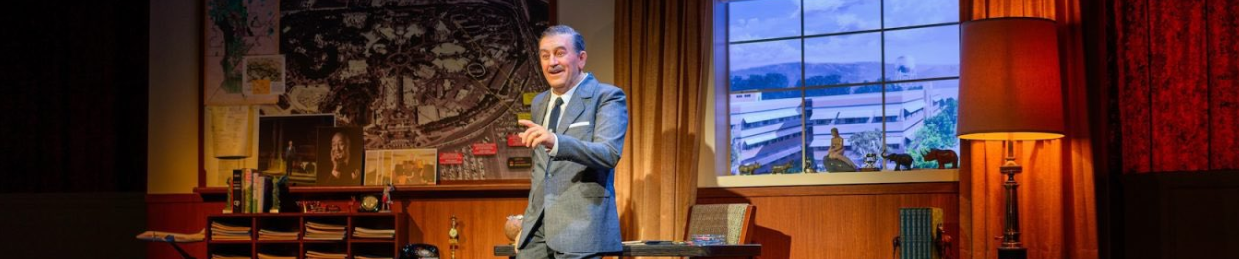
It was at the semi-annual D23 Expo in 2024 that Disney officially announced its intentions to bring Walt Disney himself to “life” via Audio-Animatronics. Premiering on the park’s 70th Anniversary, July 17, 2025, “Walt Disney – A Magical Life” gives Walt himself co-headlining presence in the Main Street Opera House, performing in rotation with the “Great Moments with Mr. Lincoln” show that the real Walt debuted sixty years prior.
Yes, it takes a bit of mental effort to overcome the inherent oddness of the concept – something like Dr. Frankenstein himself being reanimated after death in the medium he himself pioneered via the creation of his Monster. And yes, there is also deeply embedded controversy around the move when Walt adamantly declined any sort of statuary of himself being placed in the parks, and many (but not all) of his living ancestors have spoken of their discomfort at the notion of their very-real grandfather being “brought back to life” in this way. But as you’re able, put that aside and meet eyes with the first unmasked, un-stylized human Audio-Animatronic Disney has created since, weirdly enough, Donald Trump.

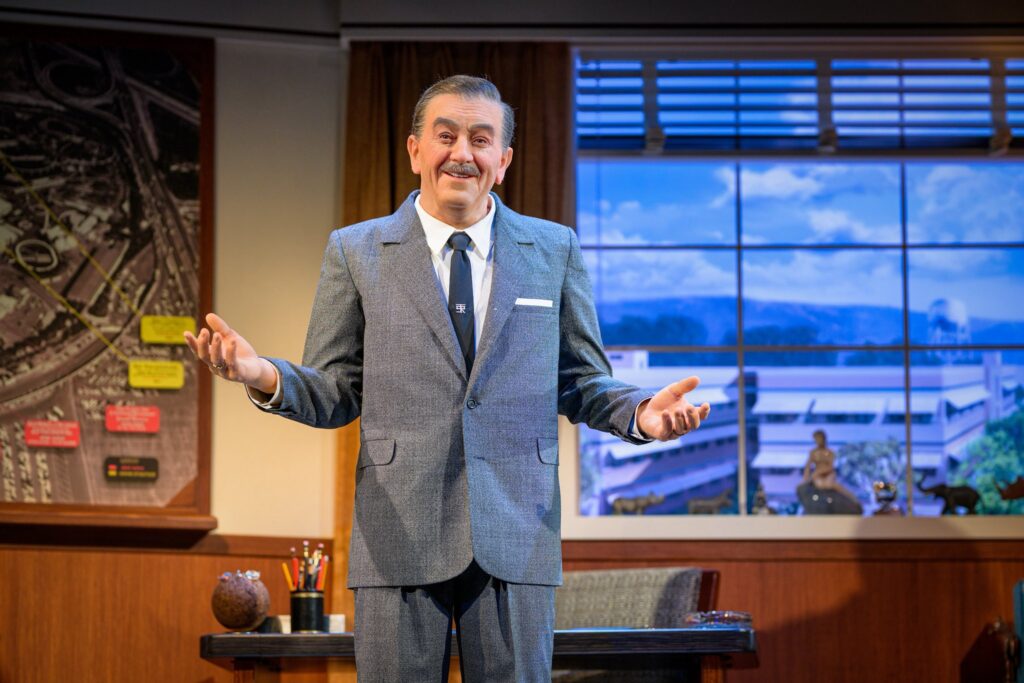
First, it’s important to note that this embodiment of Walt Disney is still stylized. It has to be. This figure needs to play to a 500-seat theater, requiring that he “reads” in the wide-shot. Maybe this helps explain his exaggerated smile and perked eyebrows. We also again face the limitations of the medium, requiring that the many actuators and motors that power fine expressions of the face be packed into a human-sized head. (Unlike, say, Kylo Ren or a Death Eater, we can’t simply put on a mask and leave the figure’s impressive large-motor movement to leave the impression.)
But the result is that in the close-up Disney provided, it seems that even this super-advanced figure has a mouth that more or less operates in 1s and 0s – on or off – open or closed – than one that convincingly lip-syncs to the piped-in speech. In person, it’s passable! But Disney’s “preview” of the show providing close-up opportunities invites scrutiny, and in glimpses, might propel the figure into the uncanny. (“He’s talking, but his mouth isn’t moving right for the sounds I’m hearing, and the sound isn’t coming from the right place to match the location of the speaker.”)
When the figure strikes a familiar Walt pose – elbow bent with clenched fist resting above the hip (above) – it does it within limitations. The fist can’t actually touch the waist, given that continuous showings across the day would see the rubber knuckle wear a hole in the fabric in mere weeks; the elbow can’t really bend to the degree a human’s can without contorting unrecognizably; and the jacket’s torsion at the twist gives the uncanny impression that there is no “meat” to the inner elbow. Indeed, in up-close flashes, one recognizes that the skin of the arm appears to terminate just past the shirt cuff, and that (despite planting little, human hairs on the outer ear for realism) Walt’s arms are hairless as an uncooked chicken breast.
And again, all of that makes the figure especially easy to criticize online where Disney (somewhat dumbly) provided us with 4K, up-close images that we really ought not equate to the experience in-theater. Still, by nature of having plenty of photos and videos of the real person, our lofty Internet perches allow us to scan back and forth between the figure and the man like a “find-the-difference” photo set, finding plenty.
But Disney Imagineers toed the line carefully in the design and fabrication of this figure, even going so far as to tout their tireless testing-and-adjusting of a “sparkle in the eye” – something that sounds silly, but that our case study of Ariel demonstrates really is required to keep these figures from entering Child’s Play territory. Then, its fine details need synced to show lighting, show audio, and the hazy “cloud” of emotion that’s meant to build up via the Opera House and show that Walt’s appearance is merely the finale to. So frankly, Disney probably shouldn’t have posted out-of-context, source-audio-supported video of the figure prior to its official debut, but they did.
Surely, the figure that serves as the anchor of “Walt Disney – A Magical Life” is the greatest test of the uncanny valley yet, precariously suspending guests over the steep drop off into the not-quite-human. This, for better or worse, is Disney’s “Soul Machine” – a figure meant to quite literally provide us with a “connection” to Walt Disney the man that feels. Feels real; feels emotional; feels personal; feels, period.
This is Walt’s digital avatar given physical incarnation. Forget whether that’s morally right or repulsive. Just in terms of its performance – its motion, its expression, its realism, its humanness… does the animatronic figure of Walt Disney teeter on the edge of the valley? Plunge into it? Or come across as impressive, comfortable, warm, and personable as Disney Imagineers hope? Frankly, the answer may be different for us all, and can really only be assessed after seeing the figure in person, at scale and in motion.
But one thing is certain: just as Imagineers propelled us into a level of experience that might actually be weighed down by exhaustive, weighty hyperrealism in Star Wars: Galaxy’s Edge, perhaps “Walt Disney – A Magical Life” risks descent into the uncanny valley… But as both projects make clear, this is a Disney Company eager to apply the highest standards and newest technologies to its storytelling… even if it takes some testing-and-adjusting to find the “sweet spot” along the way…