
2024 Theme Park Attendance Tells a Story of Post-Pandemic Stabilization and Big Bets on the Future…

It’s one of the most anticipated data drops in all of theme park nerd-dom… Every year, the Themed Entertainment Association (TEA) partners with a consulting firm called AECOM to compile an annual report on the ups and downs of theme parks, waterparks, museums, and other “thematic” experiences from the year prior. (Supporting Members of Park Lore can read our broad strokes summary of industry trends gleaned from 2022 and 2023 in dedicated Extra Features!)

Though renamed from its previous title (the Theme Index Report) this year’s 2024 Global Experience Index continues to be an annual publication of note for theme park fans in particular, and – as always – is worth an in-depth read. It’s filled with the highs and lows, global contexts, and stories that permeated theme park news in the year prior. But most importantly… it also contains a ranking and roll-up of the year’s theme park attendance.

To be clear, most theme park operators do not disclose their parks’ attendance, and even if they speak in broad generalities, totals, or percentages at investor calls, they almost never divulge specific attendance figures for specific parks… However, it’s known that many operators do work with AECOM to come up with fairly accurate figures since it’s in the best interest of their share price, financial disclosures, and year-upon-year narratives that their attendance be discussed vaguely, but honestly.

As far as industry observers are concerned, TEA / AECOM’s October report is as good as a lock on last year’s attendance numbers, providing (as always) a captivating quantitative estimate that offers some compelling trends and talking points to the community… This year, the global rankings of the top eight parks are unchanged from 2023, with only slight increases at each:

  1. Magic Kingdom (17.8 million, +.7%)
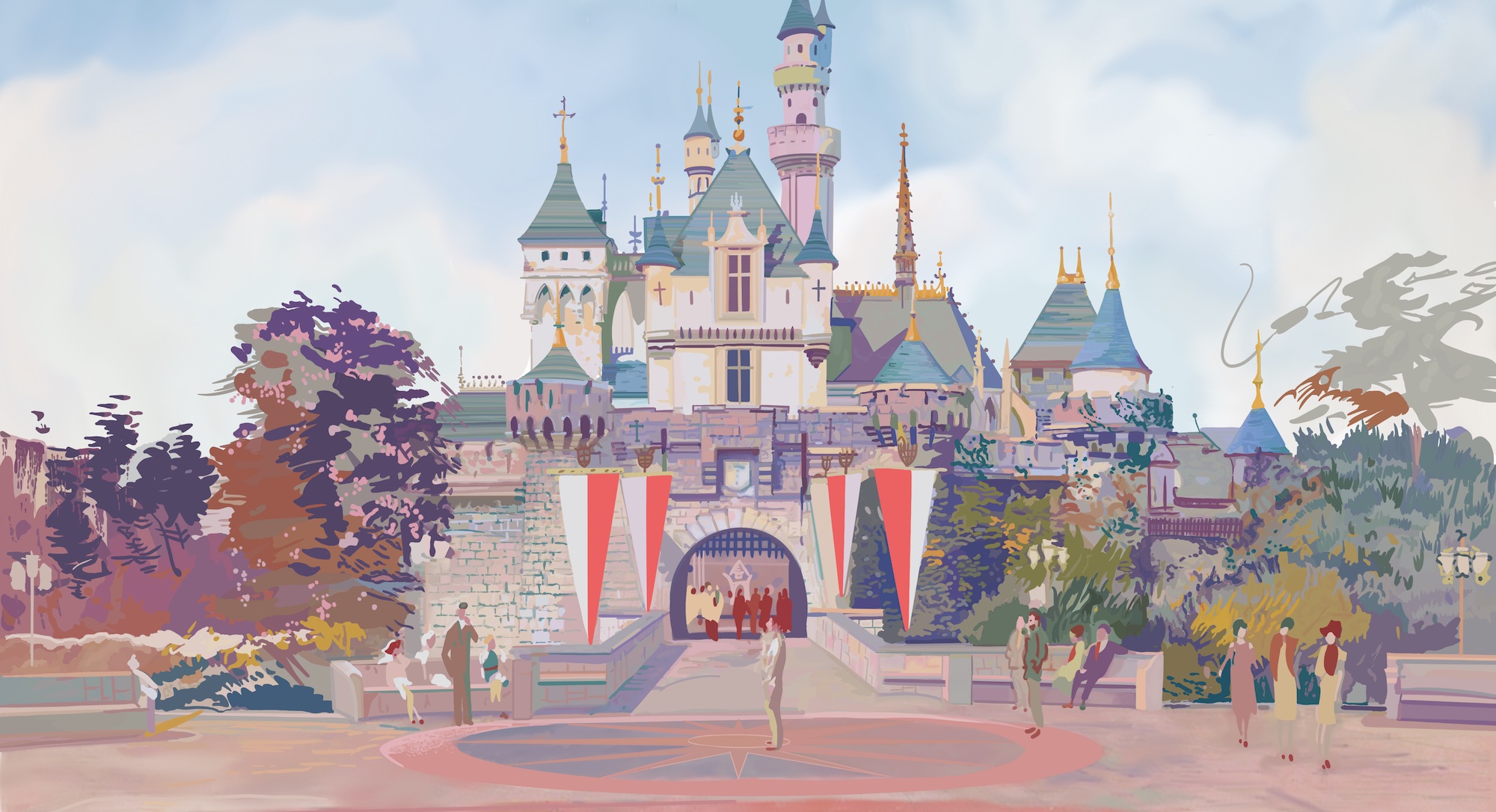
  2. Disneyland Park (17.3 million, +.5%)
  3. Universal Studios Japan (16 million, no change)
  4. Tokyo Disneyland (15.1 million, +2.6%)
  5. Shanghai Disneyland (14.7 million, +5%)
  6. Chimelong Ocean Kingdom (12.6 million, +.9%)
  7. Tokyo DisneySea (12.6 million, +2.9%)
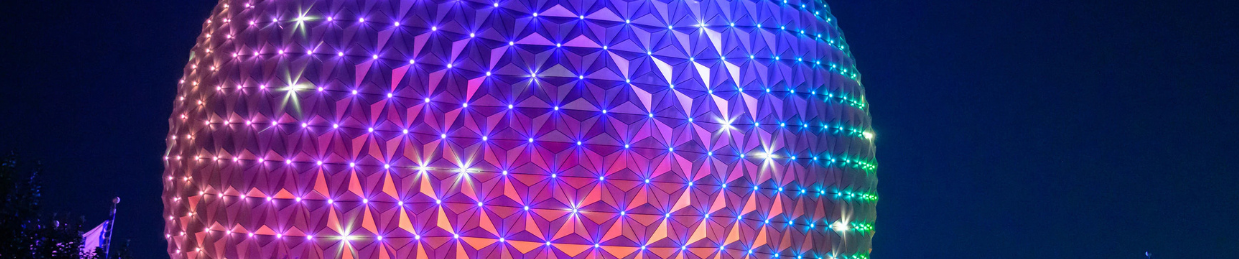
  8. EPCOT (12.1 million, +1.3%)

It’s not really a surprise that the ranking of these eight is unchanged from 2023. These parks are highly stable, built-out destinations. (There are obviously two exceptions. Chimelong Ocean Kingdom is a relatively new park buoyed by the same kind of growing middle class in China that spurred Shanghai Disneyland and Universal Studios Beijing; EPCOT has been in the “top eight” for two straight years, but will inevitably rejoin the continuous rotation of Disney World’s auxiliary parks soon enough.)
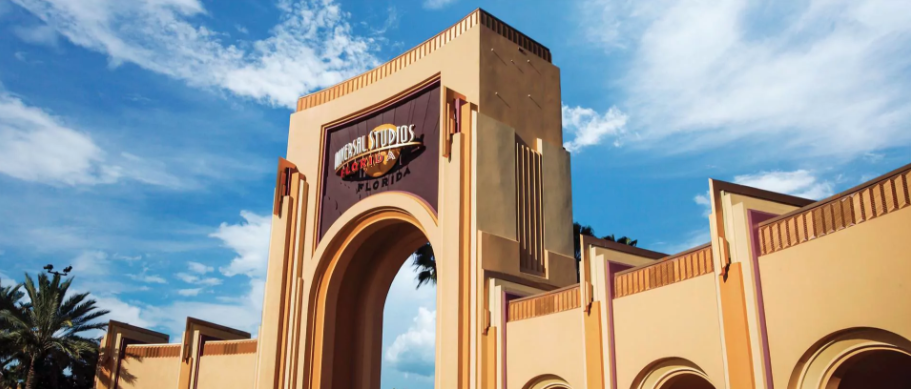
Image: Universal

Meanwhile, some parks shuffle their ranking for the next batch of the top 15…

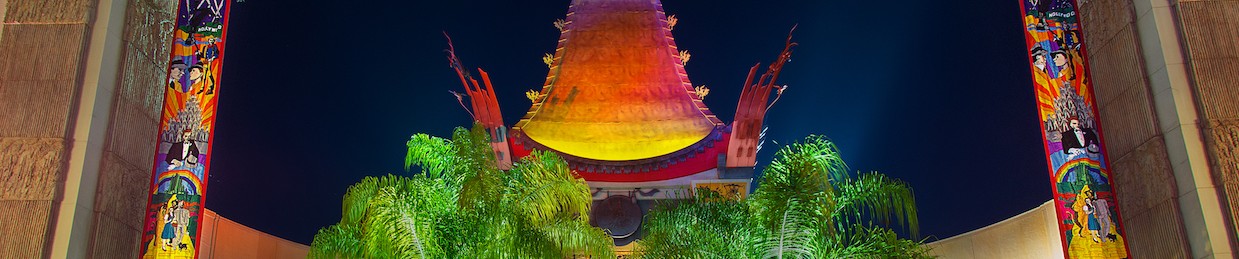
9. Disney’s Hollywood Studios (10.3 million, +.3%) (up from spot 10 in 2023)
10. Disneyland Paris (10.2 million, –1.8%) (down from spot 9 in 2023)
11. Disney California Adventure (10 million, +.5%) (up from spot 12 in 2023)
12. Universal Studios Beijing (9.7 million, +8.6%) (up from spot 15 in 2023)
13. Universal Studios Florida (9.5 million, –2.6%) (no ranking change)
14. Universal Islands of Adventure (9.45 million, –5.5%) (down from spot 11 in 2023)
15. Disney’s Animal Kingdom (8.8 million, +.3%) (up from spot 16 in 2023)

Which brings us to some big picture takeaways that these numbers suggest…

1. Universal Orlando hopes this is the darkness before the dawn

Image: Universal

Fans of the underdog story had a lot of excitement this time two years ago when the big news in the 2022 rankings was the jaw-dropping suggestion that Universal Orlando might have done the impossible and used the pandemic as a one-shot to the moon. In 2022, Universal Islands of Adventure ranked as the fifth most-attended theme park on Earth, beating out EPCOT, Hollywood Studios, and Animal Kingdom and essentially ranking among the vaunted “Castle Parks.” (Universal Studios Florida didn’t do much worse – it was seventh!)

Last year’s attendance estimates, meanwhile, suggested that the boon was short-lived. Both Universal Orlando parks were estimated to have lost attendance to the tune of 9% in 2023, falling to 11th and 13th in the ranks, respectively. Obviously, that’s a devastating blow for parks that had otherwise tracked upward trajectory for years and even seemed to have come out the other side of the pandemic right back on track and even stronger than before – something no Walt Disney World park even approached.
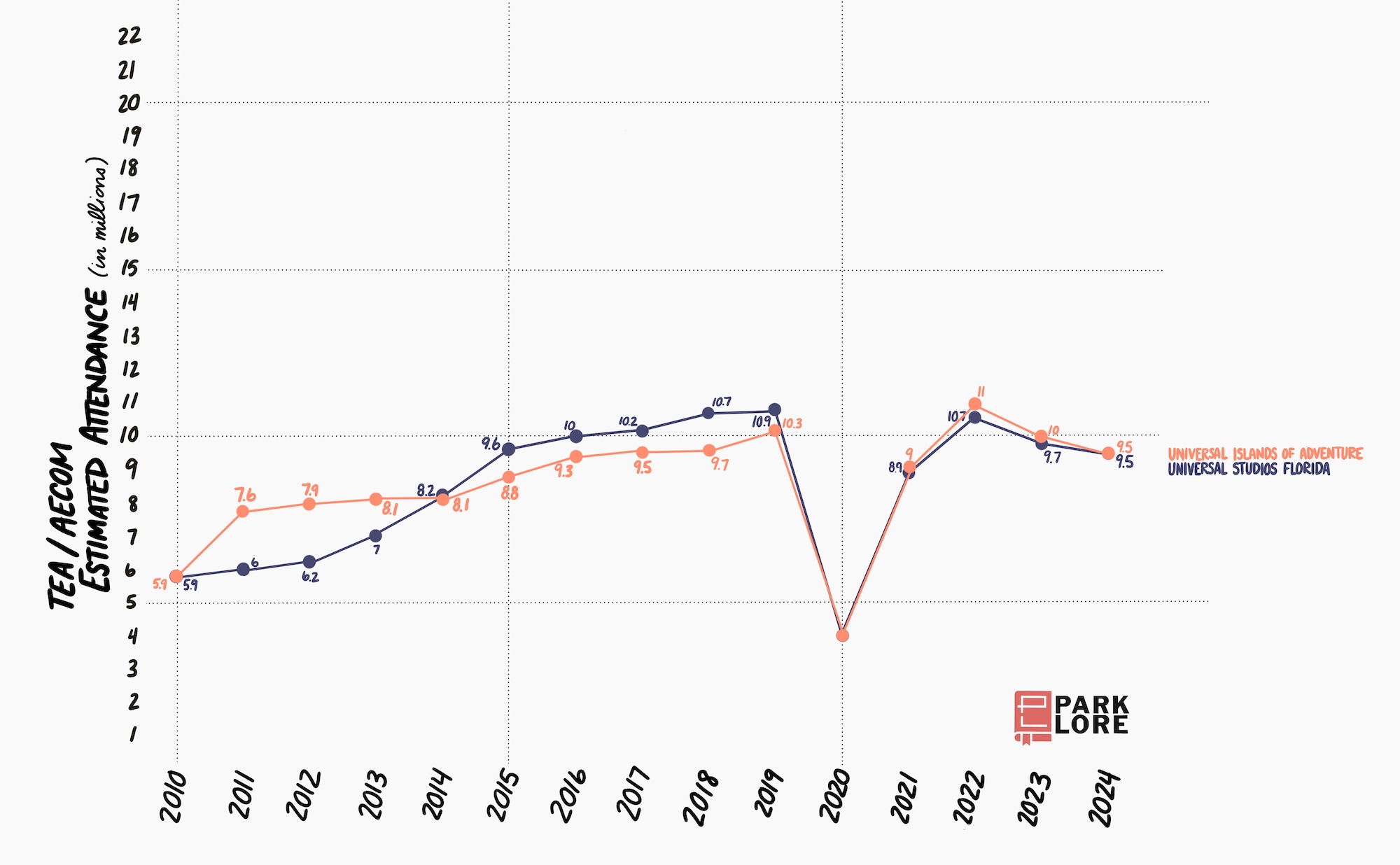
According to 2024 estimates, that slide continues, with Islands shedding 5.5% from its attendance year-over-year, and Universal Studios Florida decreasing by 2.6%. Those are better losses than the massive drop-off in 2023, but still worrying for a resort whose substantial investment and pervasive internal narrative over the last few years has been predicated entirely upon the presumption that Universal finally had the gravity to change tourism in Central Florida.

Obviously, Universal’s explanation here would be that 2024 was a year of guests delaying vacations in anticipation of the crescendo of that growth spurt: the 2025 opening of Universal Epic Universe. But very much like Ant-Man: Quantumania, these results have to have even the most resilient Comcast executive wondering if their inherited theme park division has the limitless potential and infallible trjactory that made a third theme park seem so obvious a few years ago… Speaking of which…

2. Speculation around Epic Universe’s impact is beginning…

Image: bioreconstruct, Twitter

It’s worth remembering that Epic Universe didn’t open until May 2025, meaning that we wouldn’t expect to see any data from or impact of the new park’s attendance until the next edition of the TEA / AECOM Experience Index is published in fall 2026… But even that will only represent a year with six operating months for Epic Universe (and artificially limited by excluding “Park Hopping” and Annual Passholders, at that), so don’t expect Epic to debut anywhere within the top 15 next year.

Frankly, it won’t be until late 2027 (when TEA / AECOM publishes 2026 data) that we begin to get a complete picture of Epic Universe’s affect on Central Florida. As to what that effect will be? On one end of the spectrum, Universal would very much like if Epic Universe would be the project bright and loud enough to finally establish Universal Orlando into a self-contained, “bubbled,” multi-day resort destination. In Universal’s dream scenario, a family would land in MCO without Disney World being on their itinerary at all, hunkering down at a Universal hotel with a Park-to-Park ticket, resulting in all three of Universal’s theme parks seeing continued growth in attendance.
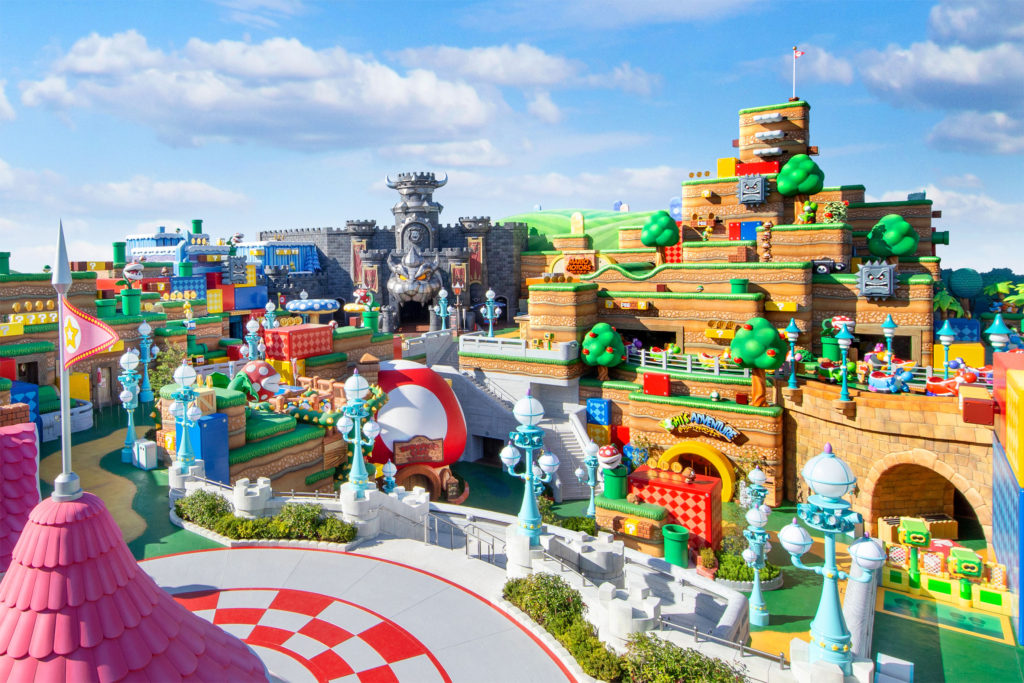
Image: Universal

On the other hand, Disney is probably crossing their fingers that Epic’s effect will be what some industry observers have warned about since the park’s announcement: that it’ll “cannibalize” the resort’s other two parks. That would mean that rather than adding a day to their overall vacation to visit Epic Universe, guests would simply replace an existing day – probably a visit to Universal Studios Florida. That would be trouble indeed, resulting in Universal attracting no more guests overall; just spreading them more thinly across three parks instead of two. Gulp. No wonder earth is already moving on major projects for both Universal Studios and Islands of Adventure…

By the way, even if the latter scenario comes to pass, the 2024 data suggests that Disney isn’t exactly in the clear… If guests do end up replacing a day to visit Epic Universe, it could very well be a Disney park that drops off the itinerary… It looks likely that one Disney Park will fall out of the top fifteen entirely, and data reveals that rumors of flatlining attendance may be more than myth… Read on…

“Walt Disney – A Magical Life” and Disney Audio-Animatronics’ Life on the Edge of the “Uncanny Valley”

“Welcome to the world of digital humans,” promises the New Zealand-based tech start-up “Soul Machines” without an apparent hint of unease or embarrassed reluctance.

Listen. Plenty has been written about artificial intelligence (AI) – technology that has been a part of our daily lives for decades, but now uniformly presents itself via retro-starred “language learning model assistants” baked inescapably into social media sites, search engines, and home assistants. And yes, it’s objectively disconcerting that such “LLMs” have variously driven people to suicide and murder, called for the extermination of minorities, and ushered in an era of “digital loneliness” all while consuming vast amounts of water. But at least according to Soul Machines, the future of AI rests even further beyond the LLM horizon – in a world where AI appears to us as a friend.

The next stop for AI might just have to do with all the data collected through Snapchat and TikTok filters – AI that manifests in physical form as a person who looks familiar, but never existed and never will. Appearing nearly as “real” as any of us, the “digital humans” Soul Machines is working on proudly sport individual eyelashes, acne scars, eyebrow hairs in need of a pluck, imperfect teeth, and a shine on the eyes to rival any “real world” loved one, best friend, or confidante. Their heads tilt subtly as they speak their “learned language” aloud; they make eye contact; they emote and express like we do.

And yet, there is something about them that’s… not quite right.

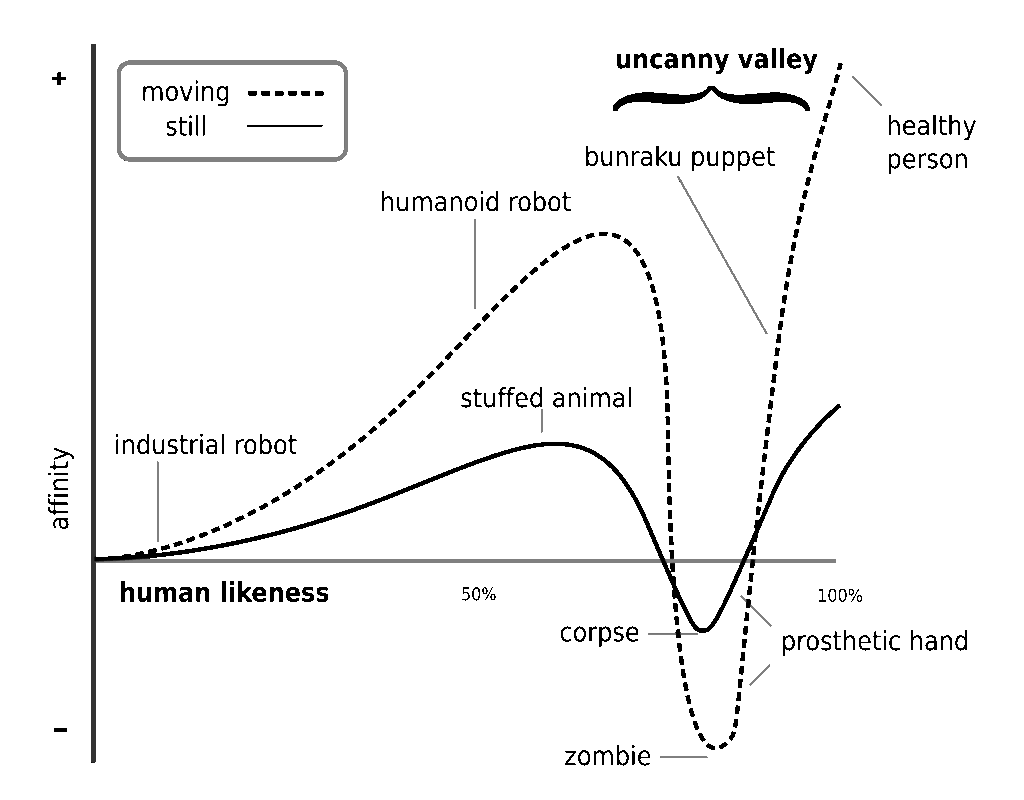
Such are the inhabitants of the uncanny valley. Less a physical place than a data modeling one, the “uncanny valley” is a concept in psychology and aesthetics that describes the relationships between an object’s degree of resemblance to a human and observers’ emotional response to the object.

First proposed by robotics engineering professor Masahiro Mori in his 1971 book Bukimi No Tani, the concept basically posits that the more human-like something looks, the more positive and empathetic human observers’ response to it… until you reach a certain degree of humanness, at which point observers’ emotional response and empathy drop precipitously to the negative. Especially if the human-like thing is moving, our affinity toward it reaches new heights… and equally, new lows.

Why? A number of theories have been proposed. Among them, that we are humans engage in “automatic appraisals” of other humans, subconsciously but instantaneously judging a range of criteria to determine, for example, who to mate with and who to avoid. A product of evolution and adaptation, this view asserts that we are inherently and physiologically “repulsed” by certain visible features that indicate poor health; that we feel instinctive “disgust” and “alarm” at things that look almost – but not quite – like healthy, typical humans.

Image: Disney

Given that Walt Disney and his designers were among the first to ever create “humanoid robots,” it’s surprising to consider how beautifully they seemed to innately understand this then-unknown, then-unnamed phenomenon. Think about it…

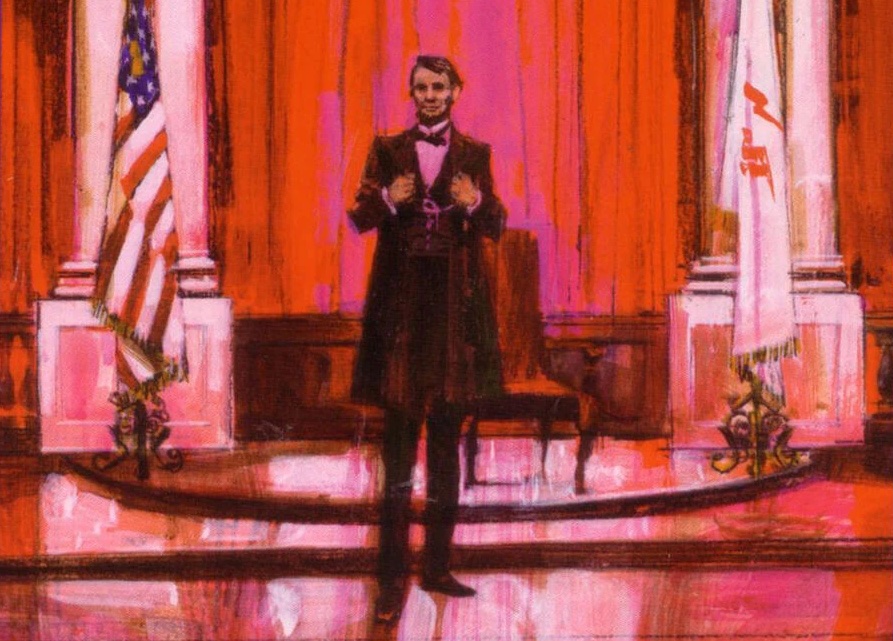
The very first of Disney’s humanoid robots came in the simultaneous debuts of what we know today as the Carousel of Progress and Great Moments With Mr. Lincoln – both premiering at the 1964 New York World’s Fair. Though these figures were unthinkable to audiences of the 1960s, it would be fair to describe them as “rudimentary” in comparison to the figures who top our list of the world’s best animatronics today. Though each genuinely carried the show and held up under multiple minutes of direct observation by an audience, none of the robotic cast could fall into the “uncanny valley.”

Image: Disney

It’s probably no coincidence that as Disney’s experimentation in the emerging field of humanoid Audio-Animatronics grew and became more lifelike, designers subtly compensated for the increased “human likeness” by dialing up the stylization.

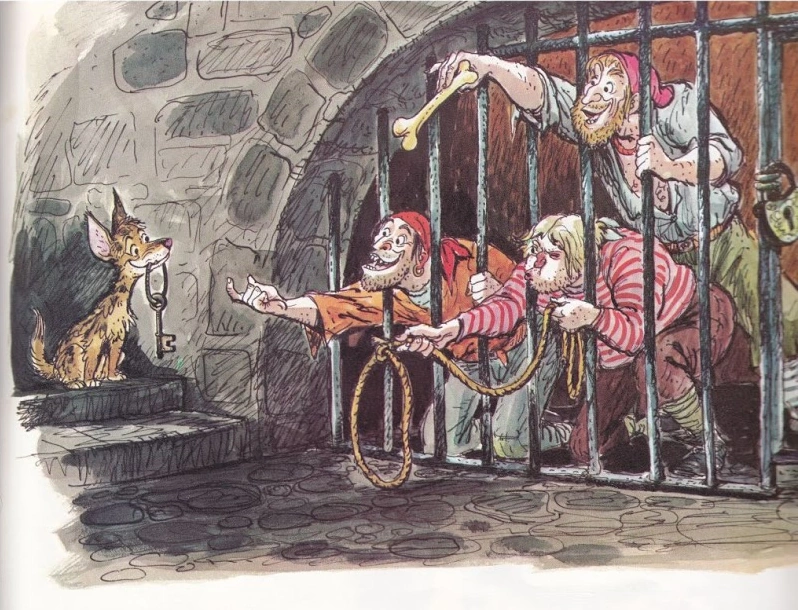
By time we reach the largest and most prolific Audio-Animatronics cast of Walt’s time – the inhabitants of Pirates of the Caribbean – we see characters whose designs border on caricature thanks to the incredible animation work of Disney Legend Marc Davis. Perfectly attuned to both the “wide shot” and the “close-up,” these figures paired their increasingly-“realistic” motion with caricatured features that communicated their less-than-humanity; according to Mori’s uncanny valley concept, a subconscious workaround to the drop-off.

Stylized figures remained the norm in follow-ups like the Haunted Mansion, Country Bear Jamboree, and Jungle Cruise additions (as well as further, unrealized Marc Davis concepts, like the Possibilitylands: Western River Expedition and the Enchanted Snow Palace). In the ’80s and ’90s, the “Ride the Movies” era brought us plenty of Star Wars Droids, dancing and singing animals, oversized Buzz Lightyears, and murderous aliens, but only the occasional humanoids.

Image: Disney

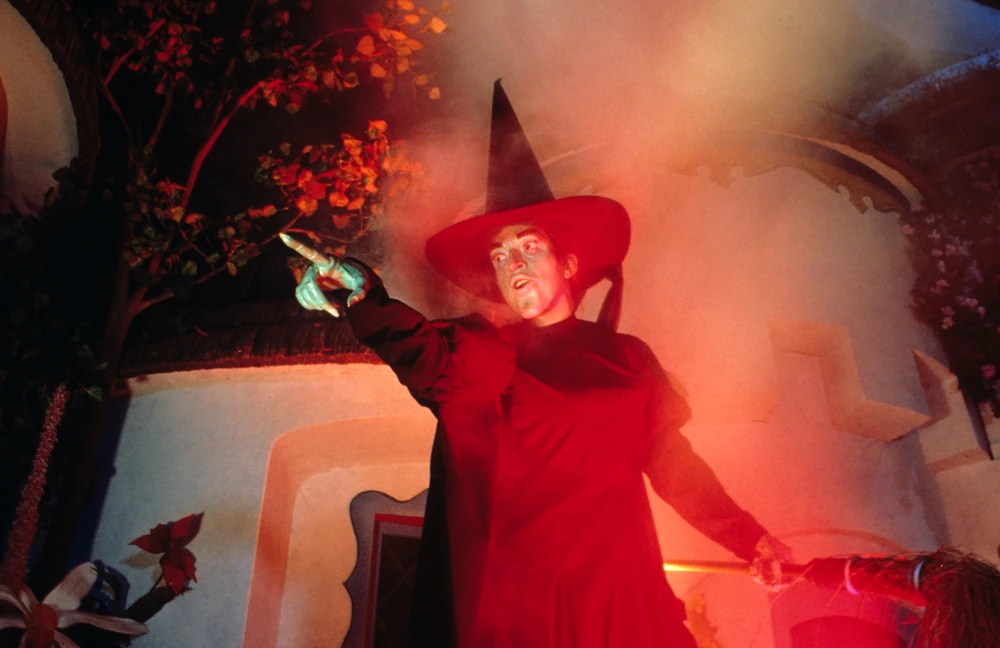
It was the Lost Legend: The Great Movie Ride that introduced Disney’s “A-100” animatronics in the form of The Wizard of Oz’s Wicked Witch of the West – more humanlike in its movements than ever, gesturing and gesticulating with the fluidity and precision that can only come from the introduction of electric actuators (versus the cumbersome hydraulic pressure-based motion of older models) – but still inhuman enough through stylization and association to avoid falling over the cliff.

Today, the power of the all-electric “A-1000” model of Audio-Animatronic leaves Disney with technology that sometimes teeters on the valley’s edge.

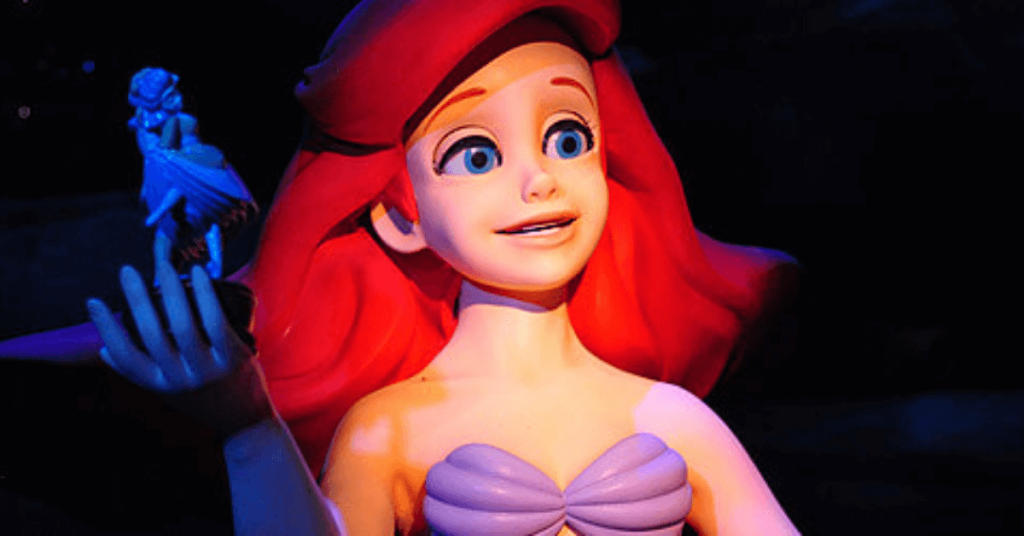
The first reactions marked by discomfort or unease probably began in earnest with the pair of dark rides themed to The Little Mermaid that premiered at Disney California Adventure and Magic Kingdom in 2011 and 2012, respectively. That ride’s figures recreating the titular Ariel certainly begin to take their place on the downward slope into the valley…

And it’s at least worth looking at these Audio-Animatronics Ariels through that lens of “automatic appraisal.” Ariel here moves like a human; she gestures, and lip-syncs, and blinks, and sways with the music. Yet translating this character to three dimensions has resulted in oversized, doll-like eyes that lack human “shine”; an upturned, squat nose with blocked nostrils; a mouth that stretches from pupil-to-pupil with a block of formless teeth; and a form that’s human-shaped, but proportionally shrunk to stand maybe four feel tall. (It’s especially surprising considering Ariel translated beautifully to an on-model, three dimensional figure in Kingdom Hearts.)

In other words, the “automatic appraisal” theory would suggest that this moving Ariel reads to our brain as something almost human, but clearly misshapen or ill, triggering our brains to feel disgust or revulsion. It’s not a conscious judgement, the theory proposes, but a deeply engrained, evolutionary one. “Something isn’t quite right with that person, and I don’t like it, so I’ll avoid it.”

Image: Disney

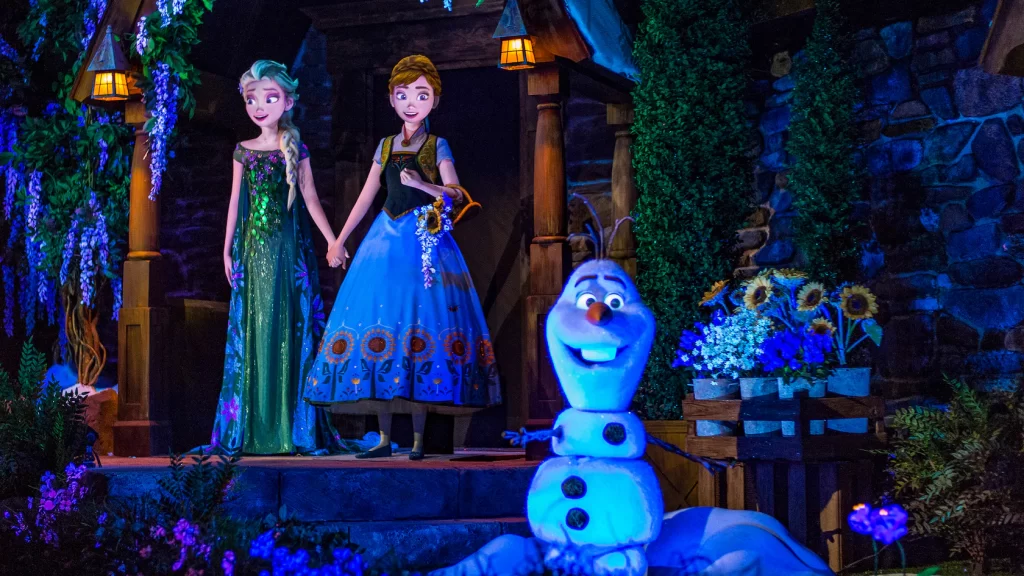
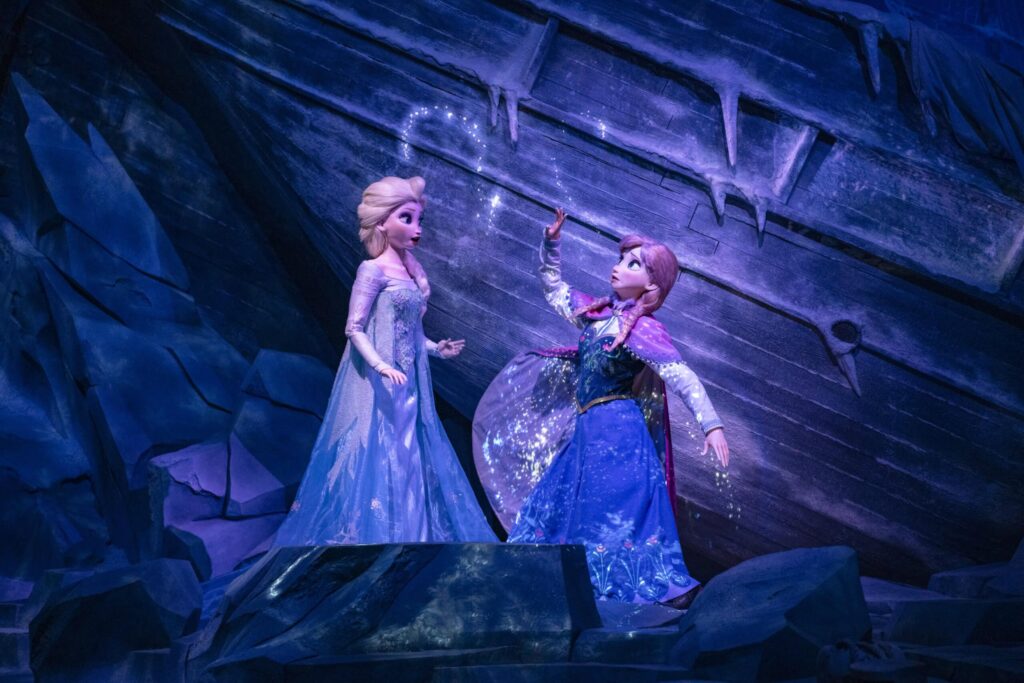
Arguably, Disney found a way to “fix” this with the ride’s spiritual successor – 2016’s Frozen Ever After: they simply said, “We won’t build a face at all.” Sure, in retrospect, these interior-projected faces earn the scorn of the Disney Parks fan community for being “cop-outs.”

But lest we forget that when the first videos of Frozen Ever After hit the web in 2016, people pretty uniformly decreed that the incredible motion of the ride’s A-1000 figures paired with the projected faces created a cast of Animatronics surely among the best in the world; true embodiments of the animated characters that looked as if they’d leapt right off the screen and into three dimensions in a way Ariel surely didn’t.

Image: Disney

Now obviously, a decade and three more Frozen rides later, we can be grateful that future incarnations of Anna and Elsa in the Animatronics medium have figured out how to turn those faces physical and – in so doing – return us in some ways to the artistry of Pirates of the Caribbean: figures that are humanlike, but caricatured through stylization in such a way that they elicit empathy without tipping into the uncanny valley.

Which perhaps explains why the top ten slots of our 25 Best Animatronics on Earth countdown is majority-occupied by humanoid figures that are all broadly either animated characters brought to life with their on-screen stylization, “human-adjacent” (i.e. aliens and monsters) enough to remain fantastical, or – for the rare human-humans, crucially – masked. Because as the concept of the uncanny valley sees it, the more realistic the figure’s scale and motion and expression become (and we know that Disney, Universal, and their vendors have that capacity) the easier it becomes to tilt over the peak and nosedive into discomfort.

Which perhaps brings us to a major test for us as observers…

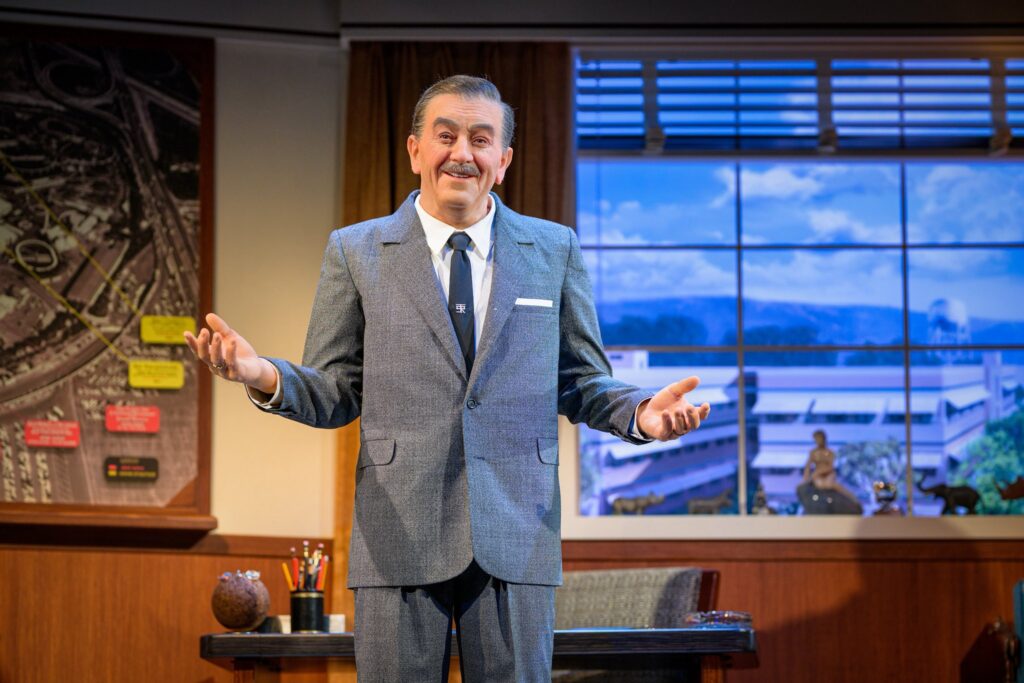
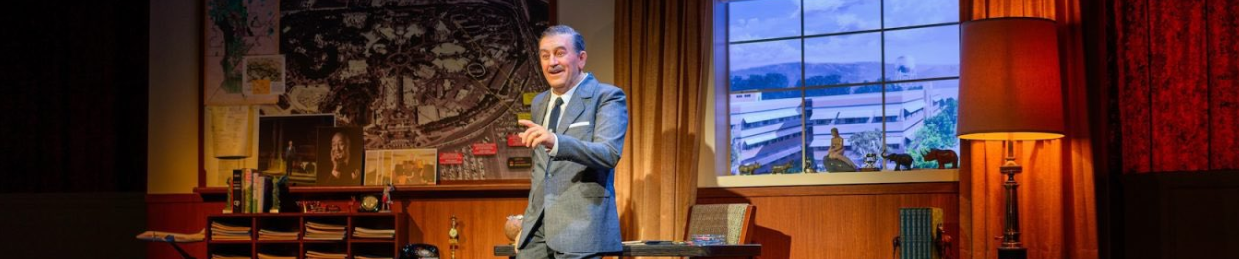
It was at the semi-annual D23 Expo in 2024 that Disney officially announced its intentions to bring Walt Disney himself to “life” via Audio-Animatronics. Premiering on the park’s 70th Anniversary, July 17, 2025, “Walt Disney – A Magical Life” gives Walt himself co-headlining presence in the Main Street Opera House, performing in rotation with the “Great Moments with Mr. Lincoln” show that the real Walt debuted sixty years prior.

Yes, it takes a bit of mental effort to overcome the inherent oddness of the concept – something like Dr. Frankenstein himself being reanimated after death in the medium he himself pioneered via the creation of his Monster. And yes, there is also deeply embedded controversy around the move when Walt adamantly declined any sort of statuary of himself being placed in the parks, and many (but not all) of his living ancestors have spoken of their discomfort at the notion of their very-real grandfather being “brought back to life” in this way. But as you’re able, put that aside and meet eyes with the first unmasked, un-stylized human Audio-Animatronic Disney has created since, weirdly enough, Donald Trump.

Image: Disney

First, it’s important to note that this embodiment of Walt Disney is still stylized. It has to be. This figure needs to play to a 500-seat theater, requiring that he “reads” in the wide-shot. Maybe this helps explain his exaggerated smile and perked eyebrows. We also again face the limitations of the medium, requiring that the many actuators and motors that power fine expressions of the face be packed into a human-sized head. (Unlike, say, Kylo Ren or a Death Eater, we can’t simply put on a mask and leave the figure’s impressive large-motor movement to leave the impression.)

But the result is that in the close-up Disney provided, it seems that even this super-advanced figure has a mouth that more or less operates in 1s and 0s – on or off – open or closed – than one that convincingly lip-syncs to the piped-in speech. In person, it’s passable! But Disney’s “preview” of the show providing close-up opportunities invites scrutiny, and in glimpses, might propel the figure into the uncanny. (“He’s talking, but his mouth isn’t moving right for the sounds I’m hearing, and the sound isn’t coming from the right place to match the location of the speaker.”)

When the figure strikes a familiar Walt pose – elbow bent with clenched fist resting above the hip (above) – it does it within limitations. The fist can’t actually touch the waist, given that continuous showings across the day would see the rubber knuckle wear a hole in the fabric in mere weeks; the elbow can’t really bend to the degree a human’s can without contorting unrecognizably; and the jacket’s torsion at the twist gives the uncanny impression that there is no “meat” to the inner elbow. Indeed, in up-close flashes, one recognizes that the skin of the arm appears to terminate just past the shirt cuff, and that (despite planting little, human hairs on the outer ear for realism) Walt’s arms are hairless as an uncooked chicken breast.

And again, all of that makes the figure especially easy to criticize online where Disney (somewhat dumbly) provided us with 4K, up-close images that we really ought not equate to the experience in-theater. Still, by nature of having plenty of photos and videos of the real person, our lofty Internet perches allow us to scan back and forth between the figure and the man like a “find-the-difference” photo set, finding plenty.

But Disney Imagineers toed the line carefully in the design and fabrication of this figure, even going so far as to tout their tireless testing-and-adjusting of a “sparkle in the eye” – something that sounds silly, but that our case study of Ariel demonstrates really is required to keep these figures from entering Child’s Play territory. Then, its fine details need synced to show lighting, show audio, and the hazy “cloud” of emotion that’s meant to build up via the Opera House and show that Walt’s appearance is merely the finale to. So frankly, Disney probably shouldn’t have posted out-of-context, source-audio-supported video of the figure prior to its official debut, but they did.

Surely, the figure that serves as the anchor of “Walt Disney – A Magical Life” is the greatest test of the uncanny valley yet, precariously suspending guests over the steep drop off into the not-quite-human. This, for better or worse, is Disney’s “Soul Machine” – a figure meant to quite literally provide us with a “connection” to Walt Disney the man that feels. Feels real; feels emotional; feels personal; feels, period.

This is Walt’s digital avatar given physical incarnation. Forget whether that’s morally right or repulsive. Just in terms of its performance – its motion, its expression, its realism, its humanness… does the animatronic figure of Walt Disney teeter on the edge of the valley? Plunge into it? Or come across as impressive, comfortable, warm, and personable as Disney Imagineers hope? Frankly, the answer may be different for us all, and can really only be assessed after seeing the figure in person, at scale and in motion.

Image: Disney

But one thing is certain: just as Imagineers propelled us into a level of experience that might actually be weighed down by exhaustive, weighty hyperrealism in Star Wars: Galaxy’s Edge, perhaps “Walt Disney – A Magical Life” risks descent into the uncanny valley… But as both projects make clear, this is a Disney Company eager to apply the highest standards and newest technologies to its storytelling… even if it takes some testing-and-adjusting to find the “sweet spot” along the way…

By The Numbers: The Definitive Ride-Count Countdown of Disney & Universal’s Parks’ Lineups

Theme parks are living creatures. Sure, they grow and change and “will never be complete…” But even more, they’re made of complex systems and elements all working together so effortlessly, you may not even realize they’re working at all. Berms act as skin, insulating parks from the sights of the outside world; intuitive layouts are a skeleton, giving the park structure; pathways act as veins and arteries, pulsing guests instead of blood; restrooms are… Well… 

Continue reading “By The Numbers: The Definitive Ride-Count Countdown of Disney & Universal’s Parks’ Lineups”
This content is available exclusively to members of Brian's Patreon at $6 or more.

The Imagineering “Bucket List:” 16 Must-See Masterpieces from Across Disney Parks

If you want to get a Disney Parks fan thinking, ask them which ride is their favorite and why… But if you want to get a Disney Parks fan dreaming, ask them which rides are on their bucket lists. After all, unless you’re lucky enough to have made it to all twelve Disney theme parks on Earth, every Imagineering fan should have a “bucket list” of must-see rides and attractions; the experiences they daydream (and sometimes, YouTube) about. And while everyone’s Imagineering “bucket list” is unique, we wanted to get you started with 16 must-see masterpieces that’ll jump start your wish list.

Don’t misunderstand: there are plenty of rides that are so definitively Disney, it’s hard to imagine a (Disney) world without them. But our goal today wasn’t to select the “best,” the “biggest,” the “coolest,” the “most classic” or even our “favorites,” but to choose the far-flung, one-of-a-kind, historic-or-modern masterpieces that are… well… rare; aspirational;  sought-after; goalsSo don’t feel bad if you haven’t gotten close to completing this list yet. Instead, add our “bucket list” picks to your list of rides worth daydreaming about… and maybe one day, booking a flight for.

How many of our “bucket list” attractions have you experienced firsthand? Which Disney Parks attractions top your “bucket list?” Which parks do you daydream of visiting, and what do you think will be your first stop when you finally get there? There are plenty to choose from, and absolutely no wrong answers!

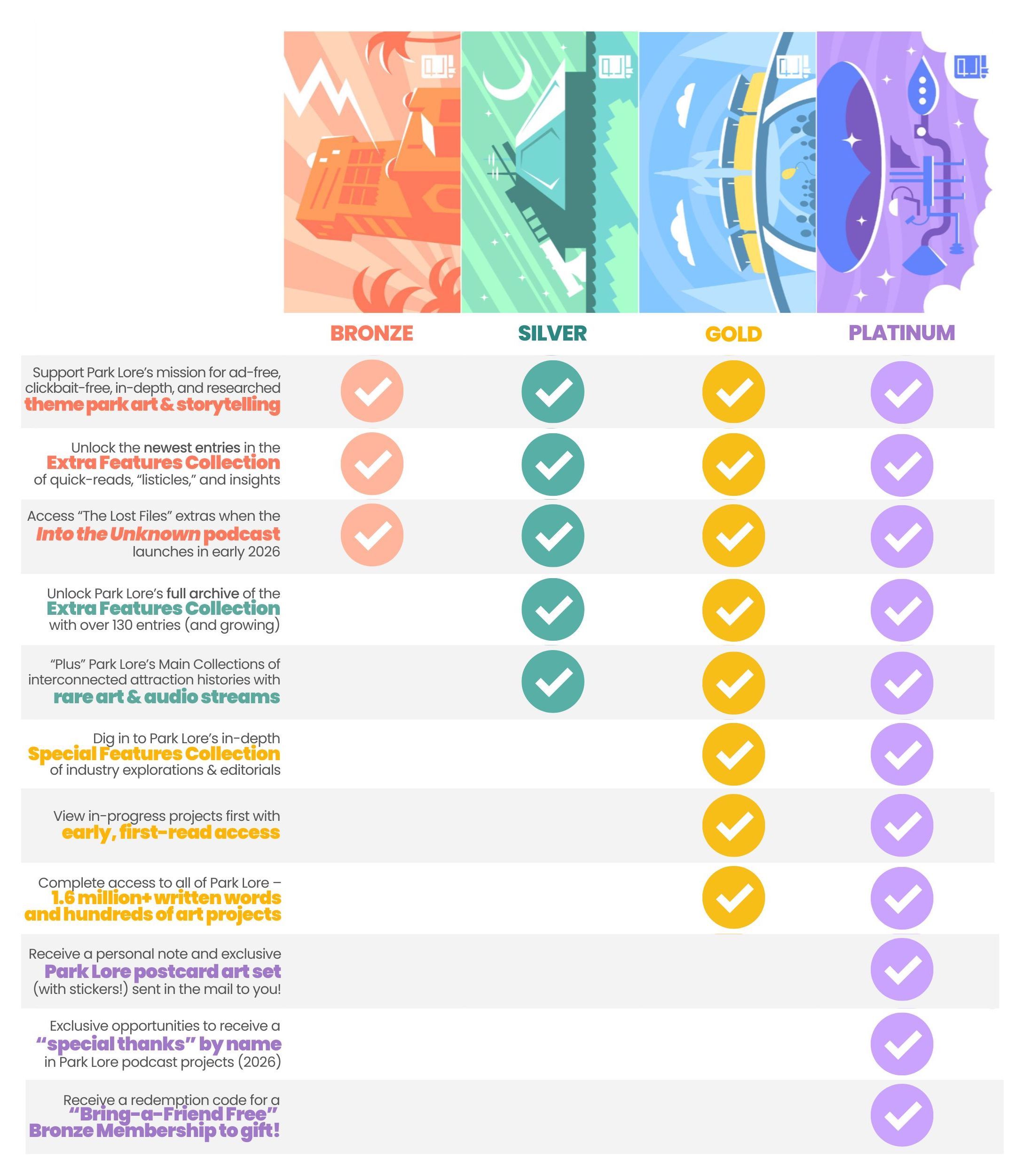
Stories in the Extra Features and Special Features collections of Park Lore are all about connections – they’re the threads that interlace between the Lost Legends, Declassified Disasters, Modern Marvels, and Possibilitylands you’ll find in our Main Collections. In other words, these features are for people who really want to dig deep.


This article and hundreds more are available for Bronze, Silver, Gold, and Platinum Members who help support this ad-free, clickbait-free, quality-over-quantity collection with a monthly membership. Park Lore Members can access more than a hundred Member-exclusive articles, unlock rare concept art and construction photos in every story, stream audio across the site, tune into podcast exclusives, and receive an annual member card and merch in the mail!

If you choose to join Park Lore’s community of Bronze, Silver, Gold, and Platinum Members, you’ll instantly unlock this story (and of course, a lot more). You can learn more about joining and supporting Park Lore (and browse all the available Extras and Special Features) in the “Memberships & Perks” menu above. If you can’t afford a Pass, please contact us; we’ll make some magic happen.


Log In or Join Now

Rides of the Renassaince: The Surprising Shortage of E-Tickets from Disney’s ’90s Classics

Nostalgia is a force more powerful than gravity. If you ask just about anyone on Earth, movies, music, television shows, video games – and yes, Disney Parks – used to be so much better. At this point, it’s really no surprise that each generation is practically repulsed by the media of the next; that our rosy hindsight leaves us sad and sorry for those who grow up without knowing the pop culture milestones that meant so much to us. Basically, everyone on Earth thinks the stories of their own childhood are just objectively the best.

Image: Disney

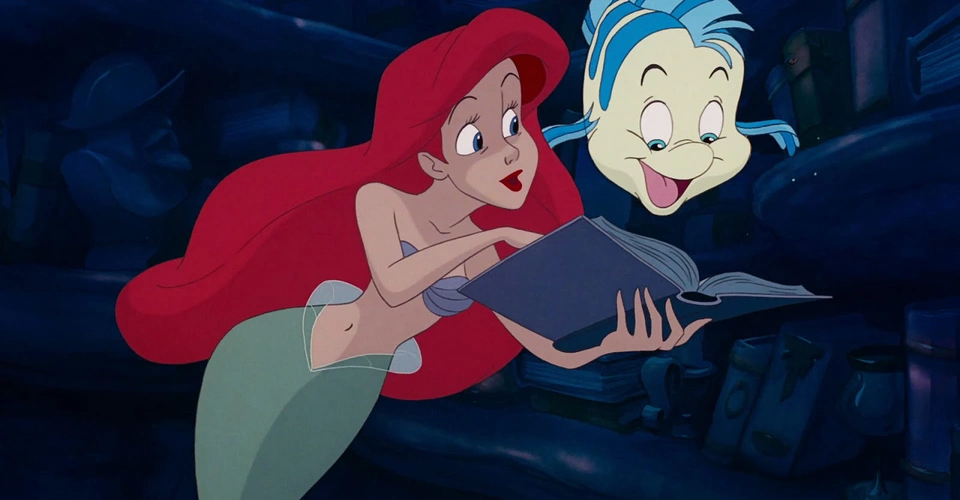
Millennials, though, are probably right. After all, in the 1990s, Walt Disney Animation did the unthinkable: it returned animation to the zeitgeist. After decades of declining returns and meh-movies that threatened to literally bankrupt Walt Disney Productions, 1989’s The Little Mermaid was not just a return to form, but a return to formula. Not since Sleeping Beauty thirty years earlier had Disney tapped so beautifully into a timeless, romantic, artistic retelling of a fairytale. And Ariel was only the start…

Stories in the Extra Features and Special Features collections of Park Lore are all about connections – they’re the threads that interlace between the Lost Legends, Declassified Disasters, Modern Marvels, and Possibilitylands you’ll find in our Main Collections. In other words, these features are for people who really want to dig deep.


This article and hundreds more are available for Bronze, Silver, Gold, and Platinum Members who help support this ad-free, clickbait-free, quality-over-quantity collection with a monthly membership. Park Lore Members can access more than a hundred Member-exclusive articles, unlock rare concept art and construction photos in every story, stream audio across the site, tune into podcast exclusives, and receive an annual member card and merch in the mail!

If you choose to join Park Lore’s community of Bronze, Silver, Gold, and Platinum Members, you’ll instantly unlock this story (and of course, a lot more). You can learn more about joining and supporting Park Lore (and browse all the available Extras and Special Features) in the “Memberships & Perks” menu above. If you can’t afford a Pass, please contact us; we’ll make some magic happen.


Log In or Join Now

COUNTDOWN: The “Best” Rides of the Century (as of 2020)

The story of theme parks in the 21st century is about to be a weird one… We may only be 20% of the way through the first century of the 2000s, but we’ve already lived through some of the wildest swings of the pendulum in themed entertainment design ever. Theme parks began in a lowly position as the tail end of Eisner’s budget-conscious ’90s and early 2000s lead to an era of underbuilt, abandoned, and low-budget plans, made all the worse by the 2001 obliteration of tourism in the wake of September 11th and, further, the financial crisis of 2008. Budgets were slashed. Theme parks cancelled. Projects downsized. 

Arguably, that trend was reversed only by the opening of the Wizarding World in 2009, propelling Universal (and by extension, Disney) into the modern age of “living lands,” big-budget investment, per-capita spending records, and theme parks as corporate revenue-generators… Who would’ve foreseen an era where E-Tickets weren’t enough? Where competitors battled over blockbuster IPs? Where guests would queue for hours not for rides, but for food and shops? Where Disney and Universal would drop a billion dollars on a single land? Of course, this golden age of investment is itself coming to an unceremonious end thanks to the catastrophic fallout of the 2020 COVID-19 pandemic, the results of which will no doubt be felt in the parks for decades. 

Image: Disney

So now, today, we find ourselves in an unusual position: half celebrational, half mournful, 2020 seems like a good time to look back at what may have represented the height of Imagineering; the pinnacle of theme park spending; the biggest $200 million E-Tickets we’ll see for a while. So today, let’s take a look at some of the best to come out of Disney (and Universal) Parks so far in the 21st century – that is, opening in the year 2000 or later(So no, Indiana Jones Adventure, The Amazing Adventures of Spider-Man, and The Twilight Zone Tower of Terror won’t be on this list… though you can read up on each in our Modern Marvels collection!)

Stories in the Extra Features and Special Features collections of Park Lore are all about connections – they’re the threads that interlace between the Lost Legends, Declassified Disasters, Modern Marvels, and Possibilitylands you’ll find in our Main Collections. In other words, these features are for people who really want to dig deep.


This article and hundreds more are available for Bronze, Silver, Gold, and Platinum Members who help support this ad-free, clickbait-free, quality-over-quantity collection with a monthly membership. Park Lore Members can access more than a hundred Member-exclusive articles, unlock rare concept art and construction photos in every story, stream audio across the site, tune into podcast exclusives, and receive an annual member card and merch in the mail!

If you choose to join Park Lore’s community of Bronze, Silver, Gold, and Platinum Members, you’ll instantly unlock this story (and of course, a lot more). You can learn more about joining and supporting Park Lore (and browse all the available Extras and Special Features) in the “Memberships & Perks” menu above. If you can’t afford a Pass, please contact us; we’ll make some magic happen.


Log In or Join Now

8 Luxurious Hotels Where You Can Sleep “INSIDE” Your Favorite Theme Parks

Let’s face it: spending the night inside your favorite theme park is probably one of the coolest ideas on Earth. Problem is that there are precious few legal ways to do it. But all is not lost. Sensing guest’s deep connection and love for their parks, some resorts have gone out of their way to create premium, outstanding hotel and resort accomodations that are completely and totally immersed into the stories and settings of their parks, and featuring exclusive entrances just for hotel guests.

Below, we’ve selected eight of the best examples of awesome hotels placed right inside your favorite adventures. All of the experiences below are pretty high-tier. Some are so exclusive, there’s practically no amount of money or time on a wait list that can promise you a stay. As for the rest, they may take some saving up, but it’s a lot more comfortable (and legal) than camping out in the bushes hoping to go undiscovered all night long. Have you had the chances to stay in any of these deluxe accomodations? Which would you most like to experience?

Do you love armchair Imagineering, in-depth storytelling, and seeing the theme parks we love differently? Park Lore is an ad-free, quality-over-quantity, one-person project centered on building a world-class collection of the interconnected stories of theme park attractions, design projects, and industry explorations.

This feature is one that’s usually locked in our Member Vault, where Park Lore patrons can find hand-drawn art, armchair Imagineering walkthroughs, and other in-depth Special Features, as well as quick-read, just-for-fun Extra Features. Thanks to supporting Members, this feature is temporarily unlocked as a preview!

But if you value my mission to provide clickbait-free, ad-free deep dives and new ways to see the parks, consider becoming a supporting Member of Park Lore for as little as $2 / month. That support is what keeps this unique themed entertainment storytelling project open, ad-free, and available to all. Thank you!

Stories in the Extra Features and Special Features collections of Park Lore are all about connections – they’re the threads that interlace between the Lost Legends, Declassified Disasters, Modern Marvels, and Possibilitylands you’ll find in our Main Collections. In other words, these features are for people who really want to dig deep.


This article and hundreds more are available for Bronze, Silver, Gold, and Platinum Members who help support this ad-free, clickbait-free, quality-over-quantity collection with a monthly membership. Park Lore Members can access more than a hundred Member-exclusive articles, unlock rare concept art and construction photos in every story, stream audio across the site, tune into podcast exclusives, and receive an annual member card and merch in the mail!

If you choose to join Park Lore’s community of Bronze, Silver, Gold, and Platinum Members, you’ll instantly unlock this story (and of course, a lot more). You can learn more about joining and supporting Park Lore (and browse all the available Extras and Special Features) in the “Memberships & Perks” menu above. If you can’t afford a Pass, please contact us; we’ll make some magic happen.


Log In or Join Now

8-Bit Magic: Throwback Video Games That Bring Disney Parks into Your Living Room

Whether we like it or not, there are simply times when going to Walt Disney World or Disneyland is downright impossible. As finances, jobs, and families shift, sometimes things just come up! Sure, we might not have expected a global pandemic to be the cause, but the point remains: when you can’t go to Disney Parks, why not bring Disney Parks to you?

Stories in the Extra Features and Special Features collections of Park Lore are all about connections – they’re the threads that interlace between the Lost Legends, Declassified Disasters, Modern Marvels, and Possibilitylands you’ll find in our Main Collections. In other words, these features are for people who really want to dig deep.


This article and hundreds more are available for Bronze, Silver, Gold, and Platinum Members who help support this ad-free, clickbait-free, quality-over-quantity collection with a monthly membership. Park Lore Members can access more than a hundred Member-exclusive articles, unlock rare concept art and construction photos in every story, stream audio across the site, tune into podcast exclusives, and receive an annual member card and merch in the mail!

If you choose to join Park Lore’s community of Bronze, Silver, Gold, and Platinum Members, you’ll instantly unlock this story (and of course, a lot more). You can learn more about joining and supporting Park Lore (and browse all the available Extras and Special Features) in the “Memberships & Perks” menu above. If you can’t afford a Pass, please contact us; we’ll make some magic happen.


Log In or Join Now

Peaks of Possibilityland: 10 Never-Built Disney “Mountains” from Around the Globe

If there’s one thing Disney Parks thrillseekers know to look for, it’s a mountain peak. After all, since Disneyland’s first decade, the connection between Disney and its mountainous thrills has become second nature. In fact, we took an in-depth look at Disney’s best “E-Ticket” peaks in their own Countdown: Peaks of Imagineering, summiting the twelve best Disney Parks mountains across the globe and how their headlining thrill rides stack up. What do you think we ranked as the top three “mountain” rides in the world? That special feature is a good place to start if you haven’t already…

Because today’s look is somewhat different. For years, our Possibilityland series has explored the incredible archives of Imagineering to dive deep into never-built masterpieces that could’ve been hits… We’re talking about the shuttered Muppet Studios once planned for the Disney-MGM Studios, a gritty New Tomorrowland 2055 once planned for Disneyland, and so many more. But this feature is special… Seriously…

Continue reading “Peaks of Possibilityland: 10 Never-Built Disney “Mountains” from Around the Globe”

Mini to Massive: How Disney’s BIGGEST (and Smallest) Parks Measure Up

Discerning Disney Parks fans are known to critique and analyze all aspects of the parks they love: their style, their stories, their smarts… But what about their size? From miniscule to massive, Disney Parks come in all shapes and sizes… but does size matter?

On our cross-continental tour today, we’ll stop by each of the 12 Disney Parks on Earth to take their measurements. Sometimes, Disney’s official numbers don’t quite add up… That’s why we’ve used simple acreage calculator maps when we need to to get closer to the real figures about just how big (or not) these parks are. Our ultimate agreement? We measure the simplest shape of a park – including its showbuildings and behind-the-scenes facilities – but excluding parking lots and empty expansion pads (which you’d think Disney would exclude, too, but they don’t always). 

Continue reading “Mini to Massive: How Disney’s BIGGEST (and Smallest) Parks Measure Up”