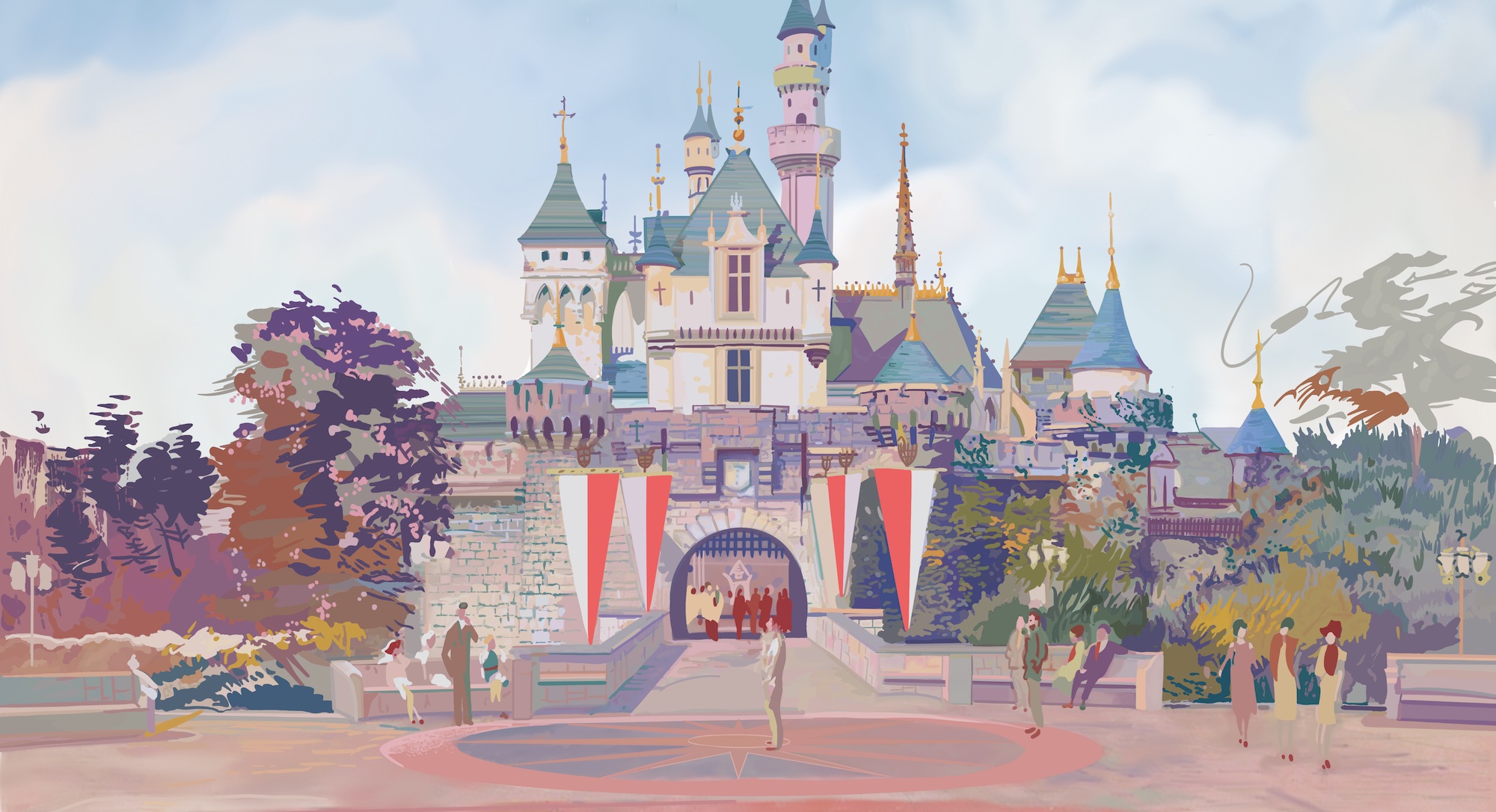


Well everyone, here we are again – and this time, at Disney’s Animal Kingdom!
By nature of reading this, you’re probably not new to Park Lore. But just in case, I’ll briefly explain. Park Lore is all about seeing the theme parks we know through new and different lenses. Since I started organizing my years of piecemeal freelance work in 2020, I’ve amassed a collection of totally ad-free, in-depth histories of beloved theme park attractions, never-built lands, closed classics, and more, increasingly interspersed with niche theme park art projects, over a hundred hand-drawn ride layouts, and a real favorite of mine – “armchair Imagineered” theme park build-outs.

Hopefully you’ve already journeyed with me through my lovingly “reimagined,” multiversal variants of Disney California Adventure, Disney’s Hollywood Studios, Magic Kingdom, and Universal Islands of Adventure. But for so many reasons, each of those was really just a practice round for tackling a very, very big one – a “Blue Sky” refresh of Disney’s Animal Kingdom.
Countless hours of work have gone into this hand-drawn build-out (inspired, as always, by the work of S.W. Wilson on the Ideal Build-Out blog). But if even one person reads it cover to cover and is intrigued, entertained, or even hopeful based on the ideas I have for Disney World’s fourth gate, it’ll all have been worth it. Likewise, if you enjoy this kind of in-depth, exhaustive, ad-free theme park storytelling and art, I hope you’ll consider becoming a supporting Member of Park Lore for even $2 per month!
With that out of the way, before we get into making changes to Disney’s Animal Kingdom, I think it’s helpful to start with a zoomed out, big picture view of the park’s story so far.
Nahtazū

You have to imagine the work that went into getting Disney’s Animal Kingdom greenlit at all. The park was famously the brainchild of Disney Legend and former Imagineer Joe Rohde. Though he’d been with Disney since 1980 (part of the massive onboarding of talent during the design and fabrication of EPCOT), Rohde’s work on the Mexico pavilion, Disneyland’s New Fantasyland, and the Lost Legend: Maelstrom are only part of the story.
As just about any Disney Parks aficionado will tell you, Joe Rohde isn’t just a sculptor, painter, or model-builder; he’s a true-life adventurer. An eclectic, philosophical world traveler, Rohde’s makings and musings (at least partially expressed via Instagram) make him an obvious inspiration behind projects like the beloved Lost Legend: The Adventurers Club that once called Downtown Disney home.
Rohde’s early concepts for a park centered on the natural world were famously resisted by the “MBAs” that then-CEO Michael Eisner had spent the ’90s surrounding himself with. Says Rohde: “They went to zoos and reported back that there’s one in every city, you pay three bucks to get in, they’re subsidized, they’re dirty, they’re smelly, animals are in cages, people think they’re depressing. How in the world is this a business we want to get into?”

Ever the philosopher, Rohde argued that the concept then called “Disney’s Wild Animal Kingdom” would be inherently different from a zoo because it wouldn’t just feature live animals; rather it would be an homage to all animals – “real, ancient, and imagined.” A Disney Park drawing on the natural world, he offered, would be so much more than a zoo, because at its core, Disney’s Wild Animal Kingdom would really be about us – our connection with, stories about, and continuous balance alongside the natural world and the other animals we coexist with – even if only in memory or legend.
Of course, even if such lofty and ambitious unthinking could help form the foundation of a Disney animal park, it would still be the park’s living collection of extant animals that would be the star – and indeed, the most expensive and controversial elements of such a park. As the story goes, Eisner was still wary about whether the “mere sight of animals” would drive guests to visit. In response, Rohde organized for a 400-pound Bengal tiger to join him in an executive session, supposedly winning the theatrical Eisner over in an instant.
Buoyed again by the success of 1994’s The Lion King and by the radical growth in attendance Disney enjoyed in the “Ride the Movies” era of the ’90s, Rohde’s park about animals and the natural world was greenlit.

Disney’s Animal Kingdom officially opened on Earth Day – April 22, 1998. By the way, that’s just nine years after the resort’s third theme park, the Disney-MGM Studios. It’s sometimes said that Animal Kingdom was something of a rebuttal to the Studio park. And maybe it was. After all, the ’90s had seen “studio-themed” theme parks proliferate across the industry. Following Disney’s own lead, theme parks now needed little more than mish-mashed IPs, beige soundstages, and interchangeable movie tie-ins, so is it any surprise that Universal, Warner Bros., Paramount, and MGM had all spent the decade opening (or purchasing) their own entries in the genre?
In that way, Animal Kingdom served as something of a return to form – a park that “only Disney” could ever make real. Well… kinda. As we know, Disney did struggle to communicate why Disney’s Animal Kingdom was worth a visit when nearly every guest to the resort probably lived within an hour’s drive of a zoo – sometimes even a very good zoo – that was probably also divided into “Africa” and “Asia” and “North America,” and probably also offered “naturalistic” animal enclosures and probably even a sky ride, or a simulator, or a drive-through “safari,” and probably cost a lot less than a Disney Park.
Disney’s marketing for Animal Kingdom came up with a clever solution: “Nahtazū!”, a sort of pan-African exclamation meant to suggest that the park was, of course, not a zoo, but so much more. Positioned high in the park’s appeal were its live entertainment offerings (like Festival of the Lion King and Journey into the Jungle Book), its realism (the park was, after all, built by genuine international artisans, unlike your local zoo’s “Africa” or “Asia”), and the “ancient” and “imagined” thirds of its lineup (the latter of which, of course, didn’t materialize as penciled in.)
Today, it’s easy to say that Disney’s Animal Kingdom served as a first entry in the “21st Century” generation of parks (a group soon joined by Islands of Adventure and Tokyo DisneySea). If you remove the rose-colored glasses of hindsight, though, Animal Kingdom did have some of the same kinds of issues that would plague other New Millennium Disney Parks. Namely, it had very few rides (it opened with just four: Kilimanjaro Safaris, the terrifying Countdown to Extinction, and two transportation systems), very few Disney characters, and very little for families.
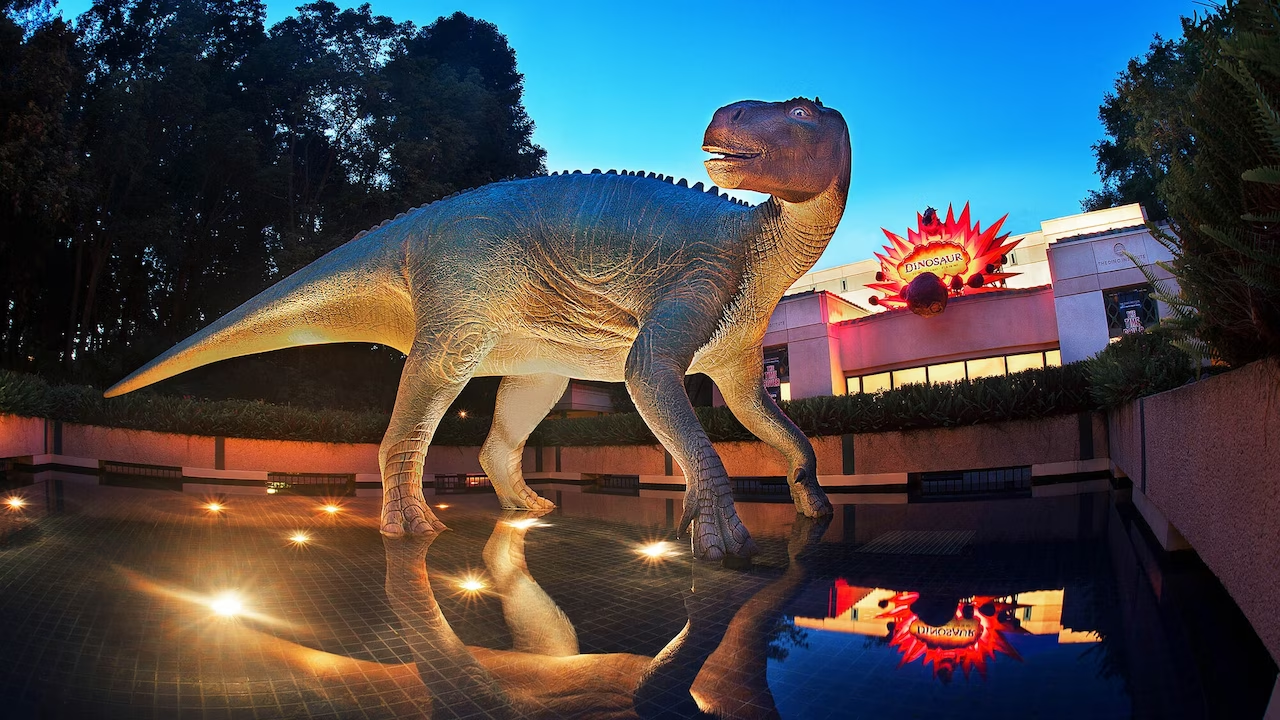
Today, by the way, Animal Kingdom still has the fewest rides of any Disney Park – just eight (and in the ongoing transition of Dinoland, just six). Now, to be fair, that criticism has always rung a little flat for Animal Kingdom, because while it’s not just a zoo, it is definitely also a zoo. So being honest, the park’s shows and (duh) animals are invaluable components. But even twenty five years later, Animal Kingdom still earns the dreaded “half-day park” label, which is clearly a problem a quarter century in.
To address that in a “build-out,” we have to acknowledge some inherent issues with the park. As “armchair Imagineers,” we inherit a park that closes earlier than any other at Disney World. That’s partly because the park is the earliest to open (given that that’s when the animals are typically most active), but frankly, is mostly because the park just doesn’t have enough to do to warrant a 12+ hour operating day, even if you amble.
In the early days, a justification for 6 PM closings was that once the animals retreat to their paddocks after dinner time, what’s the point? Especially because the animals preclude the park from having loud pyrotechnics, everyone seemed to have thrown their hands up and said there’s just no way or reason to keep people at Animal Kingdom after dark.

In the 2010s, Disney did make a concerted effort to program the park for post-animal evenings, centered on Pandora’s bioluminescence, an artifically-perpetually-sunset-lit Safari variation, mini projection shows on the Tree of Life, and a full-fledged nighttime spectacular – Rivers of Light. But post-COVID, we’re back to dusk closings most of the year as Disney cuts back expenses and – again – waves the white flag on trying to convince people to spend a whole day at Disney’s Animal Kingdom.
It so happens that Animal Kingdom is next in the ongoing cycle of Team Disney Orlando’s capital reinvestment that continuously shuffles the attendance rankings of its non-Castle Parks. The Tropical Americas that are en route (which we’ll get to shortly…) won’t expand the park’s capacity by much. Instead, it’s hoped that the next land will expand the park’s appeal. It’s a great example of the calculus that corporate Disney, Imagineering, and fans are all doing when it comes to addressing the surprising delicacy of this park… So let’s get to that.
Disney’s Animal Kingdom – Build-Out 101

One of the things you’ll hear me say a lot in this build-out (for better or worse) is “there’s not a whole lot to change in this part of the park!” Which I realize might be a disappointment for those who are hoping for some wild swings or vast reorganizing of existing lands. If you’re wanting to go totally “Blue Sky” and basically reimagine a park about animals from the ground up, you’d probably love S.W. Wilson’s plans for a wholly original animal park at Disneyland Paris; mine, maybe not so much.
But I have to tell you, one of my guiding principles in these build-outs is to try to be “reasonable” – whatever that means. Don’t get me wrong – I only ever played Arid Heights on Roller Coaster Tycoon – the level that basically gave you a terrainless, flat desert and unlimited money. But even if this build-out is “Blue Sky” in the sense that it envisions the park decades and billions of dollars of capital expenditure from now, it’s about building out, not bulldozing and starting from scratch.
Especially when it comes to Animal Kingdom, there are a number of factors that inherently reign in my thinking and have shaped the final product. If you care, here they are:
1. It’s wild

First let me say that Animal Kingdom is not a park that I know like the back of my hand, which makes mapping the finer points of its nooks and crannies an exciting challenge. You may very well be like, “Wow, my favorite drink stand is gone! He replaced it with a tree.” I promise I didn’t mean to, and it doesn’t mean anything. I just have only been to this gigantic and intricate park a handful of times, so I don’t feel like I “know” it the way I know other parks I’ve “armchair Imagineered,” leading to some unavoidable oversight.
(By the way – that’s something I bet the Imagineers would be quite proud of. Lest we forget, Animal Kingdom philosophically resisted having park maps printed at all, preferring that guests genuinely embrace the spirit of exploration, “stumbling upon” things organically and even discovering “off-roading” paths tucked into underbrush. It’s still true that in a break from every other Disney Park on Earth, you actually have to break off from the park’s main pathways to find most of its E-Tickets – a very interesting baked-in spirit! I actually feel like I learned as much about the park from this project as I would being “on the ground” inside it.)
2. It’s big

Second, this is a park that (as we know) is massive. Even though Disney vastly overestimates its size (somewhat nonsensically including its parking lot, undeveloped land, and the 100-acre Kilimanjaro Safaris into the 580 acres the company claims), the park’s “walking space” and “ride space” (minus Kilimanjaro Safaris) is still an impressive 150 acres, which is enough to crown it the largest Disney theme park on Earth by practical, pedestrian acreage.
For me, that’s a real mindset shift. My Build-Outs of Islands of Adventure, California Adventure, and even Disney’s Hollywood Studios were exercises in efficiency; trying to maximize the impact of highly compact parks, bolster attraction counts with little space, replace existing attractions, and eke out mini “expansion pads.”

Animal Kingdom is vastly different in that it’s a park with tremendous green space; literal hikes between lands; sprawling spaces; immense vistas… I mean, one far-flung part of the park is only accessible by train! This isn’t a park that’s meant to be approached through a lens of efficiency, or where the preciousness of any given square foot’s use is measured in monetization. Of course, every square foot is used – same as it would be at Disneyland – but at Animal Kingdom, the park “practices what it preaches” by allowing that space to be filled with life, demonstrating the very relationship with nature it waxes poetic upon.
Which, for a wannabe designer like me, actually makes decisions about how to use the space harder, not easier. Making changes to Animal Kingdom requires a different kind of “cleverness” than the sort of “Aha! I can wedge a showbuilding here!” that drives a build-out of California Adventure or even the concentrated core of Magic Kingdom. I’m not sure I have that kind of cleverness yet! I’ll let you be the judge.
3. It’s alive

Third, another major consideration in “reimagining” Disney’s Animal Kingdom (which really should probably be first) is… well… the animals. They say if you’re at Animal Kingdom late at night, you just may hear the wailing cries of the ghost of Michael Eisner (who’s still very much alive, mind you) weeping over the massive cost overruns that allegedly went into the park’s animal care facilities. Eisner was said to be beside himself as he considered how much cash went toward infrastructure that guests never even see.
Which brings me to my dilemma. We talked about how I try to keep these build-outs “reasonable” if not realistic. In any park, that means accounting for cast areas, backstage facilities, loading and unloading zones for retail and restaurants, etc. But obviously, having real, living animals vastly changes the calculation of what “reasonable” entails, and I’m less equipped than ever to have the answers!
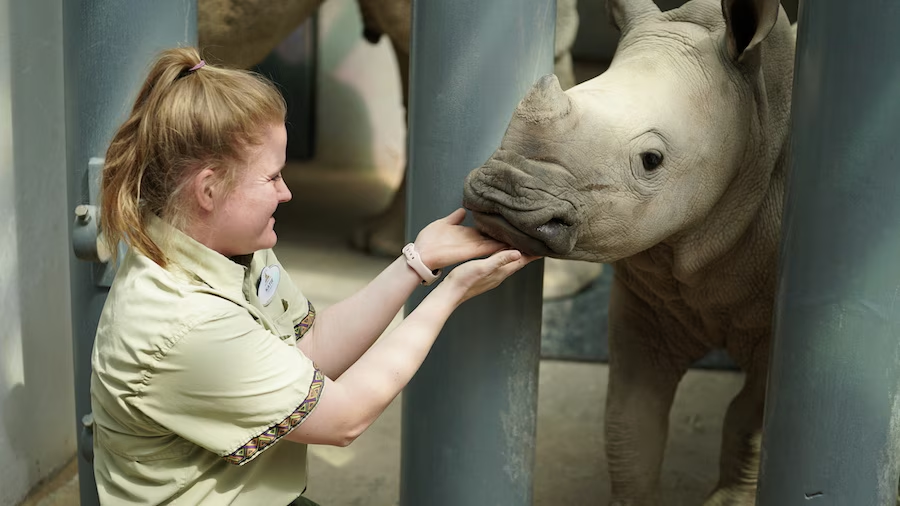
Animal Kingdom is littered with facilities where animals sleep, eat, and are cared for. Build-outs of, say, Hollywood Studios, allow us to play a little fast and loose, presuming that we can simply erase a pesky backstage building and tell ourselves that ~whatever happens in there~ can simply be done elsewhere. Poof! But at Animal Kingdom, I wouldn’t dare envision that any bland little shed you can see in an aerial view is expendable. Those of you who know the park’s backstage facilities well will doubtlessly zoom in and say, “Wow, I can’t believe he bent over backwards to salvage that shed that just has lawn mowers in it.” But I’d rather err on the side of caution when it comes to this park.
Likewise, just because an area looks like a big forested expansion pad on the map doesn’t mean it’s empty. I’m not an engineer, architect, or storywriter, I’m definitely not a zoologist. So it’s fairly silly for me to be mapping out zoological enclosures and support facilities like this is Zoo Tycoon… but here and there, you’ll see me try!
4. It’s actually about something…

Finally, there’s the lingering issue that Animal Kingdom is not a park that can or should be continuously responding to pop culture. That’s a major bummer for us, because that’s basically been Disney’s only M.O. for its parks since about 2007. I wrote pretty extensively on what I call the “Disney+ Parks” era – when Imagineers seem to have been recast from content creators to content curators. Magic Kingdom, EPCOT, Hollywood Studios, California Adventure, et al are certainly decorated differently, but are they really about anything distinctly their own? Given that Zootopia or Avatar or Moana feels equally as like to come to any of them, it’s hard to argue that any of those parks has a true “theme” in terms of a bar to entry and a centering message…
But for now, Animal Kingdom is different. Thanks to the park’s patron saint (Joe Rohde) and the innumerable Imagineers in his wake who give a hoot, Animal Kingdom is indeed about something: “The intrinsic, supreme, and untradeable value of nature” and the story of humanity’s inseparable, two-way relationship with it. Actual places, people, and cultures are depicted here; genuine nods to history, colonialism, religion, and reverence; and of course, real animals who are really cared for – living, eating, reproducing, dying… In my opinion, this is a park that demands a level of thematic purity, reverence, and accuracy that should forever preclude a neon cartoon animal city from even being whispered as a concept under consideration.
5. … but there’s still work to do!

But at the same time, Animal Kingdom was (perhaps rightly) criticized in its early days for being too thematically pure – even preachy. While the rest of Disney World’s theme parks (even EPCOT’s World Showcase!) tend toward broad strokes fantasy and idealism, Animal Kingdom’s environments offer grounded realism and reminders of humanity’s often antagonistic role in nature’s story. So even if it’s a complaint far more associated with early California Adventure than the competent and quality Animal Kingdom, this park, too, was quickly identified as needing more character, more for families, and more “Disney.”
And you know what? There are moments when we – the hyper-involved Imagineering aficionados – probably should relent and say, “Listen, if the people overwhelmingly want Zootopia, fine. Who exactly am I to tell an engaged public asking for Judy Hopps that, well, actually, that’s short-term thinking, it’s dumb, and so are they for not knowing that they deserve better.” To some extent, these places do belong to the people who visit them, and the vast majority of those people increasingly buy into Disney’s perspective that the parks are “the global hub where Disney stories, characters and franchises come to life,” full stop.

The point is, Animal Kingdom has to walk that fine line. This is a park that must reflect reality. Here, careful consideration has to be made toward clearing a bar to entry that demands reverence, humility, and artistry over animation and flavor-of-the-week films. Animal Kingdom can’t never change; but right now, the only change even fundamentally conceivable is to pluck something out of the Disney+ data’s top 10 IPs, which I can guarantee offers little in the way of “the intrinsic, supreme, and untradeable value of nature.” So… stalemate, right?
No one has all the answers, but the version of Animal Kingdom we’re about to walk through together at least tries to reconcile those extremes. Just as we fought to find the right balance of “Disney” and “California,” we’ll now tackle the difficult and maybe-impossible task of making this park distinctly 21st century Disney, but authentically itself. Ready?
Having recently watched Hoppers, one of the first things I thought coming out of it is how incredible a fit it is for Animal Kingdom! Unlike movies such as Zootopia, it really fits the themes of the park, with our connection with animals and nature being one of its main themes. I think a Hoppers show would be perfect in the Tree Of Life theater, much better than the awful Zootopia show that’s in the theater now. The story for the attraction can be set up so easily as well, as it could be about Mabel and the scientists she’s working with showcasing a new Hoppers program to guests that gets them up and close with the animals! Putting Hoppers here could even work for Disney as a brand builder, since the movie is looking to be a genuine box office success! It is insane how perfect Hoppers and Animal Kingdom fit together, it almost feel purposeful!
I just wanna say I love this Animal Kingdom build-out, especially the Gravity Falls area. Including it was a brilliant idea! I’m just bummed there’s a lack of extinct animals in your version of the park.
I totally agree! When I sketched out the first ideas that would evolve into this Build-Out more than a decade ago, I thought Pixar’s The Good Dinosaur (which wasn’t out yet) might be a good way to do that. That tells you how long these ideas sort of lingered before I had Park Lore to put them down on paper. In retrospect, even if The Good Dinosaur had been a success, putting it here would’ve done the thing we try to avoid with Animal Kingdom, which is assuming that just because a movie has animals, it’s about animals.
The other obvious problem is that Universal owns Jurassic Park and leverages it heavily in their parks right up the road. Jurassic Park brings dinosaurs to our world in a way that’s very smart and perfect for a theme park. Sure it was meant to be a sort of dystopian sci-fi story about the hubris of man, but ultimately the setting of a theme park filled with dinosaurs still lets us adore and revere them as animals. It works really well. It gives Universal de facto “ownership” over the T. rex, and the Velociraptor, and “dinosaurs getting loose.” And it puts Disney on its back foot. Sort of like if Universal decided they wanted to start a line of animated Princesses. Like, sure, I guess you can try… but you’re never, ever going to supplant the pop culture image of that genre that’s held by your competitor.
If Jurassic Park brings dinosaurs to our world, then the logical inverse is that we visit theirs. The “problem” there has always been “theme-park-ability” – like, but where are the restrooms? The restaurants? How do you sell retail in a world that exists 65 million years before humans? I think you could do it by embracing the Dino Institute frame story… Perhaps you enter the land through a Chronotech portal that bridges us back in time to a dino-reserve operated by the Dino Institute. That would give us our needed infrastructure – restroom pods, and a futurustic pop-up canteen for Dino Institute researchers, and the frame story we need to have “rides” and “laboratories.” The problem is that even though that’s the inverse of Jurassic Park, I’m not sure it would read much different. It would still fundamentally be a dinosaur theme park.
Which is why it’s so brilliant that Dinoland U.S.A. avoided the trope altogether and found another way to explore how we as humans adore and revere dinosaurs, you know? Animal Kingdom is ultimately a park about us. That’s why it was such a smart idea to have a Dinoland so uniquely about something grounded (the absurdity of giant reptiles once being the dominant life on Earth, and now being plush animals and pajama sets and cartoons)… So even if that was lost on a lot of people (which, don’t get me wrong, is ultimately the fault of storytellers whose theme was obviously not conveyed or not connected to audiences), it was such a good idea that it’s hard to decide how else Disney can “own” dinosaurs with Jurassic Park a few miles away at Universal.
Thanks for checking this out!
The original concept for The Good Dinosaur posited that the creatures never went extinct, and lived alongside humans in a more egalitarian society.
That could be an interesting approach to bring prehistoric creatures to the park.
It’s an interesting idea! My only “worry” about that is the “dinosaurs & humans coexisting” thing, specifically as it relates to Animal Kingdom. Joe Rohde has talked about how when you visit Animal Kingdom, you are in a story, but not a fantasy. Even Pandora uses the fantastic to examine the real, with messages about biodiversity, indigenous people, keystone species, etc. So while I think there’s a compelling case for The Good Dinosaur’s sort of multiversal setup of “What if the meteor didn’t hit?”, I think there’s also a delicacy in putting that sort of thing in a park people do associate with real information. A YouGov poll a decade ago found that more than 40% of Americans think dinosaurs and humans coexisted (and unfortunately I’d wager that number has increased since! 🙃). Does Disney have a moral obligation to use its pop culture powers to develop a scientifically literate society? Probably, no… but it’s still something that’s probably worth considering specifically in Animal Kingdom! haha.
Brilliant, but I really do think that prehistoric animals deserve some real representation in a park like Animal Kingdom, though I wouldn’t change anything about this fantastic build-out.
Is there nowhere you could ‘squeeze in’ an expansion land for some of the most beloved creatures of all-time?
These are all fantastic and so well-crafted! Any plans for an Epcot one? Excited to see what you would concoct up
Hi Matt! Thanks for checking this out! An EPCOT build-out is probably my most-requested on social media! I have avoided it because I don’t think an EPCOT build-out meshes with my style, which is basically an overhead map. The “pavilion” situation makes it hard to do EPCOT that way, because the physical buildings maybe wouldn’t change? So it would just be the existing park but labeled differently? I don’t know…
I have been quietly working on something else, which is a sort of new age, next generation, what-if-a-park-like-EPCOT-were-built-today concept… so keep an eye out for that! Until then, thank you so much for reading!
I love these arm-chair imagineering posts, but I have what might possibly be a dumb question: How do you make the custom maps you have here? And do you have any tips and tricks for making your own? I’ve always wanted to design my own theme park like this but I don’t really know where to start!
Not a dumb question at all. I hand-drawn these on an iPad using the Procreate program and an Apple Pencil. I usually start by drawing on top of the existing park. I then do a lot of work to make sure things are at least reasonably scaled by looking back and forth at existing parks or showbuildings and using a 1:1 scale. And of course, contextualizing all of that in new layouts and pathways and backstage access. None of it is scientific or real (this isn’t actually my day job and I don’t know what I’m doing!) but it’s fun and, again, at least “reasonable” in terms of access roads, cast infrastructure, etc. It takes weeks to make one, but you can see an example of the process in this video here! https://www.youtube.com/watch?v=qub3MDdxvao&t=1848s
Hey Brian, I have a suggestion. Can you please do another version of Animal Kingdom Armchair Imagineering, this time with a Lion King land and Dinosaur staying, and also an original park for Walt Disney World with lands based on Aladdin, The Little Mermaid, The Great Mouse Detective, Zootopia, Beauty and The Beast, Moana and Emperor’s New Groove / Atlantis The Lost Empire please?
Also, I love this idea you’ve done!!! It is brilliant!!!
Thanks for checking this out, and for these suggestions! For me, I wouldn’t probably come up with another version of Animal Kingdom for a few reasons. One is that I want to basically have one build-out of each park as my sort of definitive “version.” I just wouldn’t want to have two or three or four versions of each park. And I wouldn’t include a Lion King land in Animal Kingdom if I were given creative control because ultimately, Lion King has the same problem as Zootopia – it has animals, but it’s not about animals. It’s a parable for human experiences that’s no more about animals than Frozen would be if Anna and Elsa were designed as arctic foxes instead of humans. To my thinking, Lion King is used perfectly in the park as it is in Africa… as an excuse to celebrate African arts and storytelling. It becomes diegetic in that the people of Harambe are celebrating the story of the Lion King, which makes sense in the context of Animal Kingdom whereas a land of cartoon animals would not.
Your ideas for a new park sound really cool, and very specific! I did come up with a concept park I called Disney’s Fantastic Worlds you might enjoy. As for this specific arrangement of IP, I totally encourage you to sketch it out and see what you can come up with! Hope you do, and share it if you do!
I think if the pandora improvements, the Bugs land, and the riverboats/nighttime show happened, it would already be “complete” even before the fantasia gardens or other more blue sky stuff. Chester and Hester sought to “add capacity” but did so in a cheap way. Bugs land, if in right context, could be lower cost and add a ton of children’s capacity. Animal Kingdom doesn’t have a shortage of E tickets. It has a shortage of smaller, low-to-no wait experiences.
Can you next one be universal?
Amazing gravity falls but you should have added bill in the park
He’s there on the map, just like other creatures. 😉 He can visited in stone down a little discrete wooded trail.
I noticed that the rides for your buildout of Tropical America are the same as the rides you made for your build-out of Hollywood Studios. I think you should replace the ones in your build-out in Hollywood Studios with a Monsters, Inc. land instead.
Yep, you’re right! I designed that build-out of Hollywood Studios long before these changes to Animal Kingdom were greenlit, so it’s sort of wild that I got the mix of Indiana Jones and Encanto “right” – just at the wrong park. Haha! I think you’ll see me sweep back through that Hollywood Studios build-out eventually and do some reorganizing. I was never 100% happy with the flow that inserted an Incredibles land right between a 1930s Hollywood and a 1930s Walt Disney Studios… something seemed off about that flow, so maybe this is a chance to fix it.
Once again, you absolutely blew this out of the water! I love the Mythica, Gravity Falls, and Bugs Land combo, and the map is inspiring as always. A bit funny of a recurring joke though, is it just me or has every single buildout you’ve made (except HS) specifically include an Aquatopia-inspired ride, with the word “Skimmers” in it? Definitely enamored with the word lol
Additionally, aside from Ideal Buildout you might want to check out a few other amazing armchair Imagineering projects/blogs on the web for inspiration (if you haven’t already!) – this includes Imagineerland, DisneySky (Complete and Restored), and The Sorcerer’s Apprentice Season 8: Magic Journeys (one of many armchair Imagineering competitions). They’re all worth checking out!
I would recommend a Lion King land for Animal Kingdom. In my opinion, it really fits the theme
I think Lion King is present in Animal Kingdom in the best way it could be – drawing on its music that draws upon the “Circle of Life,” wrapped in a show that’s “decorated” with the artistry and culture of African artisans. Otherwise, I think the high bar to entry that “guards” Animal Kingdom would prevent Lion King from being included as a land or a dark ride.
Lion King is obviously a fantastic film, but I think it’s really not so different than Zootopia in that is has animals, but is not about animals. The characters could just as easily have been designed to look like humans, telling a “coming of age” story about a young boy who loses his family and is set loose in the world to find his way. The fact that its characters are stylized as lions adds a lot to the film, but it doesn’t actually make it have anything to do Animal Kingdom’s big idea – “the untradeable value of nature.” Joe Rohde’s thinking is that the park’s Africa is primarily concerned with resources – how the people of Harambe think industriously to make the most of what they have, and that they have decided to value the rhino over the horn. That’s big, deep stuff that’s dealing with human’s relationship with nature. Even though there are animals in it, The Lion King isn’t about that.
Thanks for checking this out!
As a huge theme park fan and a massive Gravity Falls fan, I adore the Gravity Falls land you made for the park! However, there are a few lore notes that I have to give about Strange Dimensions ride. Firstly, the strange creatures didn’t come from the portal. They were always in Gravity Falls, even before the portal was built, and were all at Gravity Falls because of the Law Of Weirdness Magnetism. Secondly, the portal was first built in order to get Bill Cipher and his pals to our dimension so he can start Weirdmageddon. So basically, if we reopen the portal in this ride, if this ride follows canon we should be starting the apocalypse!
THANK YOU! Like I said, this is not an IP I’m super familiar with! I have changed around the description into something more generic… but please feel free to let me know what the ride’s story should be and I’ll update it! Hahaha!
I asked the Gravity Falls subreddit on what a potential story for a Gravity Falls ride could be and they mainly said either a tour of the shack or a ride based on Weirdmageddon. Honestly, I don’t love either of those ideas. A simple tour of the shack is too quaint and small scaled for the type of E-Ticket you’re proposing here. I have always thought that a tour of the shack could be the queue of the ride, as you see the fake creatures made as the shack’s attractions while on the line, with an animatronic Stan or Soos (similar to the animatronic Mr. Potato Head from Toy Story Mania) presenting the the shack’s “wonders.” As for the idea for a ride that takes place during Weirdmageddon, I find it hard to make it work as part of the land’s timeline. There was no fair at all when Weirdmageddon started and Dipper and Mabel canonically don’t return to the shack until three days after Weirdmageddon started. Plus, we have to spoil the ending of the Weirdmageddon arc in order for the ride to have a satisfying ending. (To be fair, we pretty much have to spoil the existence of a certain character that the show keeps as a mystery for most of the show anyways, since I kinda feel like the land should take place in the summer after Dipper and Mabel’s original summer, and you can’t really do that without having that character appear.) However, I have come up with an idea that I think can work. In the Gravity Falls graphic novel Lost Legends, it is revealed that there are rifts that have opened in Gravity Falls after Weirdmageddon ended, rifts that can travel to other dimensions when someone goes inside of it. While we see the Pines fix and close one of these rifts in the graphic novel, it has not been confirmed that they closed all of the rifts, or that rifts have stopped appearing, so we can work with that. The Pines family can introduce themselves to the guests in the pre-show, and then in that pre-show we can have a character (probably Soos or Waddles) get sucked into a rift. Now we have to join the Pines and go into the rift and through the multiverse in order to save them. When it comes to what universes we go to however, I’m kinda stumped. I feel like the universes they go to have to be both relevant to the show and relevant to the themes of Animal Kingdom. I assume that most of these universes will be made just for the attraction, as the actual show never really goes dimension hopping itself, instead bringing characters from other dimensions such as Bill into our world. And even dimensions mentioned in supplemental material like the books are more sci-fi like worlds that don’t fit in Animal Kingdom at all. I had the idea of maybe crossing over with the shows Amphibia and The Owl House, shows that have basically acted as Gravity Falls’ spiritual successors, traveling to their dimensions Jimmy Neutron: Nicktoon Blast style, since I feel like those worlds fit Animal Kingdom quite well, but those shows are even more niche than Gravity Falls, making it kind of a hard sell. However, I do know that I want the last dimension they enter to be a parallel universe where the Pines family lost against Bill into Weirdmageddon. The new Gravity Falls book called The Book Of Bill confirmed that there are parallel universes that exist where the Pines family lost, so it’s a way we can have the incredibly popular and iconic Bill Cipher in the ride and go through Weirdmageddon without breaking canon! Of course, we end the ride with them barely escaping Bill, returning to their home dimension, closing the rift, and congratulating us on a job well done! My ride idea isn’t perfect, and we still need to figure out what will be the other dimensions that the characters will go through, but I feel like I have found a way to preserve your idea of traveling the multiverse with the Gravity Falls cast, without breaking the lore and canon this time!
By the way, if you want to see what other people answered on my post about what a Gravity Falls ride should be like, here’s the post: https://www.reddit.com/r/gravityfalls/comments/1gi5341/if_gravity_falls_had_a_land_in_disney_world_how/
My personal idea for a Gravity Falls ride is a “Mystery Tour” similar to the one stated in the post above with a new E-ticket focus. The idea is that Stan is testing out a new automated golf-cart mystery tour (so he doesn’t have to drive people around/pay anyone to drive people around) that will go through setup portions of the surrounding forest with cheap attractions and replicas. Soos is remotely controlling the test carts that you ride on (after going through the queue that is the Mystery Shack itself) and you load up “outside” at night for the tour. The tour goes pretty well and is “boring” until Dipper and Mabel appear over the radio and tell Soos that the tour doesn’t show anything real and to let the passengers go to some real interesting (yet safe) areas where we can find things. Unfortunately, one monster from the show (you can probably pick which one but maybe something like the Gobblewonker or bring back the dinosaurs) is a lot more dangerous than expected as you go on a high speed chase through the forest before outmaneuvering with Soos’s help allowing you to get back to the Shack.