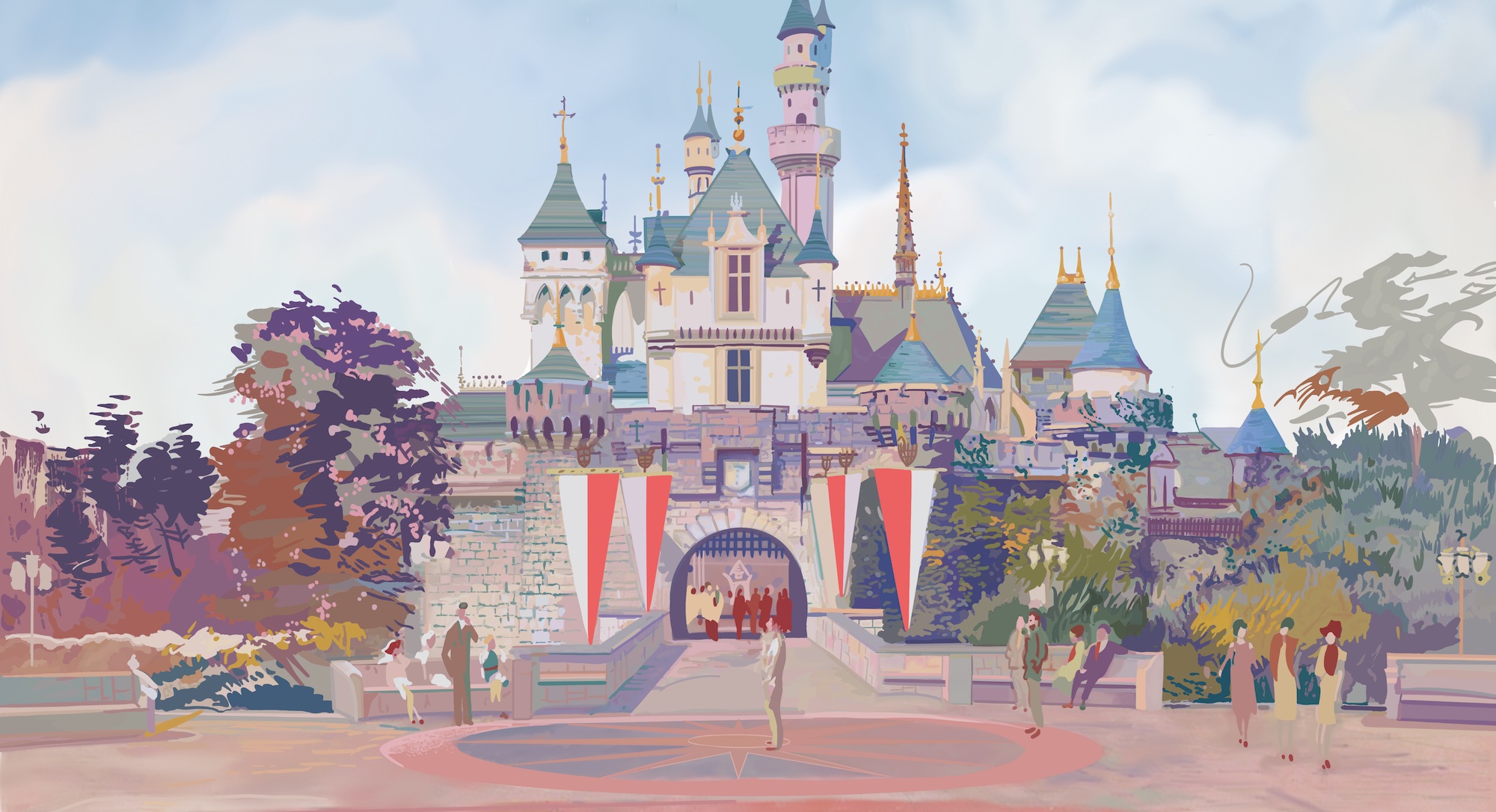
For those of us who grew up on discussion boards and social media following the goings-on of amusement parks and roller coasters, there was no more fundamental a divide than that between Six Flags and Cedar Fair. For decades, these two regional parks operators battled back and forth, inciting the “Coaster Wars” in their continuous battle for amusement supremacy. Pitting their flagship parks against one another, Six Flags and Cedar Fair raced to compete. As of July 2024, though, that long-waged war has officially ended in a truce.
Yep, in July 2024, it became official. Six Flags and Cedar Fair would officially combine in a “merger of equals” (in other words, not one acquiring the other). The newly formed company bears the Six Flags name, but is comprised 51% of Cedar Fair’s unit-holders and helmed by Cedar Fair’s CEO, Richard Zimmerman. There’s no question that it’ll take years for Zimmerman to sort out the new company’s structure – how capital expenditure schedules will adjust, how park operations should align (or not), how (or if) to merge the two portfolios’ separate licensing deals, annual pass programs, food suppliers, marketing, branding, etc… but in the meantime, a bigger question has emerged…
Well everyone, here we are again – and this time, at Disney’s Animal Kingdom!
By nature of reading this, you’re probably not new to Park Lore. But just in case, I’ll briefly explain. Park Lore is all about seeing the theme parks we know through new and different lenses. Since I started organizing my years of piecemeal freelance work in 2020, I’ve amassed a collection of totally ad-free, in-depth histories of beloved theme park attractions, never-built lands, closed classics, and more, increasingly interspersed with niche theme park art projects, over a hundred hand-drawn ride layouts, and a real favorite of mine – “armchair Imagineered” theme park build-outs.
You have to understand that for those of us who know the Disney Parks nearly as well as we know our friends and family, there’s nothing more special than the opportunity to bring along a first-timer. For people like me (and perhaps, the person who sent you this feature to research), sharing Disneyland with someone for the first time is tantamount to sharing a secret; it’s a vulnerable proposition, and one where we – the nerds – must carefully consider and meticulously meter just how much to let you in.
For many years, I was known for creating bound booklets for my friends, meant to accompany and educate them about the parks on our cross-country flights. Over pages and pages, I’d try my best to tell the chronological story of Walt Disney and Disneyland and Disney California Adventure, condensing decades of the too-much-information I have in my own head, and trying to mix it with a land-by-land tour of the parks and the briefest little synopses of rides and attractions and my thoughts and feelings… (I happen to know that many friends have kept those bound booklets, so y’know, a win is a win.)
But I’ll tell you something. For me, growing up was realizing that you only have one chance to let Disneyland make a first impression upon the ones you love. Difficult as that may be, I now see the value in not forcing my friends through a “Disneyland 101” slideshow or a booklet trying (and inevitably failing) to contextualize everything they’ve yet to see and attach emotional weight to things for which they have no context. Which leads us here.
Allan Grant / The LIFE Picture Collection via Getty
In August 2024, a lifelong friend will be joining me at Disneyland for the first time. And while I admit to taking a stab at recreating my bound books of old, I have decided (quite selflessly, I might add), that instead of cobbling together an over-the-top and exhaustive primer, I’d be willing to settle for a 9,000 word, 26-entry list of the basics – non-chronological, non-narrative, but actually (in my opinion) an excellent set-up for what you should know before you visit Disneyland.
You won’t leave these ABCs knowing the whole story (for that, see Sam Gennawey’s The Disneyland Story, or Leslie Iwerks’ The Imagineering Story – in either book form or as a docu-series on Disney+). But that’s precisely the point. This list will tell you just enough of the history and terminology and context to draw your own conclusions when you leave today and enter the world of yesterday, tomorrow, and fantasy. Enjoy!
A – Audio-Animatronics
Image: Disney
Disneyland was home to what we might call “electro-mechanical” figures from the time of its 1955 opening. For example, on the Jungle Cruise (see, “J”), a passing boat might trigger an elephant to rotate its head, or hippos to wiggle their ears. But these “rudimentary” figures weren’t programmed to perform a complex set of actions; they instead used gears, levers, and pneumatics to carry out simple, repeating motion – nodding heads, rising and lowering, flicking tails…
In 1963, Disneyland’s Enchanted Tiki Room opened, debuting something new. Dubbed “Audio-Animatronics” for their synchronization to sound, the birds in the Enchanted Tiki Room didn’t just loop through continuous, mechanical motion – they sang. Powered by cutting edge, sedan-sized computers, the birds’ beaks clacked in time with the music, chests puffing as they breathed. It’s impossible to overstate how unthinkable the technology was to mid-century audiences. In fact, Disney positioned a single “barker bird” animatronic outside of the attraction to give passing guests a taste of what awaited within… but the curious, speaking bird drew such enormous, gawking audiences that it needed to be removed lest the pathway into Adventureland be permanently blocked.
Today, Audio-Animatronics are a staple of Disney Parks attractions. Incredible innovations have seen hydraulically-powered figures upgraded to electronic ones, capable of staggeringly precise, realistic motion. Disney’s newest generation of figures (dubbed A-1000s) are almost unthinkably “real” – astounding illusions that merge art and engineering in the way Imagineering is known for. Spoilers abound, but if check out our list of the 25 Best Audio-Animatronics on Earth for a look at some of the figures you’ll find at Disneyland.
B – Berm
Image: Disney
Walt Disney once said, “I don’t want the public to see the world they live in while they’re in the Park. I want them to feel they’re in another world.” The image above is a real aerial photograph of Disneyland in 1955. (Notice U.S. 101 – soon to be “upgraded” to Interstate 5 – in the northeast corner, the blacktop parking lot south of the park, and the orange and strawberry groves still in existence around it.) Even though the “urban sprawl” that would eventually surround Disneyland hadn’t yet materialized, Walt and his early team of Imagineers had built a solution into the park’s DNA: a berm.
The berm is literally a 20-foot tall raised earthen “mound” constructed around the circumference of the park. The berm – planted with trees that have grown tremendously over the last seventy years – is like an insulating “shield” that keeps any sights or sounds of the “real world” out of the park. It works.
Guests enter the park by passing through tunnels in the berm. A plaque above famously states, “Here you leave today and enter the world of yesterday, tomorrow, and fantasy,” and… It’s true! While you’re standing in Disneyland, you can’t see any hotels or electric wires; you can’t hear the traffic on the bordering Harbor Blvd.; you can really imagine – even if only briefly – that you’re in another place and time.
The second theme park at Disneyland Resort – Disney California Adventure – was infamously built without a berm. In the early years, guests standing in the park could easily see the Anaheim Convention Center, electric poles, and towering hotels that surround the resort. As part of that park’s billion dollar reimagining, Imagineers have since tried to retroactively build visual barriers to block views out of the park, and maturing trees help. But certainly, the lack of a berm at Disney California Adventure exemplifies the transformative power of blocking out the outside world at the original Disneyland Park.
C – Cast Members
Image: Disney
Disney Parks are well-known for their “Five Keys of Guest Service” – a simple framework that Disney famously trains other businesses on through its “Disney Institute” program. The Five Keys – in order – are Safety, Courtesy, Inclusion, Show, and Efficiency. It’s “Show” that the Disney Parks are perhaps best known for. Even (and perhaps, especially) in Walt’s era, there was a strict sense that being “on stage” required a particular allegiance to “Show” – that there should be as few intrusions of the “real world” as possible once guests set foot inside of Disneyland. (The “Inclusion” Key was added in 2021, and slots above “Show” on purpose – it’s the reason Cast Members can now display tattoos, grow facial hair, and wear whatever “gendered” costume they prefer.)
Lots of tools contribute to the “Show,” and lots of theatrical terms. But one of the most well-known is that Disney employees across the company are known as “Cast Members.” It’s actually a term that Walt himself was never recorded using. (Its first use was in 1976 – ten years after he died.) But the term embodies Walt’s commitment to making guests feel that when they’re in Disneyland, they’ve left today and entered worlds of yesterday, tomorrow, and fantasy.
D – Disney California Adventure
Image: Disney
Even if you’ve never been to a Disney Park before, when you think of Disneyland, you probably picture a castle, princesses, pirates, and Mickey Mouse. But it’s worth remembering that Disneyland Resort contains two theme parks, and Disneyland Park is just one of them. In the ’80s and ’90s, a prominent CEO of Disney set out to usher Walt’s tiny little mid-century park into the future by turning it into the same kind of multi-park, multi-day resort destination as Walt Disney World in Florida. Of course, since Disneyland is infamously landlocked, a second theme park would need to be placed on the only land available: Disneyland’s blacktop parking lot.
If you’re a super nerd, you can read our epic three-part history of the project that begins here, but suffice it to say that the winning concept for a “second gate” was Disney’s California Adventure – a park meant to let guests explore the highlights of the Golden State without leaving Disney property. Unfortunately, the park was wildly underfunded. It had practically no Disney characters, very few rides, and practically nothing for families. Opened in 2001, the park pretty instantly floundered. Disney spent years pouring money and resources into California Adventure before deciding that the park needed a permanent fix – something that would not just add new rides, but give the park a new spirit.
In an totally unprecedented move, Disney announced a five-year, $1.2 billion reconstruction effort, reimagining California Adventure’s lands to be historic, idealized, romanticized – just like Disneyland’s. A 1920s Los Angeles, a turn-of-the-century Victorian boardwalk; a 1950s redwoods National Park; a 1940s Hollywood; and the piece-de-resistance, Cars Land, bringing to life the neon-lit streetscape of a Route 66 desert town. California Adventure closed for a single day, re-opening on June 15, 2012 as a park reborn. Though several changes since have been eyebrow-raising to say the least, California Adventure is now a park packed with beautifully-decorated lands that recreate the beauty, diversity, and history of California… and then packs them full of Disney + Pixar + Marvel characters.
E – E-Ticket
Before Disneyland, nearly all amusement parks were free-to-enter and walk around, with guests merely paying per ride (think, for example, of seaside boardwalks like New York’s Coney Island or picnic-parks-turned-midways like Cedar Point). Believe it or not, one of the things that made Disneyland different from the start was that it had a single entrance… and an entrance fee (in 1955, $1). Even once guests had paid to get in, they still needed to pay-per-ride. But Walt quickly became uneasy with the idea that guests might feel “nickel-and-dimed” by handing over coins for every ride they wanted to experience.
In short order, Disneyland introduced “Ticket Books.” Rather than handing over cash at a ride entrance, guests instead purchased bundled booklets with tear-out tickets. For $2.25, guests could receive admission to the park plus a given number of ride coupons. That booklet might offer “Eight Adventures” including three “A-Ticket” coupons (for the simplest rides) and only one “D-Ticket” (for the most elaborate).
In 1959, an all-at-once expansion of Disneyland’s Tomorrowland overseen by Walt himself introduced three brand new rides on one day: the Matterhorn Bobsleds (the world’s first steel roller coaster), the Submarine Voyage (an underwater dark ride), and the Disneyland-ALWEG Monorail (the first daily-operating monorail system in the hemisphere). Each was so grand that Disney introduced a new “E-Ticket” coupon required to ride them.
Disney Parks retired the “Ticket Book” system in 1982, moving to the pay-one-price model they still use today. But the term “E-Ticket” is still used to refer to the most elaborate, cutting-edge, and headlining rides at the parks. There’s no question, for example, that Indiana Jones Adventure is an E-Ticket. If you ask most fans, though, there is one ride that’s even a step further. Sometimes called an “ultra-E-Ticket” or “U-Ticket,” Star Wars: Rise of the Resistance, in Star Wars: Galaxy’s Edge.
F – Fantasyland dark rides
Image: Disney
Fantasyland was one of five “Opening Day” lands back in 1955. Back then, it was a fairly simple land stylized as a “Medieval Faire” of pastel striped “tournament tents,” the swirling Dumbo the Flying Elephant, a historic carousel, and – importantly – three iconic dark rides.
In amusement park speak, a “dark ride” is an attraction where guests are seated in vehicles that move through scenes – traditionally, painted in ultraviolet-reactive paint and lit by “blacklight.” Disneyland’s Fantasyland opened with three: Snow White and Her Adventures, Peter Pan’s Flight, and Mr. Toad’s Wild Ride. Designed and created by Imagineers (see, “W”) plucked from the studio, these early dark rides were simple, but that’s the point. Embodying the deep “pathos” of the animated films they were inspired by, the three classics represented fear (Snow White), joy (Peter Pan), and mayhem (Mr. Toad).
In 1983, Disneyland’s Fantasyland was entirely redesigned. Its Opening Day Originals were expanded and reimagined, coinciding with the land itself dropping the “tournament tent” styling and instead becoming a charming cobblestone European village.
Today, Fantasyland proper contains a staggering six dark rides – Snow White’s Enchanted Wish, Peter Pan’s Flight, Mr. Toad’s Wild Ride, Pinocchio’s Daring Journey, Alice in Wonderland, and “it’s a small world.” Those dark rides are downright naive compared to modern dark rides like Indiana Jones Adventure or Star Wars: Rise of the Resistance… but that’s the point. Charming, effortless classics, they’re absolute icons. The “New Fantasyland” is now forty years old, but remains what Walt called “the heart of Disneyland” for a reason.
Some Walt Disney World hotels make you feel like you’re down in ole’ New Orleans strolling through bayous and mansions. Some take you to the grand seaside Victorian hotels of yesteryear. Some place you in the Caribbean for a sun-drenched vacation in a colorful village. But only one of Walt Disney World’s hotels is a post-modern abstraction; a geometric icon of architecture and a divisive remnant of ’90s design somehow elevated to timelessness.
Say what you will about The Walt Disney World Swan & Dolphin, but these two unusual sister resorts set around Crescent Lake near EPCOT are captivating; interesting; different. Today, we’re taking a look at the Origin, Architecture, Legends, and Story behind the Swan and Dolphin. Hopefully by the end, whether you love or hate these two-of-a-kind resorts, you’ll appreciate that Walt Disney World could use a little more of their kind of boldness today…
NOTE:This feature is intended as a bit of a time capsule, written during and about Walt Disney World’s 50th Anniversary celebration from the perspective of the time when it occurred (in 2020 and 2021). Rather than updating it to change verb tenses and remove assumptions, it’s being preserved in its original state.
Walt Disney World has history. A lot of it. Of course, that’s what living fifty years will do for you!
Walt Disney World started big, and it’s gotten bigger. Over the course of its first five decades, the “Vacation Kingdom of the World” has grown from a ‘70s leisure resort anchored by a “Disneyland East” into a pop culture icon surpassing its older sister. Walt Disney World is practically ingrained in the DNA of the Western World. It’s as American as apple pie; as “middle class” as home ownership; as much a rite of passage as a driver’s license.
For almost as long as designers have been adding things to Disney Parks, they’ve been taking things away. In the name of progress, expansion, modernization, changing trends, or funding, sometimes beloved attractions are simply lost to time. As readers of ourLost Legends or our THEN & NOW layout series know, even Walt Disney World’s “blessing of size” doesn’t guarantee that classics are spared from the wrecking ball.
Given that fan-favorites are talked about like the timeless, definitive highlights of Disney Parks, sometimes it can be shocking to discover that… well… time moves on! Here, we’ve collected 9 rides Imagineering fans still tend to think of as mere “replacements” that actually lasted longer than the “classics” they took the place of! Prepare to have your mind blown.
“Here you leave today and enter the worlds of yesterday, tomorrow, and fantasy.” Since 1955, those words have welcomed guests into Disneyland, and their spirit pervades Disney theme parks across the globe. Filled with artistry, history, and memories, each of them is, in some ways, alive, with its own unique personality.
At Park Lore, I’ve been working on a very, very niche personal art project that I’m excited to finally share: a look at the histories and personalities of the theme parks we love… as told by their pathways. Made possible by the support of Park Lore members, each of the hand-drawn illustrations you’ll find below is part mathematical model, part artistic abstraction; colorful lines that would be meaningless to most, but that can be mapped with memories for some! I sure hope they connect with you and inspire you to see each park’s story in a new light…
There’s nothing quite as distinctly Disney as the “Disneyland-style” theme park. Since Walt’s original magic kingdom opened in 1955, the tenets of a “Castle Park” have been written and rewritten, from Anaheim to Orlando; Tokyo to Paris; Hong Kong to Shanghai.
Here at Park Lore, we explored that evolution in our must-read Park Paths Special Feature, seeing how the histories and personalities of each park can be read in its pathways. That’s probably as close as we can get to comparing the more qualitative aspects of each “Castle Park” – their malleability and rigidity; their revelatory spaces and discovered ones; their naivete and certainty.
Image: Disney
So today, we wanted to compare those six sister parks more quantitatively. Luckily, our By-The-Numbers miniseries in Park Lore’s Extras Collection gives us a perfect place to start: their rides (note that as in that feature, we mean ride – not attractions, shows, walkthroughs, etc. which would be far too subjective and cumbersome to include as you’ll see below…).
After many, many, many drafts and attempts to get it just right, we’ve assembled a one-of-a-kind, six-way Venn diagram to see both the shared rides and – just as interestingly – the rides exclusive to one “Castle Park” versus its sisters. We’ll reveal each park’s exclusives one by one below, but if you’re as fascinated by this “Comparing Kingdoms” graphic as we are, you can purchase poster and canvas prints (or tees to give people behind you in line something to study) at Park Lore’s Shop.
Special Features are typically available exclusively for those who support this evolving theme park history project with a monthly Membership.It’s been unlocked for a limited time, but if you enjoy what you read, consider becoming a Park Lore Member for as little as $2 / month!
“Armchair Imagineering.” For Disney Parks fans, it’s a skill that’s learned early, and practiced often. Almost inescapably, theme park aficionados can’t help but to imagine what could be; what we think should be; what we would do if we were given creative control of a theme park we love and an unlimited budget to make it happen.
If you’ve been around Park Lore for long, you might have already stumbled on my hand-illustrated, ideal build-outs of Disney California Adventure, Disney’s Hollywood Studios, and Universal’s Islands of Adventure. It takes dozens of hours over the course of months to draft out these imaginary redesigns, so it’s probably no surprise that those park build-outs are some of the projects here at Park Lore that I’m most proud of, and reader comments, private emails, and shares on social media regarding them are some of the kindest, most creative, and most thoughtful feedback I ever receive.
So I guess all of that fueled me enough to finally do something I never thought I would: to tackle a “Castle Park.” And not just any Castle Park…
It was January 2018 when Busch Gardens Williamsburg announced that unbeknownst to fans, they’d already taken their last ride on the park’s Lost Legend: Curse of DarKastle. Originally opened in 2005, DarKastle had done the unthinkable by porting the still-coveted ride system of Universal’s Modern Marvel: The Amazing Adventures of Spider-Man to a regional, seasonal park and a totally original, IP-free reincarnation. Punching well above its weight, Busch Gardens’ DarKastle was a cult classic fusion of mythology and technology, introducing a completely original story, characters, music, and world in a ride that was funny and frightening; action-packed and adventurous.
So when Busch Gardens re-opened for the spring season in 2018, seeing the gilded German palace on the edge of Oktoberfest roped off with its marquee removed was a heart-breaker. Even seeing the dark ride’s showbuilding hollowed out in favor of seasonal haunted houses and Santa Claus meet-and-greets felt like a gross underutilization of prime real estate… and a tragic abandonment of a genuinely-cool, original IP.