

Planning Paris
The truth is that a Disney-MGM Studios Europe was quite literally baked into the plans for Euro Disney.

Forget Marne-la-Vallèe. Forget the Paris metropolitan area. Forget France. Even when it was just a concept – a twinkle in Eisner’s eye, you might say – “Euro Disneyland,” wherever it ended up, was uniquely positioned in its potential. Here, Eisner and company could harness all they’d learned from the limitations in California and their ongoing optimization in Florida to finally build a “Goldilocks” destination; a place master-planned from the start to grow into a multi-day, multi-park, “Disney Bubble” destination. In his 1998 autobiography, A Work in Progress, Eisner made it clear that Disney made “a conscious attempt to model the development of Euro Disneyland after Walt Disney World.”
The opportunity to create a true global resort destination that could primarily serve Europe demanded strategy. Famously, teams within Disney battled over whether a Euro Disneyland should be located in Spain (with a pleasant climate, excellent rail system, and strong intracontinental tourism base) or France (colder, but more central in the continent, more “international,” and more focused in its tourism via Paris – a city within a 4 hour drive of 68 million people, and with a further 300 million accessed via a 2 hour flight). Speaking with Forbes, Eisner recalled the cost-benefit analysis of each, noting that he “never wavered” from France.
In addition to Eisner’s personal preference to bet big on France’s centrality, “economic and infrastructure advantages” (that is, favorable tax incentives, commitments to public road and rail expansions, and beneficial land deals facilitated by the French government) eked out the win for Paris.
Disney hired French consulting firm Bourdais Consultants Associés to find suitable sites. From the dozen or so locations around Paris they recommended, the final choice was a 5,510 acre site in the rural Marne-la-Vallée, twenty-eight miles from Paris proper – but with the government’s promise to extend the country’s RER train system to EuroDisney’s front gates by the park’s planned opening in 1994. In March 1987, Eisner and French prime minister together signed the “Agreement on the Creation and the Operation of Euro Disneyland in France” (also known as the “Master Agreement”).

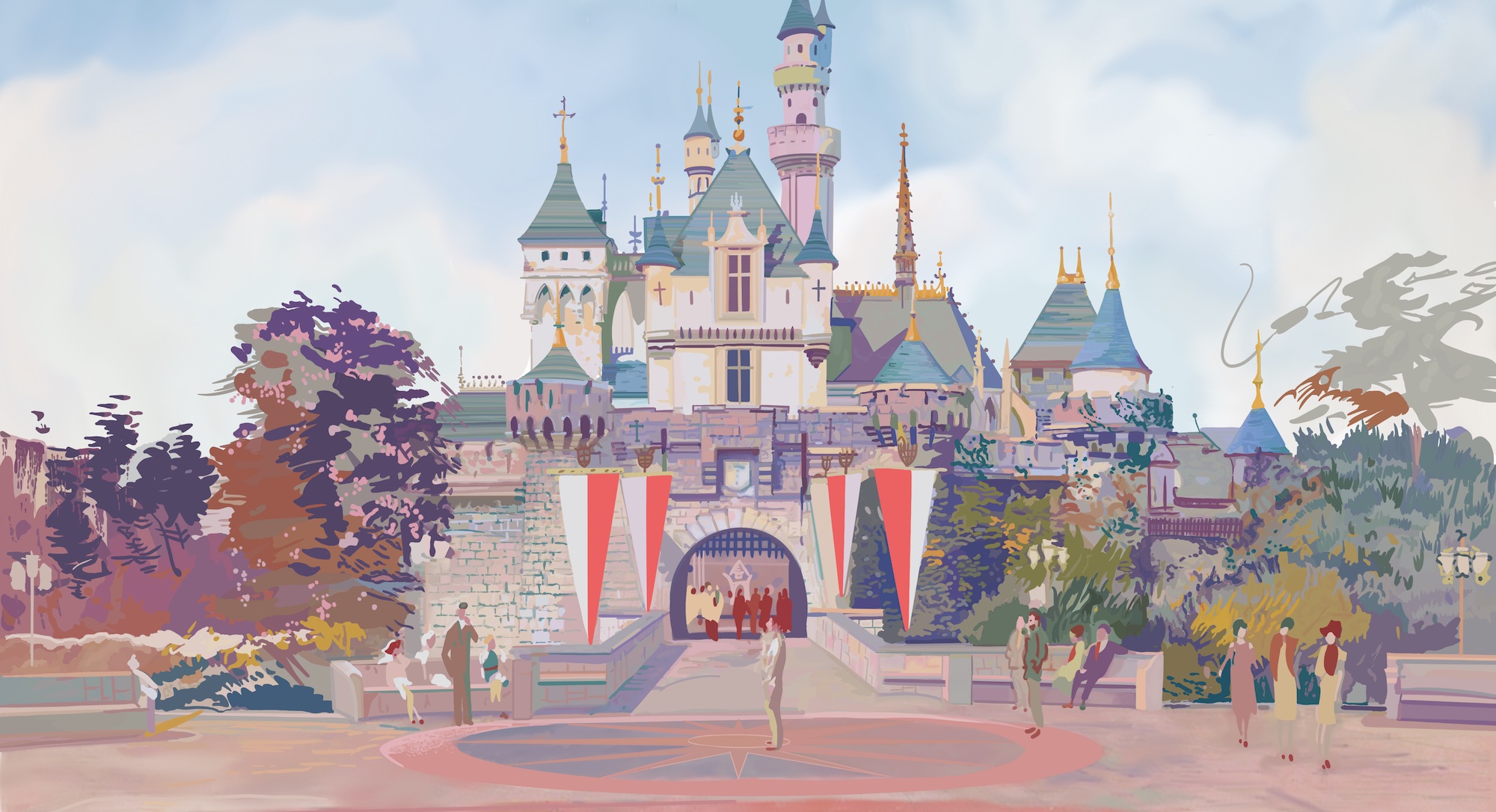
Even the first draft site plan prepared for Disney by the French community planning firm PBA, Inc. (above) notably included a second theme park. That’s informative to our purposes today because from the beginning, a second gate in Paris wasn’t just nice; it was necessary. As spelled out in the Master Agreement, “Phase II” of the resort (30,000 additional hotel rooms, a “water recreation area,” a second golf course, “residential and commercial development,” and of course, a second theme park) was a contractual obligation, required to be operational within ten years of the property’s initial opening – ultimately, 2002.
That wouldn’t be a problem, of course, given that Disney Imagineers were already underway in finalizing concepts for the resort’s second gate, set to open in 1995.
The Disney-MGM Studios Europe

In 1989 – bolstered by the immediate success of the Disney-MGM Studios in Orlando and certain that the under-construction Disneyland Paris would be a triumph – a French follow-up was de facto announced when Michael Eisner told the LA Times:
“In addition to the already opened television and motion picture animation company in France, employing 100 artists, we are excited at the prospect of bringing additional full-scale movie and television production to Europe while providing guests with the entertainment magic of a second Disney theme park.”

Just as Imagineers had redesigned Disneyland classics to appeal to European audiences in Euro Disneyland, the Disney-MGM Studios sketched out for Europe would be tailor-made for the continent.
The development of Euro Disneyland itself had been greatly informed by evaluation suggesting that while French citizens largely saw Disney as an embodiment of American commercialism at best and a “cultural Chernobyl” at worst, European visitors to the existing Walt Disney World responded positively to certain elements of Americana (hence why all six of Paris’ resort hotels were themed to various regions and time periods in American history). Those findings would likewise inform the contents of the Studio park – not just embodiments of the romantic Hollywood that served as the front half of Florida’s park, but of quintessentially American imagery represented by road trip films, gangster movies, and urban cityscapes, all present in the new park’s plans.
Naturally, the Disney-MGM Studios Europe park would open with a tremendous new take on a park’s “Main Street” – an idealized Hollywood Blvd. that would be located entirely indoors, setting the cinematic stage for a park unlike any Disney had built before… and providing weather-proofing. Under perpetual darkness, the glowing neon avenue would welcome guests before they’d exit into the daylight and stand before the Chinese Theater (above), home to a French version of The Great Movie Ride.

Beyond, the park would come pre-built with attractions that Orlando’s Studio park would only add later – the Honey, I Shrunk the Kids Movie Set Adventure, Special Effects soundstages, the Sci-Fi Dine-In Theater, Superstar Television, Animation exhibitions, and a gangster shootout thrill ride that we can imagine was based on the Dick Tracy Crimestoppers dark ride once planned for Florida.
“Before this year ends,” an Imagineer boasted in a televised 1992 Grand Opening of Euro Disney television special, as a camera pans over a scale model, “ground will be broken for a second theme park – the Disney-MGM Studios – a working motion picture and T.V. production facility that will give visitors the opportunity to experience the world of movie-making and the Golden Age of Hollywood. Opening date? 1995.”
Disney had planned to invest $3 billion in the second gate. Longtime Imagineer (and later, President of Walt Disney Imagineering) Bob Weis recalled in Leslie Iwerks’ 2022 tome The Imagineering Story, “I think Michael and Frank were very excited about the public reception to Disney-MGM Studios [in Florida], and I think that gave them this interest in, does this concept have legs internationally? So that’s when we started looking at it as a possible second park for Japan and as a possible second park for Paris.”

Suffice it to say that when 1995 arrived, there was no Disney-MGM Studios Europe. In fact, not one shovel of soil had been moved. Instead, aspirations for Euro Disneyland were a world away from what Disney had hoped. “The best thing about 1994,” the resort’s CEO Phillipe Bourguignon reported at a financial disclosure press conference, “is that it’s over.” Michael Eisner himself declared to a French magazine that when it came to Euro Disneyland – the project once envisioned as his key legacy marker with the company – “anything is possible today, including closure.”
Concept art, scale models, and blueprints for Paris’ second gate were sealed deep in the Disney vault. There would be no Disney-MGM Studios Europe. There might not even be a Euro Disneyland for long…
« Ô, quelle toile emmêlée nous tissons »

To understand why, you have to recognize that Euro Disney would not be owned by The Walt Disney Company like the resorts in California and Florida. However, it wouldn’t be wholly owned by a third party – like Tokyo Disneyland – either. The legal intricacies of Euro Disneyland’s initial ownership & operation model is complex enough to warrant the analysis of a contract lawyer, but in short, the endeavor would be beholden to the “Master Agreement’s” conditions as embodied by several unique legal entities.
- Euro Disneyland S.C.A. (a “societe en commandite par actions,” the French equivalent of a limited partnership or “LP” in the U.S.) – The resort’s owner. Equity in this French corporate entity would be held 49% by The Walt Disney Company through a separate EDL Holdings shell corporation that assumed liability for its share of the S.C.A.’s debts, and 51% by shareholders represented through several French banks, effectively placing majority ownership and fiscal responsibility for the resort outside of Disney;
- Euro Disneyland S.A. – A wholly owned subsidiary of The Walt Disney Company, and would serve as the resort’s operator, and an umbrella corporation presiding over the S.C.A.;
- Euro Disneyland S.N.C. – A shell company owned 17% by Disney and 83% by a faction of French corporations, existing solely to buy the finished Euro Disney from the S.C.A. and then lease it back, allowing the associated French companies to take advantage of tax write-off benefits from projected losses during the resort’s first years of operation

In short, The Walt Disney Company overseen by Eisner was not the legal owner of Euro Disney, nor fully, singularly responsible for its trajectory. Instead, the majority-shareholder-owned S.C.A. – heavily leveraged by €1.75 billion in bank loans and a further €1.75 billion in convertible bonds provided by Disney – took on such a high debt load that the resort teetered perilously into financial risk even before it opened. Even in the best economic and cultural conditions, Euro Disney was a risk…
But once the French resort debuted in April 1992, it quickly became apparent that those economic and cultural conditions had perfectly aligned to set up the property up for financial collapse, leading to a catastrophic cratering of share prices.
The reasons are many, and explored in-depth by true experts on the French resort. It’s well documented, for example, that a sizable segment of the French population had rejected the premise of a Disneyland in Paris outright – the fabled headline that the park was a “cultural Chernobyl” well encapsulated the French media’s assault on the idea such an icon of American consumerism cropping up on the outskirts of the “City of Lights” – tantamount to building a McDonald’s under the Eiffel Tower. That resentment among the public grew to a tidal wave thanks to a series of P.R. snafus, labor disputes, and policy decisions tailor-made to incite France’s legendary capacity for public revolt and protest.

What’s worse, Disney had grossly miscalculated guest behavior, discovering that Europeans didn’t spend on food or merchandise the way that Americans or Japanese had.
Disney was also surprised to find that Europeans didn’t have the inherent reverence and respect of the Disney brand that Americans and Japanese did. Americans tend to understand innately that a Disney Park is an “elevated” experience versus, say, a Six Flags, and requires a different admission fee, expectation, and guest “decorum”. It wasn’t so in Europe, where guests wholly rejected the resort’s elegant, upscale eateries. Those restaurants across the resort uniformly transitioned to pizzerias and burger restaurants, aligning with Europeans’ overall association with amusement parks as frivolous, fatty, places that even a Disneyland couldn’t pull itself out of.
By the way, that lack of inherent reverence was also apparent in guests’ behavior. To this day, the resort is considered one of Disney’s more… well… lawless. It’s not uncommon to see guests climb sets and decor pieces to eke out fireworks viewing. Visitors trample through planters; people openly smoke with no regard for Cast Members; groups cut lines with reckless abandon. At Euro Disney, a cultural maelstrom of languages, attitudes, assumptions, and behaviors from around the continent collide. (Harvard Business School’s Euro Disney: The First 100 Days article read, “Scandinavians appear quite content to wait for rides, whereas some of the southern Europeans seem to have made an Olympic event out of getting to the ticker tape first.”)

But the resort’s most crippling financial ailment rested in the notion that Disney had been an order of magnitude off in its occupancy rate assumptions for the property’s seven(!) on-site hotels, each designed by world-renowned architects at art patron Eisner’s behest. Aside from the plain absurdity that seven hotels could be needed to support a single theme park (Remember, Disney World had only four for its first decade!), Disney quickly discovered that visitors would rather stay in Paris proper than at Disney’s artificial resort dozens of miles outside the city… and more to the point, that visitors largely saw Euro Disneyland as a day trip, not a self-contained, multi-day destination requiring overnight accommodation.
In its first winter season, interest in Euro Disney’s hotels was so low that the resort mothballed the Newport Bay Club (model above) entirely, beginning a seasonal rotation of hotel availability. Across the whole of 1993, Disneyland Paris’ hotel occupancy rate barely crested 50% – an absolutely astonishing and totally unsustainable low.

At the close of the 1993 fiscal year, Euro Disney S.C.A. reported a loss of $921 million.
Euro Disneyland was meant to be Eisner’s legacy project; the blockbuster success that would be a permanent testament to his executive tenure. Instead, the property faced mounting financial losses, rising debt, and doubts about the company’s ability to cover interest payments, much less principal on the billions of euros in debt held by Euro Disney S.C.A.
If you had bought $100,000 worth of Euro Disney S.C.A. shares in 1992, by mid-1994, they’d be worth less than $10,000 – a 90% loss. If it was you, would you hold out hope… or cut your losses? So when Eisner said aloud in 1994 that “bankruptcy was on the table,” it was a risky gambit, signaling that Disney was willing to pull out of the European resort altogether unless French creditors agreed to lower interest payments and renegotiate loans.
It worked, lighting the way for a restructuring package that was announced in June 1994. (This is when Disney agreed to sell 75 million shares in S.C.A. to Saudi Arabia’s Prince Alwaleed Bin Talal Bin Abdulaziz Al Saud, a billionaire businessman and investor known as the “Arabian Warren Buffett.” As a result, Disney’s ownership stake of Euro Disney S.C.A. was reduced from 49% to 39% – not exactly a show of faith.)

On October 1, 1994, Euro Disney was officially renamed Disneyland Paris – a move that Eisner acknowledged was necessary in his autobiography, Work in Progress. “As Americans, the word ‘Euro’ is believed to mean glamorous or exciting. For Europeans, it turned out to be a term associated with business, currency and commerce. Renaming the park Disneyland Paris was a way of identifying it with one of the most romantic and exciting cities in the world.”
It was at a press conference in fall 1994 that Euro Disney’s CEO Phillipe Bourguignon reported the resort’s financial standing with that declaration that “The best thing about 1994 is that it’s over.” Behind the scenes, Bourguignon was adamant that the “Phase II” obligation in the Master Agreement had been deferred and that the clause requiring a second gate by 2002 was null and void. But a faction within Euro Disney believed that just the contrary, a second gate was perhaps the only thing that could propel Euro Disney into a global, multi-day destination it would need to be to regain its financial footing.
Would a second theme park save Disneyland Paris? Or overextend the already cash-strapped resort? It’s what the French would call a real l’œuf ou la poule – a chicken or egg.

In 1995, Disneyland Paris reported its first ever month, then year, of operating profits (albeit, only because of the restructuring plan’s debt relief, the suspension of interest payments, and Disney’s pausing of management and licensing fees, bolstered by the opening of the Lost Legend: Space Mountain: De la Terre á Lune). But even if Disneyland Paris had taken the first steps toward recovery, fans will tell you that Michael Eisner never really did. The once-bullish CEO famously retreated from his once-grandiose M.O. Regarding plans for an ambitious second gate in California – the Possibilityland: Westcot – Eisner told the LA Times in 1994:
“I don’t even know if there’s going to be Westcot. We’re at a real crossroads. […] We had a very big investment in Europe, and it’s difficult to deal with. This is an equally big investment. I don’t know whether a private company can ever spend this kind of money.”

Newly-petrified by extravagant expenses, Eisner pivoted to an era of low-budget, low-risk projects. By far, though, none was as tragic as the companion park to Disneyland Paris. On September 29, 1999, the announcement was made: Euro Disney S.C.A. would borrow $405 million to help finance the development of a second theme park – Walt Disney Studios – set for a fall 2002 opening. (The renegotiated agreement required a second park by the end of 2002 lest unused land revert back to the government’s control.)
And that’s where our story heads next. Ready to step inside…?
the strangest thing about this whole project to me is the fact that paris didnt attempt to fight or even redesign arendelle so they weren’t left with the worst of the three lands as its lynchpin 2 years after the others opened.
For most people who’ve visited both the consensus seems to be hong kong has the vastly better land while tokyo has the vastly better ride. Then Paris is coming along and getting hong kong’s lesser ride and half of the land it has and nothing from tokyo. I know that guests are overwhelmingly local but still youd think paris would want something unique about their arendelle but instead they seem to be basing the expansion off of half of hong kong’s land.
the whole strategy here just seems so weird
Absolutely true. Even from the earliest artwork of the park’s big expansion, people were zooming in and going, “Wait, it’s only half of Galaxy’s Edge, too?” That artwork has what would typically be the Millennium Falcon Smugglers Run half of the land, but with an X-Wing instead of the Falcon, so it was like, “Okay, so… it’ll be Black Spire Outpost, but with Rise of the Resistance?” I really do this that was their M.O. here the whole time – basically “sampler” versions of the “Living Lands” designed for other parks.
It’s not like the Sliding Sleighs ride in Hong Kong is a masterpiece, but yes, it’s totally nonsensical that Frozen Ever After – Frozen Ever After! – is what awaits at the end of the literal and metaphorical journey for this park. Even when that ride debuted at EPCOT and all the talk was about how Frozen was too new to have a permanent ride in a park (that “mindset” at Disney feels ancient now…) I said that Frozen definitely deserved a ride… it just deserved a better ride than even the best makeover of Maelstrom could produce. And now we see that ride recreated two more times by choice, which is wild… As you said, especially because Tokyo’s exists. I don’t think Disney is at all interested in paying for that (not to mention, OLC probably has a multi-year exclusivity window), but even so, it is somewhat depressing that at the end of this, Walt Disney Studios’ multi-billion-dollar makeover took seven years to result in… (checks notes) Web-Slingers, Flight Force, two flat rides, and Frozen Ever After.
yeah i can accept lesser rides (very very likely that OLC does have an exclusivity clause) but usually id prefer them to be paired with more developed lands. Like HK’s arendelle isnt winning awards for its rides but its arguably the best “land” either Disney or universal has put out in decades just because its absolutely overflowing with everything else that makes a living land
Im concerned these ‘sampler’ lands simply wont be immersive enough. Like HK’s arendelle isnt that big despite how packed it is and its twice the size with you being able to look over the harbour at more land. Pride lands is barely more than a ride with an immersive outdoor queue.
They already tried the “sample disney and if you like it go to a better disney” with original HK and it failed miserably, i hope they dont go that route again
Agreed. In my mind, it’s because the intentional strategy was to get “mini-lands” rather than full copy-pastes from elsewhere. (The early concept art seemed to be signaling that their Galaxy’s Edge would be just the “village” half, but with Rise of the Resistance instead of Smugglers Run.)
Theoretically, when this all sums up in fifty years, that would’ve created “sampler” sized” lands comprised of 1 ride, 1 restaurant, and 1 shop each, so you could cram four, five, or six of those around the lagoon whereas the more sprawling Frozen land in Hong Kong or a full sized Galaxy’s Edge would mean you could only ever amount to having two or three.
Again, I have no reason to know that was the intention, but it’s the only explanation I can come up with to explain why – to your point – they’d build all of that to conceal what’s ultimately a copy of the mediocre boat ride. I think the land itself is phenomenal, but surely even the quality-starved visitors in Paris will get off Frozen Ever After and go “Oh… that’s… that’s it?”