
Aside: The Search for Another World
As the big finale of our Build-Out of Epic Universe, we find ourselves with one final expansion pad to play with – the big one. Again, it’s actually quite rare and thoughtful that this park comes loaded with a “land-sized” expansion pad when few modern parks – especially compact, urban, landlocked ones – are afforded such reserved foresight. Again, it could just be that this land was set aside because the budget to construct something there didn’t make it into Phase I, but the result is the same – we have space to think big!
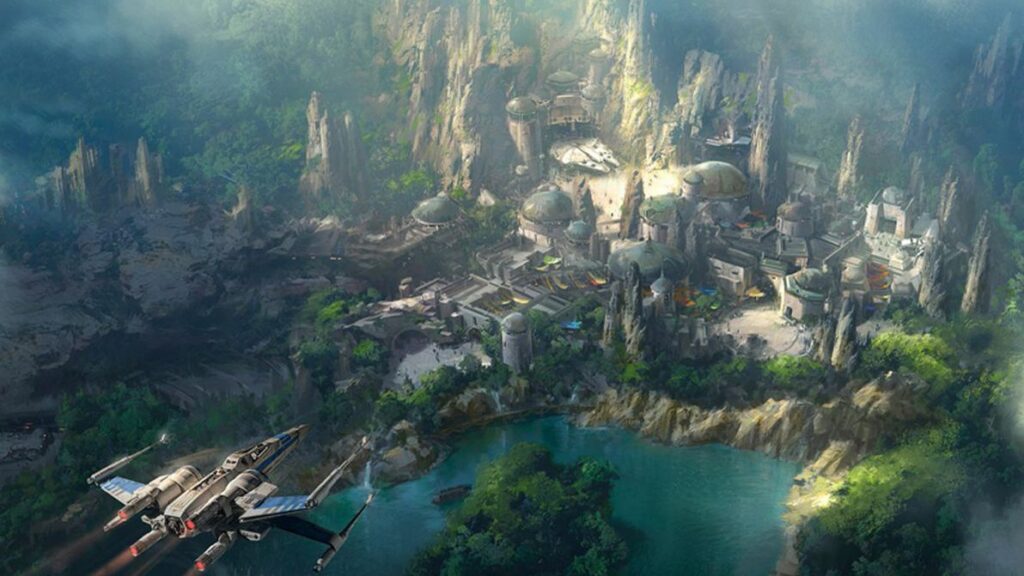
It’s a fairly recent phenomenon that parks have begun to trumpet how many acres their lands fill up, but it’s a helpful metric here for our visioning. On the smaller end, there are projects like Avengers Campus (6 acres) and Diagon Alley (6 acres) and Magic Kingdom’s New Fantasyland (10 acres). On the larger end are Cars Land (12 acres), Hogsmeade (13 acres, albeit it 6 comprised solely of Hagrid’s Motorbike Adventure), and Star Wars: Galaxy’s Edge (at 14 acres). That helps to contextualize that the space left here between the Wizarding World and the Isle of Berk is 17 – 20 acres, which is pretty incredible.
The space does have some drawbacks. For example, it’s very narrow at its entry point (the current dead-end outside of Stardust Racers’ entrance) before expanding substantially into a massive 16 acre bulk plot. In terms of sightlines, it’s also wedged between the ever-visible Stardust Racers and the showbuilding we’ve constructed for the new E-Ticket in the Wizarding World. Given the benefit of a Blue Sky process, we can just assume that we’ll cover those vantage points, but in reality it’s certainly something fans will be persnickety about with whatever ends up here.

Anyway, the real question is to the land’s content – what intellectual property will this be? Luckily, we already have a cued up list of possibilities – our “What’s Left?” look at unclaimed or underutilized IP that’s still out there in the world. Especially given that this space is huge, it really requires an A-List IP.
I already explained that neither Pokémon nor Zelda will factor in here since they are both anchors of my Build-Out of Islands of Adventure. The Wizard of Oz in on the list, but obviously we’ve already applied that to this very park via Wicked. There’s Star Trek, which has been conspicuously absent from theme park conversations (aside from being featured in Universal’s Fan Fest Nights event as a walkthrough). SpongeBob Squarepants doesn’t really fulfill our pre-req for “epic.”
So in my list, at the intersection of “widely popular,” “timeless,” and “epic” reside three things that (coincidentally) all feel cut from the same general cloth of “swords and sorcery” fantasies: Game of Thrones, The Chronicles of Narnia, and Lord of the Rings. All three are fittingly “epic” with sweeping worlds. All three also require that a land embodying them contain multiple locales since no single “locale-as-snapshot” could really capture the “quest” at their cores. I have seen all of the films / TV seasons of these three properties, but I’m not an expert on any of them. So the choice really has to come down to theme-park-ability, popularity, and appeal.
For that reason, I have chosen…
MIDDLE-EARTH: THE REALM OF THE RINGS
Background

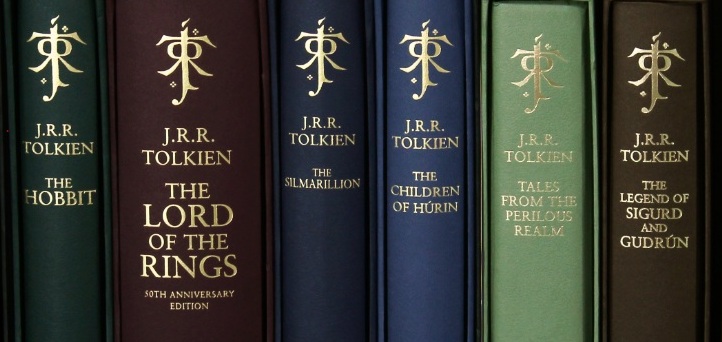
When English author J. R. R. Tolkien published The Hobbit in 1937, he probably wouldn’t have imagined that the “children’s fantasy novel” would grow to be one of the best-selling books of all time – much less that it would spur the creation of one of the most comprehensive, encyclopedic, and beloved fantasy worlds in literature.
Published in 1954 and 1955 after nearly two decades of writing, The Hobbit’s follow-up – The Lord of the Rings – wasn’t a mere children’s book, but a 1,077 page, three-volume literary epic regarded as one of the most influential fantasy books ever written. The Lord of the Rings is the prototypical high fantasy and is singlehandedly responsible for establishing many precedents of the genre: Tolkien’s fictional “Middle-earth” is a world of stunning detail and density, with exhaustive histories of centuries-old places and people, meticulous lore, invented languages, and the now-definitive forms of fantasy races like “elves,” “dwarfs,” and “orcs.”
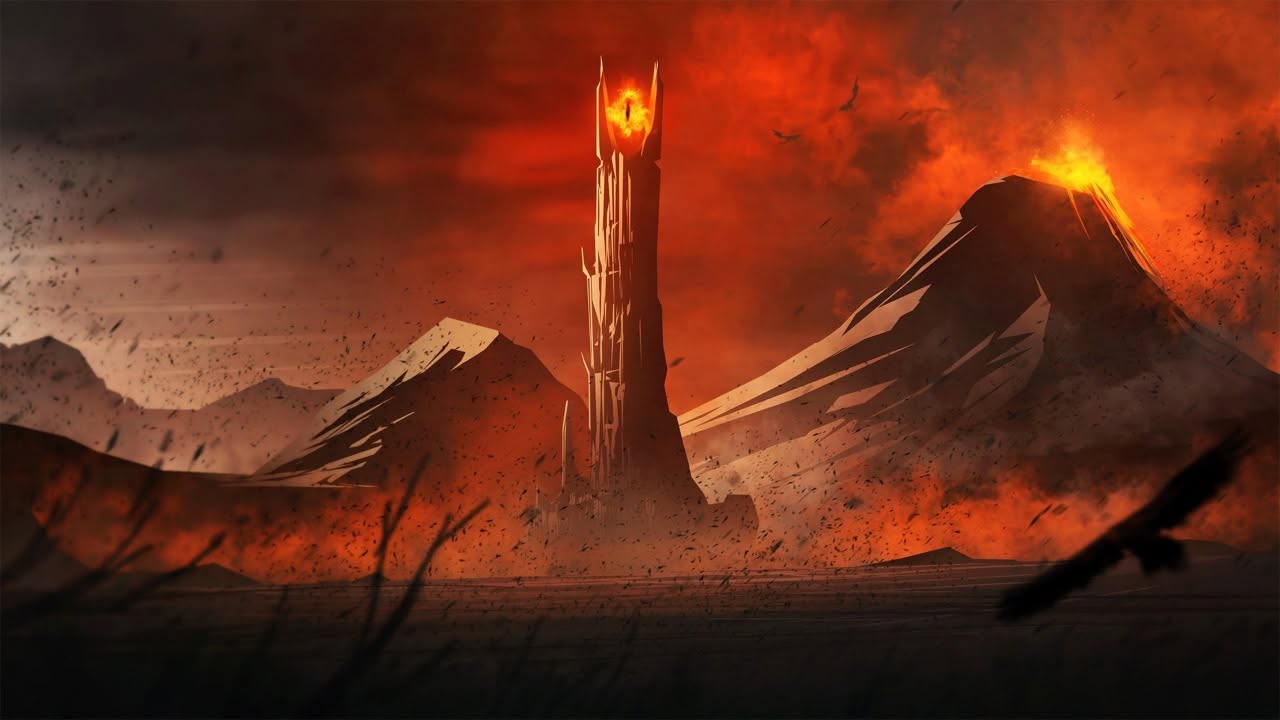
Despite its grandiosity, the universe is made real via the quest of Frodo Baggins (young cousin of The Hobbit‘s titular Bilbo) and his inheritance of the “One Ring” forged in secret by the Dark Lord Sauron. A “lowly” Hobbit bestowed with the corrupting power of a ring granting limitless power, Frodo and his Company must quest across Middle-earth to the evil land of Mordor where the fires of Mount Doom – the Rings’ forge – are the only way to destroy the One Ring and end Sauron’s pursuit of power forever.
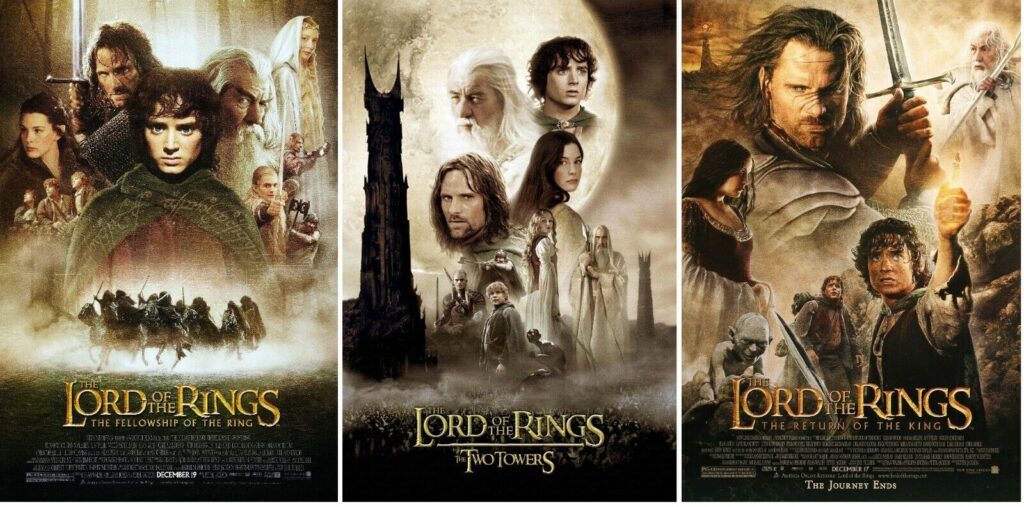
But it was director Peter Jackson’s film adaptation of the three volumes (2001’s The Fellowship of the Ring, 2002’s The Two Towers, and 2003’s The Return of the King) that gave modern audiences the definitive forms of its characters and settings. And with 17 Academy Awards (out of 30 nominations) and a $2.9 billion box office haul, is it really any surprise that Jackson’s The Lord of the Rings is widely regarded as one of the greatest films series ever made? Rarely does a film series translate to the screen (the cast, the production design, the score…) so resoundingly as to make the idea of a reboot or remake a nonstarter.
(That’s less true for the Jackson-helmed Hobbit prequel series that was released from 2012 to 2014, often criticized for its over-reliance on CGI and its insistence that the 300-page children’s novel be expanded to fill a cinematic trilogy by any means necessary. But given that those three films also netted a cumulative $3 billion, you can’t argue with the results.)

Obviously, the success of The Lord of the Rings and its enduring popularity leads to the inevitable question: why hasn’t it become part of a theme park already? One answer is doubtlessly the one we already touched on: that like many literary epics or high fantasies, it’s hard to pin the vast world of Middle-earth into a “theme-park-able” scale. No single locale from the series can ever fully represent it, and even if it could, it would inherently lack the “journey” or “quest” that’s foundational to Tolkien’s world. (Even in my Build-Out of Islands, we discussed that Lord of the Rings is literally a perfect for the park, but to do it any justice would require space far, far greater than Islands can offer; maybe an entire Lord of the Rings theme park!)
The other hurdle to bringing Middle-earth to life in a theme park is that ownership of The Lord of the Rings is… more complicated than you’d imagine. The films were produced by New Line Cinema, which is today a subsidiary of Warner Bros. As a result, New Line is able to make further films (hence, The Hobbit series) and is involved in other filmed adaptations (for example, Amazon Studios’ The Rings of Power series, which is co-produced by New Line, but is explicitly not a continuation of the films per Warner Bros.’ requirement).
But of course, it’s not that simple. Unlike Harry Potter (where Universal and Warner Bros. have the benefit of being able to receive counsel and instantaneous approval from series creator J.K. Rowling), many of the trademarks surrounding The Lord of the Rings are the property of the Tolkien Estate, a legal trust whose executors have assigned many copyrights to subsidiary entities.
Add to that, Tolkien himself sold the stage and merchandising rights to the Lord of the Rings in 1969. That means that the rights to produce some adaptations and nearly all products themed to the property belong to “Middle-earth Enterprises” – today, a subdivision of a Swedish media holding group. Middle-earth Enterprises also owns the copyright to names of characters, places, objects, and even events within the series, as well as the copyright for certain “phrases and sayings” associated with Tolkien’s work.
To give you a sense of just how complicated this is, in 2012 the Tolkien Estate actually sued Middle-earth Enterprises, Warner Bros., and New Line Cinema for producing casino games using the film characters, insisting that Middle-earth Enterprises only had the right to sell “tangible” products (“such as figurines, tableware, stationary items, clothing, and the like”) but had no right to product intangibles or media, such as video games. The suit was settled in 2017, but the point is that at least until The Lord of the Rings enters the public domain (at present, expected to happen in 2050), anything Lord of the Rings requires collaboration between three very large, very unwieldy, and very self-serving, insular entities.
In the mid-2010s, rumors began to suggest that the rights-holders to the series had been spotted touring Disney’s Animal Kingdom with Disney Parks executives… a rumor that was swiftly spun into speculation that Disney was courting Lord of the Rings as a potential land for the park, especially in the midst of a rumored rough patch with James Cameron that fans suspected might derail plans for a then-in-development Avatar-themed land… If that’s true, it at least suggests that the powers that be in Middle-earth are or were at least open to the idea of their blockbuster property being licensed for use in theme parks…
Anyway, the point is that clearly, Lord of the Rings is the answer to “What’s Left?” in a major, A-List, top-tier IP sense. It’s also a property that’s “right-sized” (aka, huge) for Epic Universe’s last expansion pad, and “epic” enough to be a place we need to step through a portal and be transported to. This sort of high fantasy is also conspicuously missing from Epic Universe. To its credit, it’s also easy to imagine that Universal’s existing relationship with Warner Bros. (for Potter) and Peter Jackson (for 2005’s King Kong) could be a major boon to the concept, too.
So with just 17-ish acres to play with, here’s what I drafted as a way to bring at least a representative portion of Middle-earth to Universal Epic Universe…
Build-Out
To start, we need to figure out access and entry here. Remember, the entry to this expansion pad starts out really tight, wedged between the immovable Stardust Racers and backstage roads required to supply Le Goblet Noir. Given my quest to make sure these Build-Outs are at least “reasonable,” neither of those can go anywhere. And it hardly makes sense to build the portal to this world right at the entrance to Stardust Racers only to have it shrink down to its narrowest point soon after.
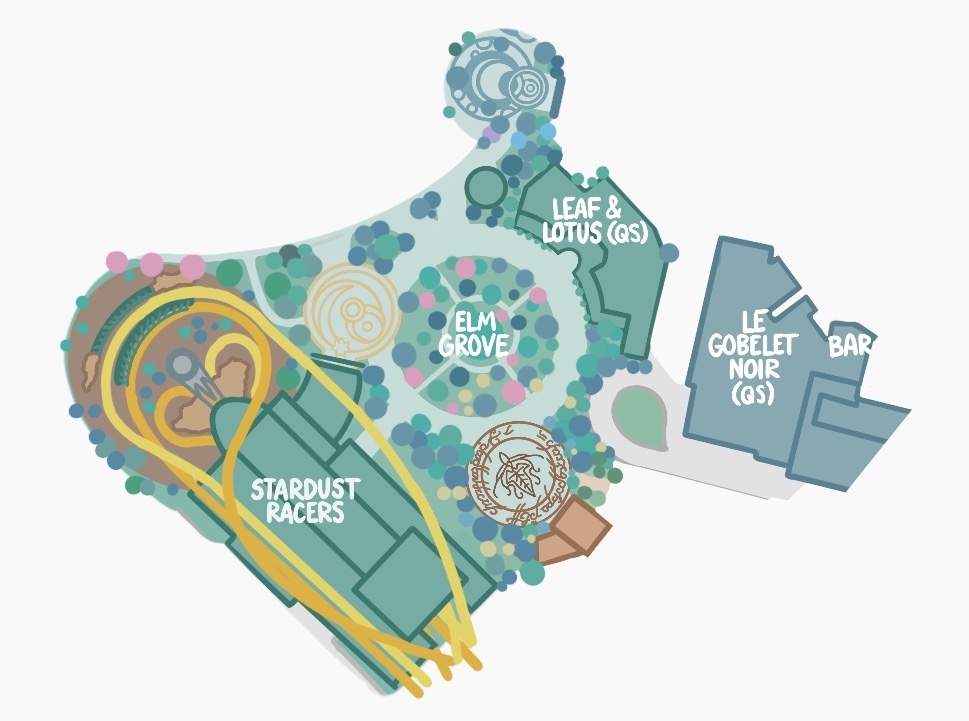
Instead, I want to position the portal at that narrow point so that the world beyond widens. You have even noticed back in Part I that I did that by continuing the circle motif from Celestial Gardens to a new circular plaza outside of Stardust Racers.
While we could put a flat ride here, I actually feel that it gives us an opportunity to provide something Celestial Park needs – ELM GROVE, a “Great Lawn” providing shade, play space, hills, a stage, and a genuine relaxation zone. Anaheim’s Downtown Disney recently added this sort of thing – with small faux hills and a bandstand and lights – and it’s just the greatest place in the evenings as kids roll and play tag and dance while also providing natural, shaded picnic space by day. I also added LEAF & LOTUS, a quick service boba, tea, coffee, and pastries joint well positioned to serve the lawn as a chill-out zone.
Anyway, we’d then pass through an ancient stone portal inscribed with our entry quote for this land:
I found it is the small everyday deeds of ordinary folk
That keep the darkness at bay
With that simple call to action, we arrive in the first of three sub-sections of Middle-Earth…
Hobbiton
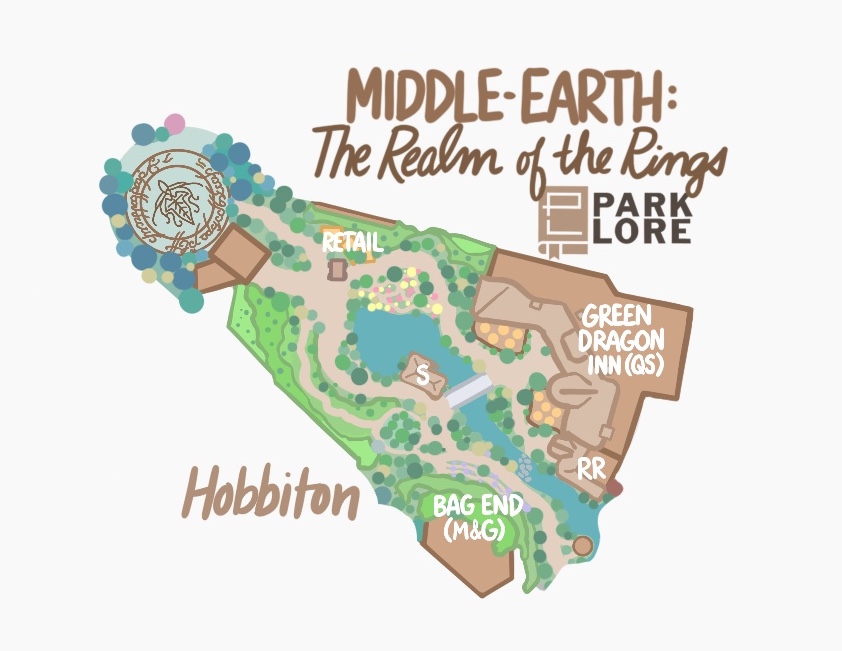
The quaint, comfortable place where so many tales begin: the Shire. The pastoral town of Hobbiton is probably the most instantly-recognizable locale in the Lord of the Rings canon if only because any other locale could just as easily be from Narnia or Game of Thrones or the like.

But Hobbiton – with its little Hobbit homes and circular doors embedded in hillsides is clearly the home of Bilbo and Frodo Baggins. This space is so “iconic” that the on-location sets (from filming in Matamata, New Zealand) are preserved and operated as a guided tour attraction for New Zealand tourists.
For our purposes, beginning in Hobbiton makes sense narratively (again, our warm, green, comfortable place of departure and eventual return) and logistically. Because this is the narrowest part of the land, we never get a “wide-shot” view north or south, so by constructing various layers of Hobbit hills, I think we could actually do a fairly good job of blocking views of the rear of Place Cachée and Stardust Racers.
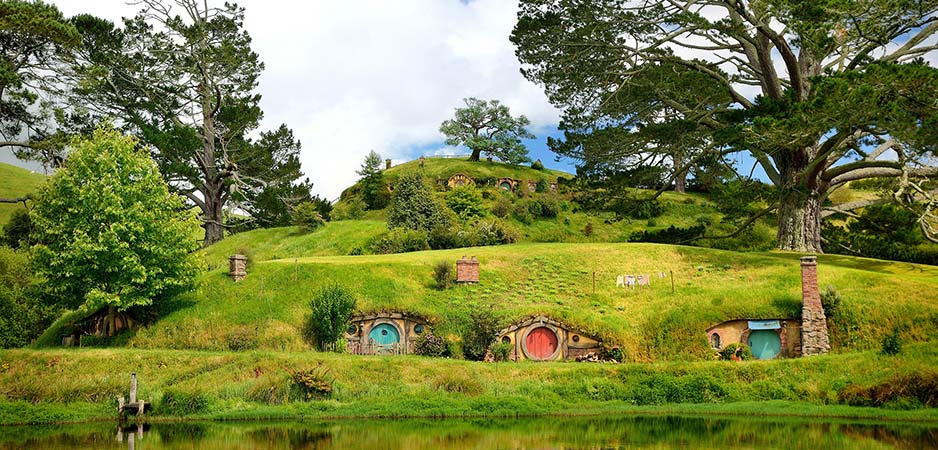
The result is that Hobbiton surrounds us in the nestled hills with paths along hillsides with a placid, reflecting pond and stream splitting right down the center. Retail is provided via HOBBITON MARKET, a covered marketplace where, under fluttering overhead quilts and repurposed banners, parked wagons offer hand-crafted textiles, wooden swords, and other imaginative Hobbit-made products suited for adventure.
The rolling hills and their front gardens serve as photo opportunities for guests, as does a waterfront pollinator garden located across the pond. Further on in the land is BAG END – Bilbo’s own home, here used as a walkthrough experience with an optional meet-and-greet with the harrumphing Hobbit at the tour’s end.

This subsection also offers two comfortable dining locations: the GRISTMILL situated right on the Shire-water is a snack location serving the land’s signature Seed Cake bread, while across the stone bridge is THE GREEN DRAGON INN, a quick-service eatery allowing guests to dine on roasted meats, potatoes, sausages, and pies. (This may be unnecessary since Das Stakehaus and Dragon’s Mead Hall both, to some extent, fill this need in the park’s lineup, but I think the allure of dining in the world is the point here, and the Hobbit-stylized menu could have some clever creations to keep guests engaged.)
Obviously, this relatively small, narrow space is just our introduction to the Realm of the Rings; indeed, there’s really no way we could have a Lord of the Rings world without this specific place being our start. Next, we encounter the unignorable truth that we can’t contain the entirety of Middle-earth, so we must choose our next location cleverly so as to display as much of the breadth and depth of the world as possible. So that placid pond leads to a bridge ascending to our next sub-section and the heart of the Realm…
Nintendo luigi’s mansion dark ride
Small portal spot one peice
monsters creature from the black laggon
Potter qwitish coaster
Dragon flight sim
Big spot land of these (lord of the rings ,dnd ,dc, monster verse, or stranger things.
Fantastic build out! Idea after idea here that I really love. The themed flat rides in Celestial Park would add some great kinetic energy, and ditching the 1920s time period in Ministry of Magic makes so much sense. I think the new dark-ride boat-ride in Isle of Berk is exactly what is needed, that would be a top attraction in the park, I’m sure. And the vintage nighttime Mario car ride would probably be my favorite in the park — simple, classic, imagination-inspiring theme park fun!
On the large expansion plot, I would be thrilled with a Lord of the Rings land, as you describe. But I do wonder if there would be some redundancy in the realm of Euro/Medieval (inspired) fantasy between Lord of the Rings, Harry Potter, Isle of Berk, and Dark Universe. Stuff like stone walls, magic, wands, wizards, taverns, dragons…
I agree that expansion plot deserves something “epic.” Setting aside the licensing hurdles, one IP that qualifies, I think, is DC Comics. Like Lord of the Rings, it offers multiple locations that can be featured in sub-areas, to fully exploit the acreage available. Here’s my pitch:
1. A main area that is Gotham (kind of Gotham Times Square), gritty, art deco, with towering buildings, an elevated train or subway, news updates on mega screens, and hustle/bustle. Restaurants (deli, hotdogs, donuts and such at street level, and a multi-room Club 33-like fancy dining on a second level with views down onto the streets).
2. Wayne Manor/Batcave (an amazing queue for a high-speed Batmobile ride).
3. A Coney Island-like sinister-vibe pier amusement park (on a toxic, sewer-fed bubbling swamp) run by the villains with an intentionally decrepit-looking woody roller coaster plus themed flat rides based on Poison Ivy, Harley Quinn, carnival games run by The Riddler, and a Mystic Manor-like funhouse dark ride themed after the Joker. And of course the Hall of Doom would be here, as a restaurant or shop.
4. A Superman ride that you get to by (seemingly) taking a train from Gotham City to Metropolis. This would be like the starship we ride in before arriving at the Star Destroyer in Rise of the Resistance. The pre-show would simulate a high-speed inter-city train ride to Metropolis, where we would disembark in the downtown train station, and then ultimately get into the Superman ride vehicle in the Daily Planet building (which I don’t have a specific idea for but a flying theater like Soarin’ could be great).
5. A lush Themyscira kid’s “challenge course” area would be cool if a transition/travel conceit could be figured out (maybe through a portal from the Hall of Justice). This could be similar to Redwood Creek Challenge Trail but with Amazons/Wonder Woman lore.
You know, considering all the bad reviews Epic Universe has recently been getting, I can’t help but feel like your build-out can greatly benefit Epic Universe by adding more rides to help boost guest capacity and solve reliability problems. It can surely feel like a huge plus to the park!
I don’t think that the ending for Black River is too sappy. In the movie they let him go, so it seems on point. However, I do think that pollution explanation feels a little too forced. That’s my opinion though. Also, do you think the canning factory would disrupt the view and feeling of Curse of the Werewolf and Burning Blade? They’re tucked away in the back of the land, giving off a mysterious feeling.
I would have done one piece which is a big franchise over at universal japan and even in hollywood that dosen’t have any prescene in the orlando parks
Interesting idea. Enthusiasm for One Piece seemed like a big draw at Universal Fan Fest Nights! But I don’t know enough about the IP to consider it here, and I think it’s a tall order to imagine dedicating permanent real estate in a major U.S. theme park to an anime, which is – almost by definition, for better or worse – a relatively niche franchise. In other words, to choose One Piece or something with broad, commercial appeal would be a really interesting artistic endeavor, but theme parks are inherently commercial places designed to appeal to the widest audience possible. I’m not sure even a “mainstream anime” outside of Pokémon reaches that bar.
How fun to see a new Build-Out!!! Was the idea for Chronomica at all inspired by Symbolica in Efteling? I think that trackless ride that has the same beginning and ending, but with multiple middle sections would be pretty cool to see implemented in a US theme park at some point.
LOVED the idea of bringing the Wizarding World land into present day makes so much more sense, especially with the Dolores Umbridge trial being a major event throughout the entire wizarding world.
Any plans to do an EPCOT build-out anytime soon?
Hi Raymond! Yes, Symbolica was definitely top of mind here! Something ethereal and whimsical and otherworldly that’s (at least kinda) plotless and atmospheric, but with great, iconic sights. I think Symbolica would be at that top tier of dark rides if it weren’t for the somewhat weak “interactive games” sections that really take you out of it, but I think if you mixed something like Symbolica with the sort of immersive, moody, almost trippy Eaternalin, you’d end up with something really cool.
I feel like it’s a “no brainer” to advance the Wizarding World to the present, and like I said, I don’t even think you’d need to change much in the land! People expect Paris to be filled with people dressed like the 1920s even in the 2020s. Haha! And I do think it would be powerful to have the whole land chattering about Umbridge’s trial. Like I said in the article, this is somewhat obvious stuff, so my sense would be that Universal Creative was explicitly told that Paris needed to be the 1920s… otherwise, they probably would’ve made that change themselves.
An EPCOT build-out is probably my most frequently asked question on social media. It’s hard to do because the format these take – an overhead map – doesn’t really compute with EPCOT’s pavilions, where I could just draw the park as is and then label the pavilions differently to indicate new things inside of them. Instead, I’ve had a long running project in the background trying to design a new concept park that’s like EPCOT, but if it were built today… So keep an eye out for that…
Thank you so, so much, as always, for reading!
Or, following on to my previous comment, convert the Islands Hyrule to HG Wells England with the Invisible Man and War of the Worlds. Classic Science fiction literature would certainly fits Islands brief.
I think given the rights issues and philosophical issues around Lord of the Rings discussed in the previous comments that makes Realm of the Rings very unlikely, I think a slightly less “Blue-Sky” but more plausible possibility is:
Relabel the Epic land to Hyrule, and the Blue-sky Hyrule at Islands into either Merlinwood 2.0,
or Dungeons & Dragons (which
a. started as a game BOOK fitting Islands literary theme,
b. probably has cleaner copyright ownership than the Tolkien Trokia
c. is Middle-Earth with the serial numbers filed off anyway.
They would both be “High Fantasy” lands centered around quests, but somehow Hyrule feels like a better fit for the open space at Epic (especially with its Nintendo sister) next door, and D&D the tighter space at Islands.
All interesting ideas! I think you’re right that Dungeons & Dragons is a particularly interesting possibility. I don’t play it, but the world is broad, the appeal is there, and it captures that “swords and sorcery” vibe and backs it up with a high-recognition IP.
I think you should at least note that a theme park is probably not something that JRR Tolkien would have approved of if he were around today. His son Christopher was more sensitive to his anti-consumerist wishes in this respect. And the recent surge of low-quality middle-earth adaptations is likely a result of his passing.
I really like theme parks. I think LotR would work great as a theme park. But I also hope it never happens.
This is really great insight. I had never known or considered that aspect of it, but I think it’s a really, really important consideration. I wonder what changes we might make – even to an imaginary, “Blue Sky” concept for Lord of the Rings in a theme park – with this context. I imagine that justification for the film series would center around it being a way to bring this vibrant world and its resonant message and morality to a wider audience, and I would hope that any attempt to bring it to life in a theme park could be centered on the same themes. I’m glad you brought this up for all of us to consider!
I speculate part of the reason Lost Continent was never turned into an LotR park over the decades is because of Christopher’s higher-bar for licensing approval. He famously was not pleased with Peter Jackson’s films, believing they reduced his father’s work to action film fodder and flattened its thematic and philosophical depth.
This pissed off some of the fans who pointed out how many millions of people were exposed to the books for the first time because of the films, souring them against Christopher as an out of touch elitist. But he had a point. And only a few years removed from his depth, we have a terrible animated film that actively defaced its original story, a mediocre Amazon Prime show, and Animal Crossing with hobbits.
Also, I hope I did not come off as rude to you. I later realized that was my first comment on your site, despite having read hours worth of your work and enjoying it immensely, especially your build-outs of existing parks. I’d love to see an opinion piece from you on what, if anything, you think the Astro-Blasters refurbishment in WDW means for Tomorrowland’s future.
Cheers!
Great buildout!! Not sure, but is the final conclusion (and final total buildout) missing. The article ends for me after the Lothlorien chapter.
Thank you so much! I’m really excited about it. As a Member, you caught it in an early “sneak peek” preview form, but a conclusion has now been added! Hahha. Thanks for reading!