Change sucks. That feeling is existential, isn’t it? It’s true across time, across space, and across fandoms. Nostalgia isn’t just natural; it’s a component of well-being. We all experience a sentimental longing for the past; a wistful affection for “the good ole days” over the here-and-now; an unshakable belief in a self-told story of the ways things were.
It’s uniquely human to envision that when you were at your prime, the world was, too. There are countless psychological theories to explain why we experience nostalgia, but the way it manifests is fairly straightforward: in a nutshell, we’re happy for Hilary Duff and her new album, but when we go to the concert, we want to hear “Come Clean.”
Luckily for myself and my fellow Millennials, nostalgia has never been more “now.” It seems at times that the entire world – and certainly, the entire entertainment industry – has reorganized itself to please us (or, more cynically, to extract every dollar of our “double-income-no-kids” lifestyle) by reflecting echoes of what we used to love back to us. Loved The Little Mermaid? Live action remake! Played Final Fantasy X? We “HD remastered” it! Miss Sonic the Hedgehog? Here he is, in exactly the form that makes you most comfortable! He-Man? He’s back, baby!
TV series revivals! Legacy sequels! Adult cartoons! Boozy milkshakes! “You know that thing you loved in the ’90s and 2000s? Buy it all over again, with interest!” Nobody wants change, and to make matters worse, the world seems to be on our side of the fight right now; actively trying to keep us from having to consume anything new.
Which is a whole lot of words to say that unfortunately for me, Busch Gardens Williamsburg has burst my protective bubble, and god damn it, I wish they’d just left me – and by extension, my favorite roller coaster, Verbolten – alone. But the May 30, 2026 opening of “Verbolten: Forbidden Turn” has arrived, and I have a list of things that Busch Gardens will either need to address, or I’ll need to get over… I wonder which it’ll be.
The Big Bad Origin
There’s a subtle comedy in writing a think piece about how Busch Gardens’ 2012 roller coaster Verbolten ought to have been considered hallowed and unchangeable. After all, it is – quite famously – a ride that many theme park enthusiasts basically blacklisted from the start given it was itself a product of unwanted change.
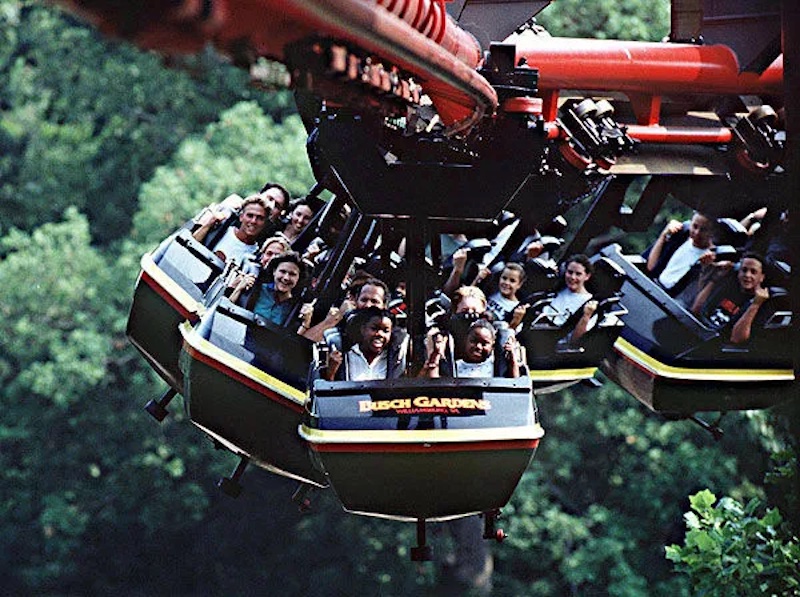
Opened in 1984, the Lost Legend: Big Bad Wolf was a rare Arrow Suspended Coaster, with riders seated in “buckets” hanging from overhead track.
Big Bad Wolf was the first Suspended Coaster that worked. (A prototype opened at Kings Island in Cincinnati in 1981 was a maintenance nightmare, and operated sporadically for just two seasons.) It also leveraged Busch Gardens’ beautifully-forested Virginian location and its “storybook” European theme to phenomenal effect. Riders would be released, swinging, swaying, and slaloming through the forest, banking dramatically on every turn for near-miss interactions with an “abandoned” German village hidden in the woods. The effect was meant to convey that we were the Big Bad Wolf of legend, rampaging through a town as its residents were huddled inside, candles extinguished, in terror.
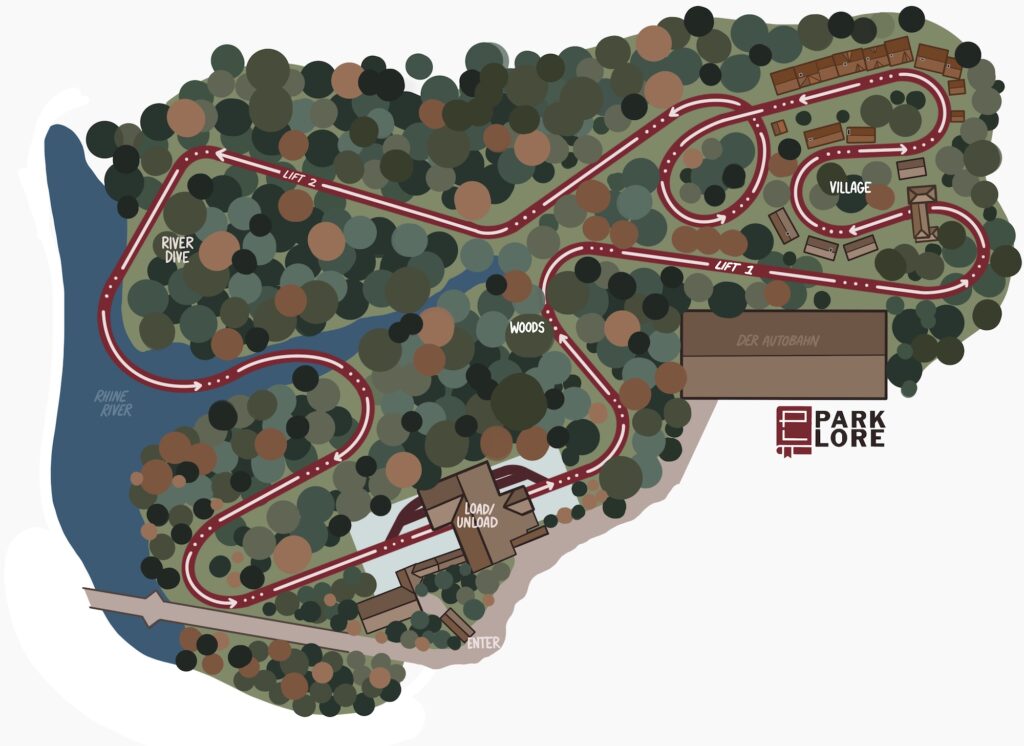
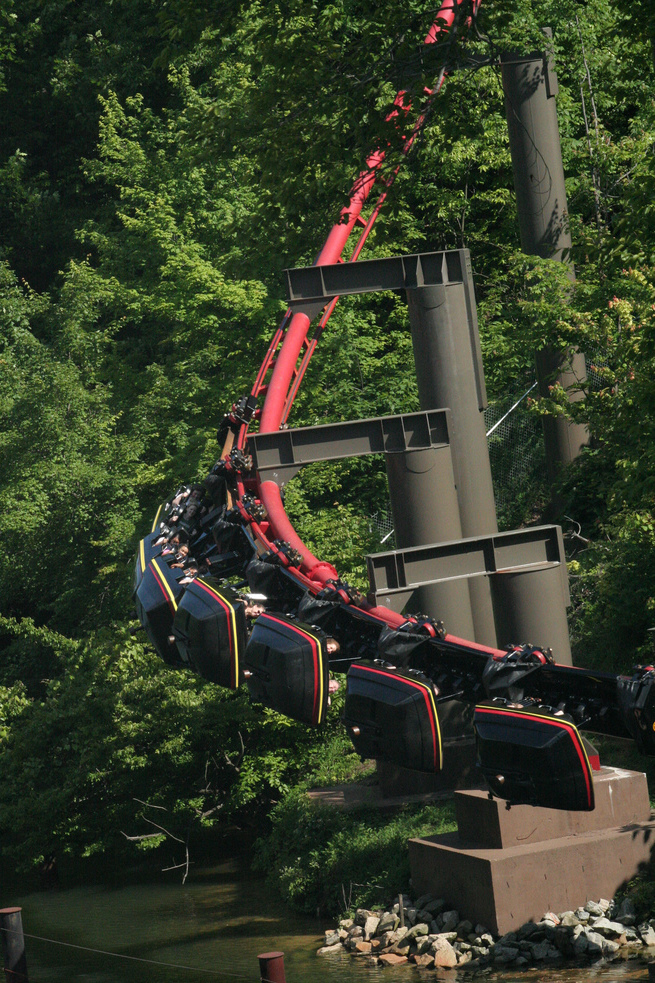
Of course, the Big Bad Wolf’s signature move was really the only bit of the coaster that pedestrian onlookers could see at all: a second lift rising to a treetop, hillside height of 100 feet over the park’s central Rhine River below. Dangling there for only a moment, the Big Bad Wolf would race down a forested 80 foot drop, plunge toward the water, swing out dramatically over the river, and then gallop back into the woods for a tear-jerking, max speed climb back up the hill to the unload area.
The Big Bad Wolf was a genuine legend, and it’s impossible to overstate just how many of the 30 million riders across its 25 year life cite the Wolf as their first “big” coaster; the one that saw them graduate from kiddie rides by providing that first hit of coaster adrenaline. The Big Bad Wolf was – like the character its named for – mysterious and frightening, dwelling “out there” in the woods and manifesting visibly only as a very big drop toward the water. And twenty five years is long enough that those who first experienced the ride as kids themselves later got to bring their children… a truly intergenerational milestone ride for the region.

In 2009, Busch Gardens announced that the Big Bad Wolf had reached the functional end of its “serviceable life.” In other words, parts for the increasingly-rare ride model constructed by a long-defunct manufacturer were difficult to find, and maintenance costs for the ride had grown past its sustainable usefulness. It was a cold sort of calculation, (especially considering that today, the five remaining Suspended Coasters are all older than 25 years, with Cedar Point’s forty year-old Iron Dragon leading the pack at 39).
Despite mournful howls, the Big Bad Wolf closed September 7, 2009. In hopes of providing comfort, Busch Gardens had announced that they were already drafting plans to use the space for a new attraction, but many loyalists had made up their mind: nothing could live up to the Big Bad Wolf, and whatever they built in its hallowed woods was as good as cursed. How dare a new attraction stand where it had stood? And how much hubris could the park have to envision recapturing that perfect lightning-in-a-bottle, “first big coaster” recipe a second time?
Brave the Black Forest

In 2011, Busch Gardens began to poll guests on a potential name for its long-awaited replacement for the Big Bad Wolf. In its long-kept tradition of offering two terrible names (in this case, “Autobahn Express” and “Black Forest Turbo”) and a single option that’s so clearly destined to win that they’d already filed the paperwork and gotten a sculptor working on the sign, it was obvious that the in-development coaster would ultimately be named “Verbolten” – a play on the German word for “forbidden” (verboten) with the injection of an l emphasizing speed and making the design trademark-able.
That was confirmed when Verbolten was officially announced that fall. To be clear, fans (led by the intrepid and thoughtful bgwfans.com) had already uncovered publicly-filed plans for the attraction, with three substantial discoveries confirmed:
- Verbolten’s layout would be partially contained within a showbuilding, cleverly hidden from pedestrian view (thus, a “surprise” in its own right);
- The ride would contain a first-in-the-nation ride element that would make it a historically notable coaster, even if it still slid into the “family coaster” scale of its predecessor;
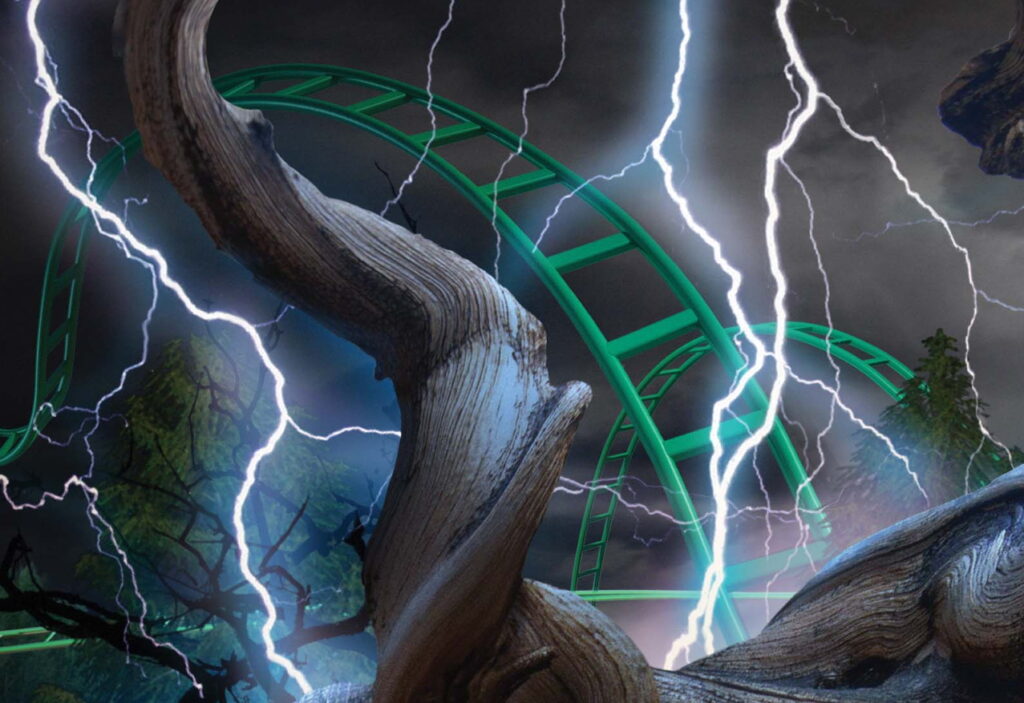
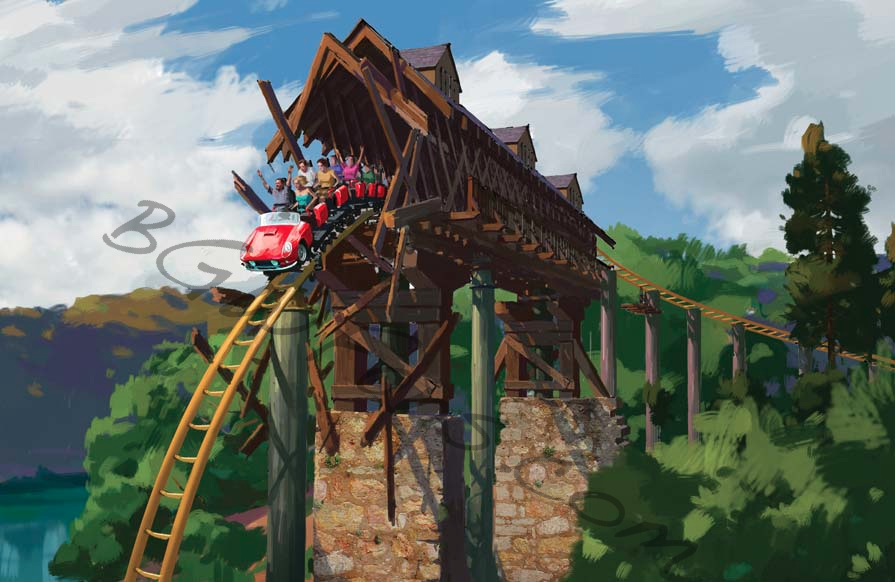
- Verbolten would quite literally recreate the iconic “river dive” finale of the Big Bad Wolf – now recast as plunging from a dilapidated covered bridge, above – even re-using its (reinforced) footings to literally follow in its concrete footsteps;
While those may have been intriguing propositions, progress is made of equal parts hope and fear. And frankly, Verbolten also charted into unknown narrative territory for the park. Busch Gardens Williamsburg had, for many years, been subtitled “The Old Country,” emphasizing the culture and cuisine of old world Europe in its storybook-scaled “hamlets.”
Even the growth of its steel coaster lineup set those rides down in lovely settings, sort of insinuating that each was an experiential, abstract embodiment of a mythic creature – be it Scotland’s Loch Ness Monster (arrow double looper), Italy’s Apollo’s Chariot (a B&M hypercoaster), Germany’s Alpengeist (B&M invert), France’s Griffon (a B&M dive coaster), and even the Big Bad Wolf itself.
Verbolten would change that. Rather than something abstract and timelessly emotional, Verbolten would be concrete and contemporary; a “story coaster” presumably set in present day, placing riders in little German roadsters for a high octane race through the Black Forest. That’s a huge divergence from precedent, and for Big Bad Wolf loyalists, another knock against the would-be replacement.
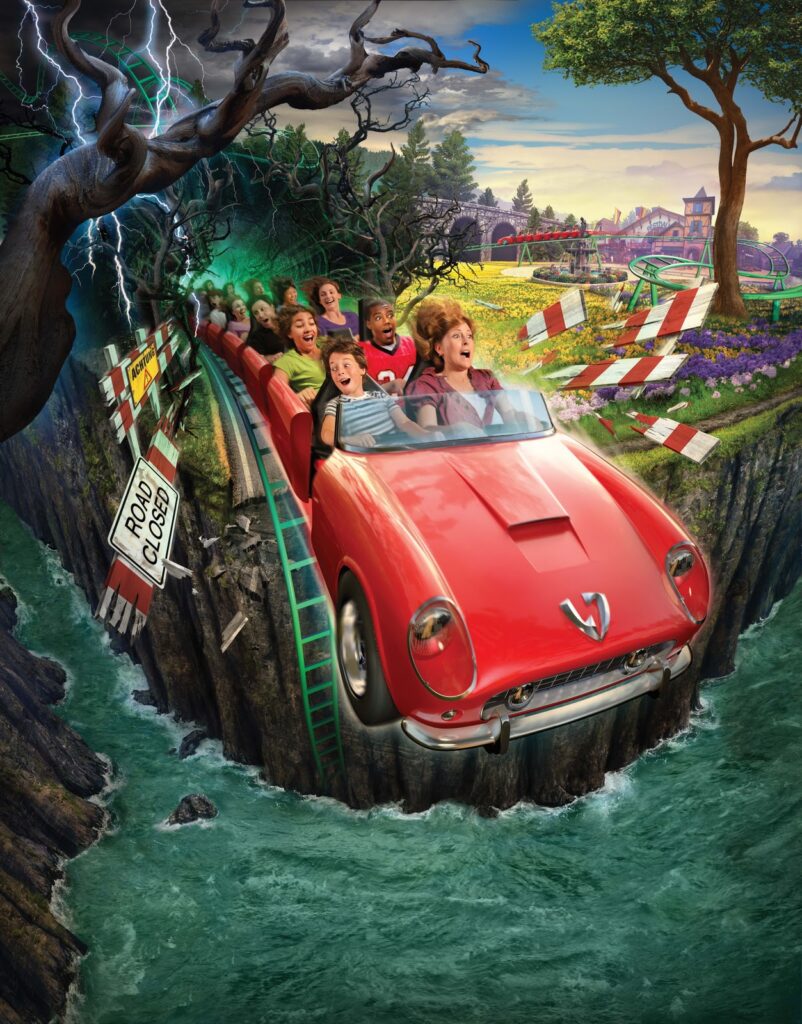
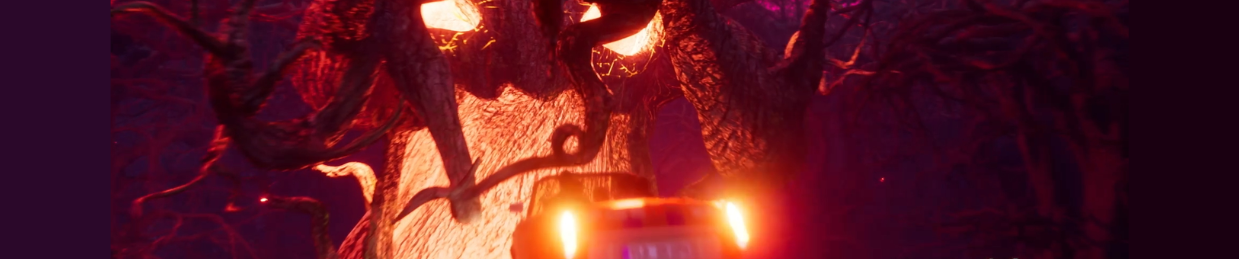
As promotional material was unveiled, it became clear that even if Verbolten would technically (and sometimes literally) chart the same “family-oriented” course as Big Bad Wolf, it also wouldn’t be afraid to tip into the darker and more dramatic. Indeed, Verbolten would recontextualize Germany’s very real Black Forest (actually a sort of idyllic-if-enchanted natural region where many of the Grimm brothers’ fairytales are set) into a malevolent, dark, sinister place filled with snarling vines, mystical spirits, and moonlight – tonally aligning with the park’s nearby dark ride and Lost Legend: Curse of DarKastle.
So again, it’s admittedly a little silly to act like the “original” Verbolten was somehow sacrosanct or timeless or universally beloved. Even in theory, it was a divisive replacement for the Big Bad Wolf that some number of Busch Gardens loyalists spent at least a a few days, weeks, months, or even seasons boycotting based on its unlucky role as a follow-up to a legendary coaster felled before its time…
But I’m asking you to take the ride with me as we zoom into some of the details and lore behind Verbolten… and the ways in which its 2026 “reimagining” is… maybe a step backwards?
The Case for Verbolten
Okay, join me now in 2012. While you may know the secrets of Verbolten, it’s likely that your travel companions don’t. So it’s worth setting the stage for them in the right way: approaching the park’s Germany in a roundabout way, trekking through Italy and across the elevated Ponte del Accordo bridge lofted high over the Rhine River. That’s where you’ll get Verbolten’s signature shot (and indeed, like its predecessor, really the only visible evidence of that coaster set back in the Black Forest).
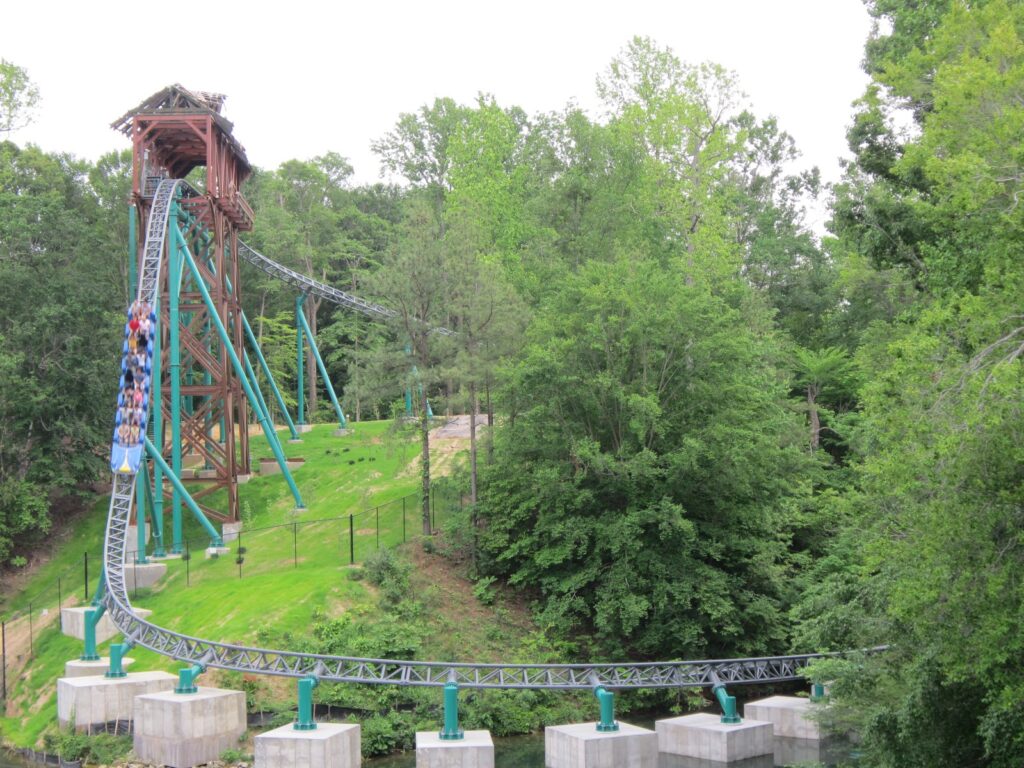
If you’d visited the park in the past, this iconic river dive finale will look familiar… but with a change. While the Big Bad Wolf lumbered up a lift hill, riding out of the trees to dangle atop the final drop, the autobahn-style cars of Verbolten come tearing out of the woods, racing up a twisting incline to reach the decaying covered bridge that plays a role in the ride’s story, dipping toward the water before disappearing back into the tree line…
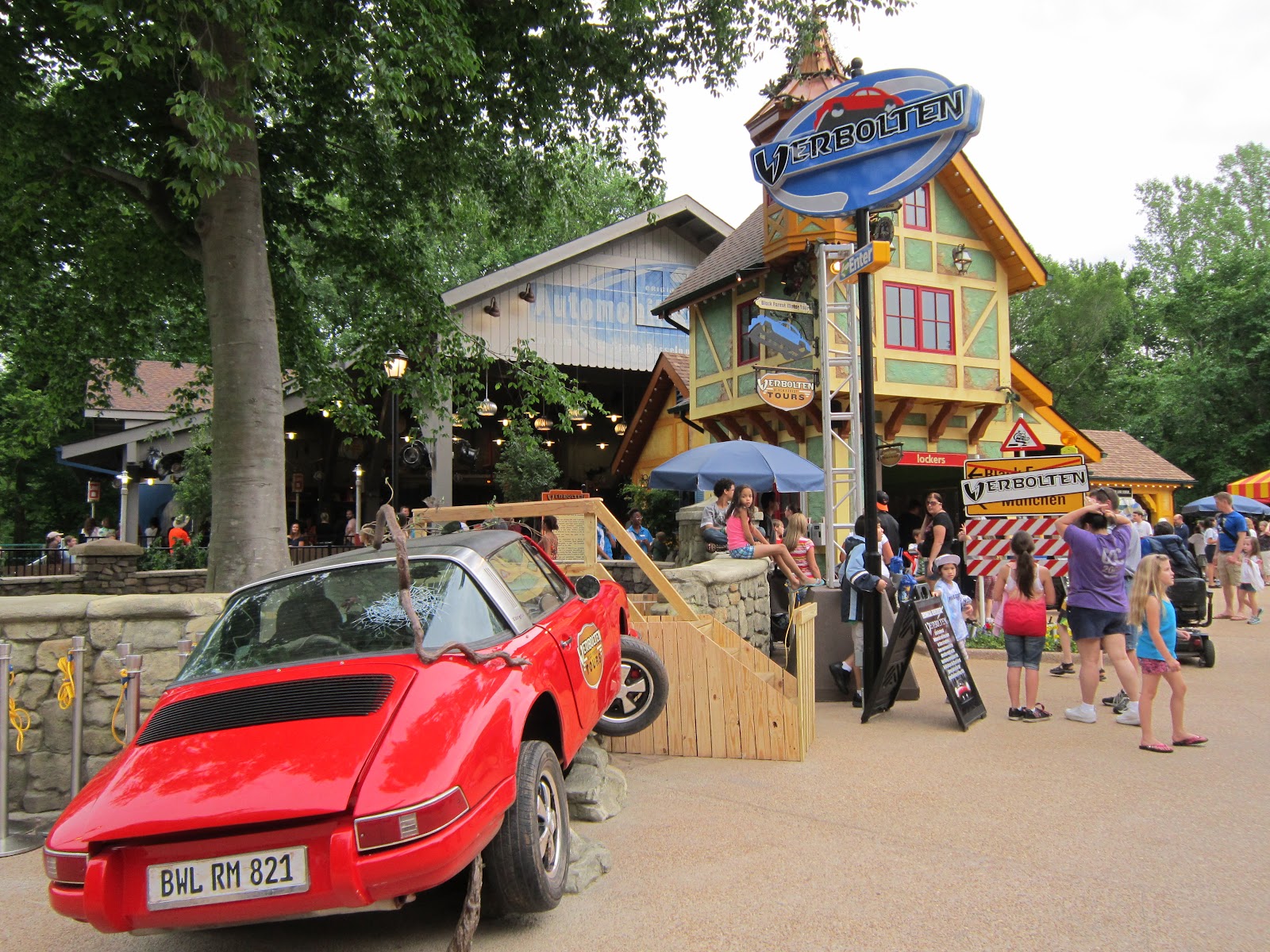
Once we’re back on solid ground in Germany our first view on the left is the Big Bad Wolf’s queue house and station on the slope of the hill, up against the unknown of the forest. It’s been salvaged, but now, it’s drawn into a story that we’ll be a part of. This, we’re told through signage, is the Tourist Center of Gerta & Gunter’s Tours and Rentals – our go-to spot for renting cars that’ll whisk us out of the hustle and bustle of Oktoberfest and into the placid tranquility of the German countryside.
As for that wrecked car out front, smoking and rumbling as vines ensnare it? Don’t worry about that! The lovely garden queue leads into the hillside queue house – now dressed as the Tour Center. It’s filled with posters advertising destinations across Germany; shelves filled with gnomes, guide books, and other trinkets, and a sort of “video pre-show” provided by the lederhosen-wearing Gerta.
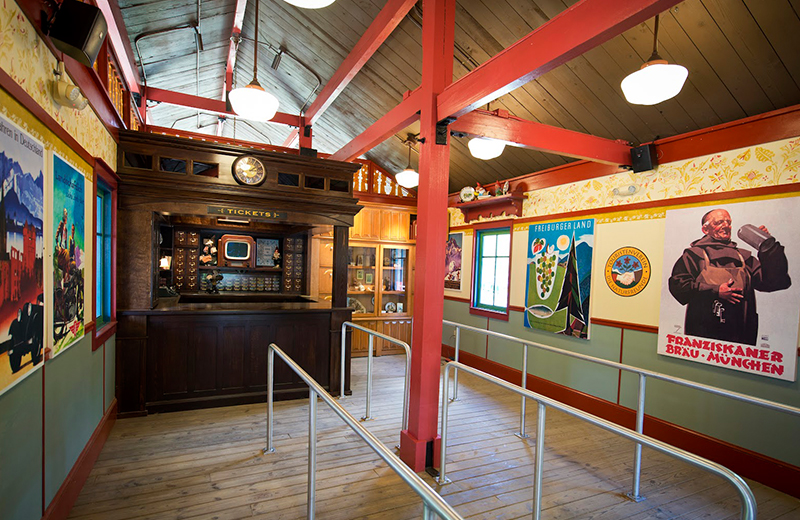
The long and short is that Gerta can’t join us (she’s busy at Oktoberfest) but encourages us to enjoy our motor tour of the countryside… with one exception. Whatever we do, we should not approach the legendary Black Forest – it is strictly verboten. We’re best to avoid the old stone wall that holds the forest at bay because if we become ensnared in its sinister vines, escape is unlikely and provided via that old covered bridge on the edge of the woods… Luckily, her brother, Gunter, will be the one programming our cars’ routes, and Gunter would never put us in danger…
Of course, that’s a little undercut by our next stop – a shed-turned-makeshift-office for the unseen Gunter, where vials of sprouting seeds suggests that Gerta’s brother has developed a morbid fascination with the Black Forest… and based on the stacks of luggage shoved into every nook and cranny of the space, that perhaps – unbeknownst to his sister – has been using the siblings’ customers as guinea pigs in his experiments…
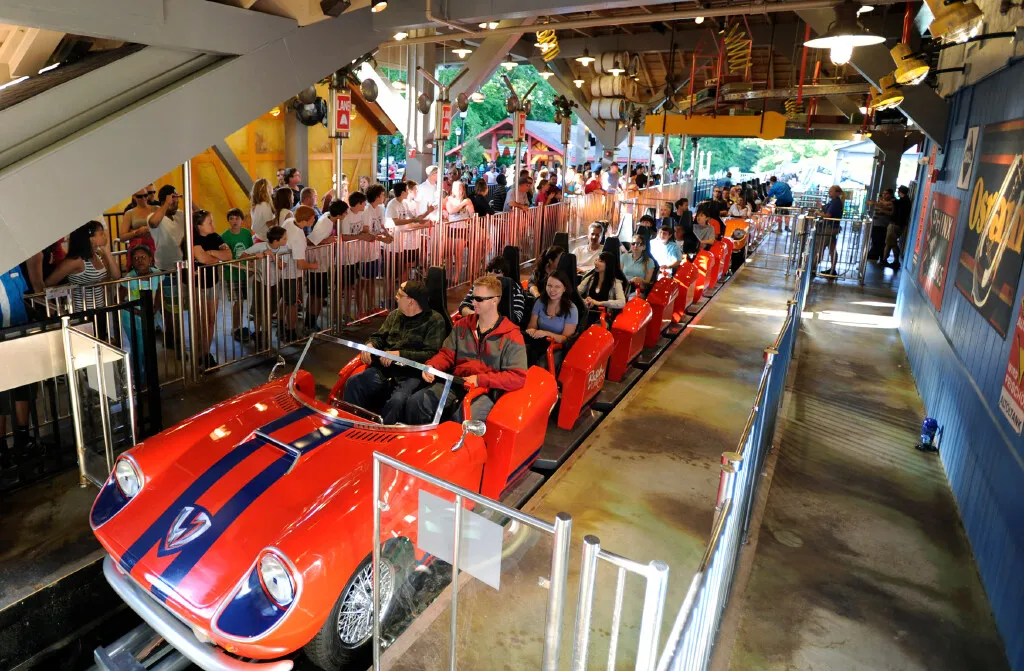
The queue ascends to the open air garage (where once the Big Bad Wolf loaded). Along the ramp, the observent may note that some of Gunter’s vine have broken out of containment, creeping out of the shed and alongside ascending guests…
Anyway, beneath the garage’s roof – under oil cans turned into lane markers – visitors board the ride’s iconic roadsters (complete with real German-made tires and license plates like “BLK 4ST,” YLB DRPN,” and the nostalgia-tinged “WLF XING”. With the green light to go, Gerta’s voice memorably challenges us, ‘Don’t look back, as you Brave the Black Forest…”
I loved the old Verbolten and was lucky to see all of the show scenes. I told everyone who would listen it was one of, if not the best, regional family rollercoasters out there.
I’ve only seen the POVs of the new one, but my first impression was “is this a joke? That can’t be the updated ride.” The climax seemed campy vs the old mysticism and build up of the old scenes. The “Don’t turn right” is a horrible knock off of “don’t go in the shed” when you consider you’re hearing that on Mystic as you’re rolling into the shed; meanwhile you turned right ages ago. It definitely seems like they wanted a “tshirt phrase”, which I am usually a huge fan of but it just doesnt inspire any excitement for me on this ride. Maybe I’ll enjoy it more in person, but most of my first impressions align with what you’ve described here! I appreciate BGW wanting to do QOL updates, but this one seemed like a rush job after the cars didn’t work out for this year.
Exactly right. It’s just so odd to lose the “artful abstraction” for something so campy and caricatured. I’m just so disappointed that restoring this ride was like, the easiest layup ever and they seem to have misunderstood what was so powerful about the original ride to begin with. Again, the fact that people are generally seeming to be really excited about it means maybe I’m just being too critical and need to let go and have fun with it, but I really loved Verbolten. I loved this idea of a “number 0” coaster, meaning it’s not your number one, but something different – a ride that you’re really deeply connected to even if you recognize it’s not “the best.” Verbolten was mine. So it’s particularly sad, I guess. Wahhh. Haha. Thank you for making me feel less crazy.
Is this still better than the change from Journey into Imagination to Journey into Your Imagination? Or about as bad?