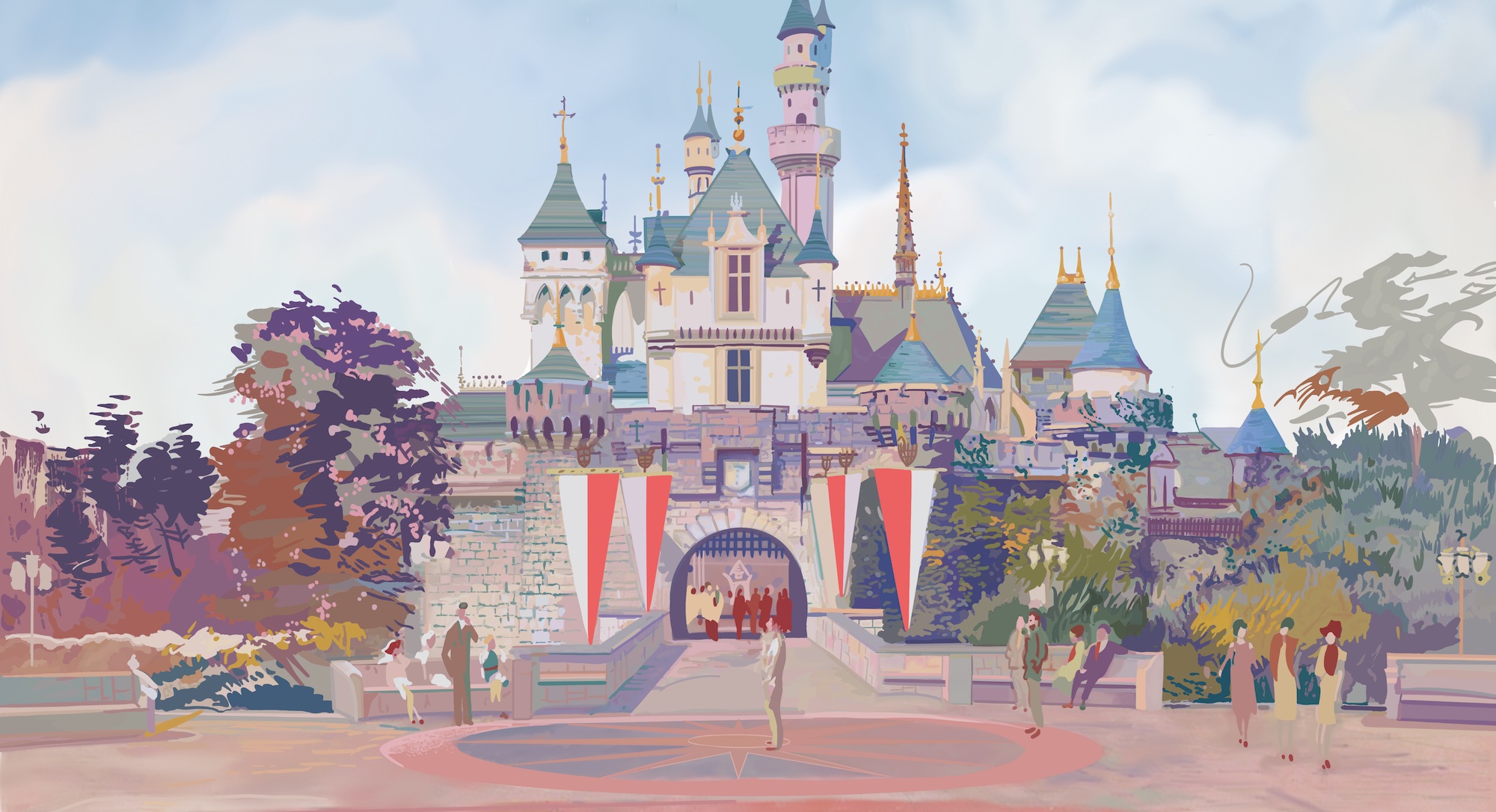


Before: “Studio 1” / “World Premiere”

Already we have done a lot of complaining about the big soundstages that served as the entry to Walt Disney Studios. But it’s also important to note that actually, the set of three large, beige showbuildings with lite architectural ornamentation were arguably among the most successful visual features of the original park (and weirdly, maybe the only vertical structures with any sort of intentional presence given that quite literally every other building in the park was a “warehouse” or “production office”).
For their part, the two flanking buildings on either side (“Studio 2” and “Studio 3”) are each 1,100 person theaters that, in 2002, contained the only two well-loved things in the park’s roster (Cinémagique and Animagique, respectively), whereas the central structure introduced the potentially-clever idea of a fully enclosed “Main Street.” Unfortunately, what existed inside that central “Studio 1” was a product of the same Imagineering age that created Disney’s California Adventure and its brutal “Hollywood Pictures Backlot.”

As a “Main Street,” Studio 1 suffered from the same “cheap and cheerful” mentality that defined the park as a whole – basically, the notion that a “studio”-themed park can turn the experience inside out, relishing in its low-cost rather than trying to conceal it. Unlike Hollywood Studios’ entry land – the immersive Hollywood Blvd., a true love letter to Tinseltown’s heyday – the interior of “Studio 1” was a sort of day-glo, cartoonish, Superstar-Limo style caricature of a Hollywood set.
The buildings along the street weren’t dimensional sculpts, but layered flats; dragged-and-dropped facades of Hollywood storefronts were, of course, false fronts for a hamburger eatery; suspended scrims provided “camera-convincing” backdrops; lighting came not from the streetlamps, but from gelled lighting rigs overhead. The road wasn’t asphalt, but painted concrete, flush with the sidewalks because hey, this wasn’t a real street – it just needs to look like one for the “filming” made evident by permanently-parked directors chairs, microphone booms, and striped studio barricades.

As part of the transformation to Disney Adventure World, Studio 1 became “World Premiere,” peeling away the caricaturization and instead recreating a softer, kinder, more romantic Hollywood street under perpetual night skies.
This is Disney’s forte, right? Cricket noises in the planters, warm bulbs in the streetlights, big band music reverberating… Make no mistake: World Premiere is better, and sweeter, and purpler, and “more Disney” in that it “transports” us to another place (and maybe, time? Or is this a ritzy, modern Hollywood premiere party?). And absolutely, it’s better. But if we’re “armchair Imagineering” and thinking through the underlying philosophies and narratives here, the “World Premiere” frame adds a layer of discordance, too…

Because even if “Studio 1” (above) was indefensibly cheap, it was also instantly comprehensible. We entered under a studio arch, passed through a relatively elegant, palm-lined “Visitors Center” courtyard that most real Hollywood studios have, and then walked into a looming soundstage. Inside of it, we entered a “hot set” of a “street, exterior, night” scene, open to explore.
The implication is that a movie was actually filming here in this soundstage at Walt Disney Studios in Paris, and we just missed ’em as the cast and crew are off filming elsewhere. As we exit out the rear of Studio 1 and into the park proper, we’re entering into the “real, working” production facility that supports this unseen film, where the unsung heroes work in editing, effects, and more. There is no fourth wall. Art imitates life. The time is now and the place is here. “Studio 1” was our invitation behind the camera and into the production. And narratively, that worked! So sure, knock the execution… but that does “flow” as a logical narrative sequence.

As “World Premiere,” we still see that big soundstage, but what’s inside isn’t meant to be thought about as a set, nor even the interior of the soundstage we’re entering! Just the opposite, we’re supposed to suspend our disbelief and agree that we’re actually outdoors, at night, in Hollywood, attending a premiere for a movie. That “illusion” might set in if you linger, but would you? This space is the park’s Main Street, and your incentive is to pass through it quickly and get to park proper.
And since World Premiere is only about 250 feet long (a quarter the length of Main Street), a typical person can pass from end to end in about 57 seconds. And the “exit” is itself a discordant moment! We exit World Premiere by passing under the marquee of the “Disney Theater” as if entering its lobby, but the doors there instead deposit us… outside, in broad daylight, at the base of the Twilight Zone Tower of Terror. That’s… odd, right? Wouldn’t it actually be more logical to wrap the building as the Disney Theater on the exterior, and allow the building’s interior to be an elaborate, plush lobby? It still wouldn’t make sense to exit back into daylight, but the “city in a box” thing is its own kind of awkward.
“Studio 1” was cheaply done, but made sense and succeeded at the (cop-out) thing it was trying to do. “World Premiere” is more luxurious in its execution, but its goal is different, ergo its grading scale is different. So which is better, the version that aspires to little and succeeds by that metric, or the version that aspires to a lot but then falls short?
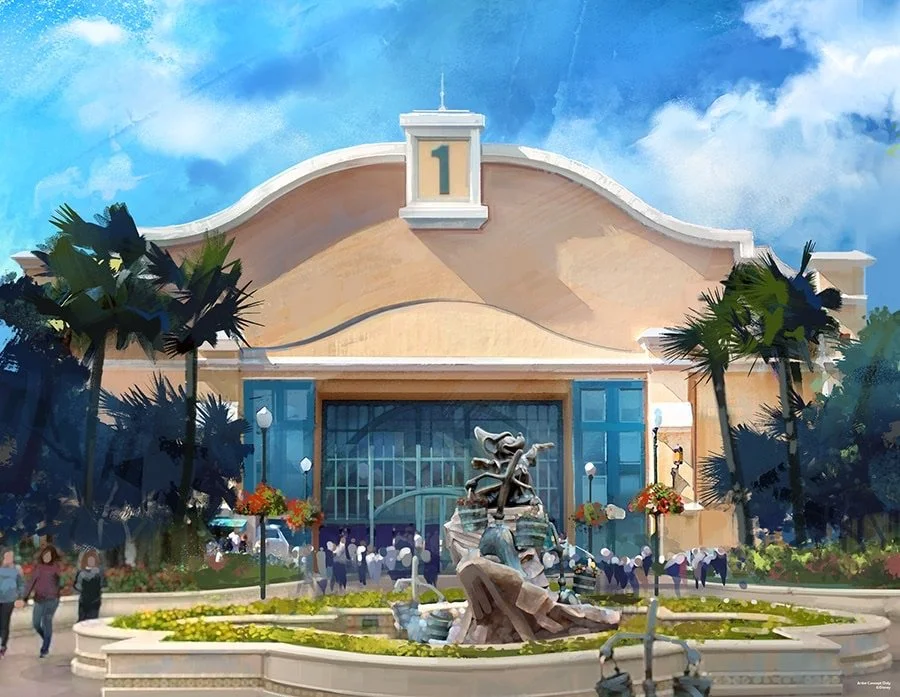
Obviously, “World Premiere” was a needed change and an upgrade in every way that counts, and only those of us who think too much about these spaces would analyze it in the way I have here. But what I think I’m trying to get at is that there’s something fundamentally “off” about this entry sequence no matter which way you frame it. An “indoor set” is logical, but cheap, tacky, and misaligned from the park’s shifting focus. A “real city at night” is very “Disney,” but discordant with the exterior and hamstrung by being wedged into a box that must inevitably dump guests into daylight. With all respect to the Imagineers who did a lot with a little, we can probably all agree that in a perfect world this park could’ve at least had a proper Hollywood Blvd., and at best could’ve used the opportunity inherent in a redo of Studio 1 to drop the “Hollywood” connection from its entry altogether.
But we already agreed that the central soundstage entry needs to stay lest our Build-Out veer into pure fantasy, and it provides for some great weatherproofing besides! So our search becomes one for a perfect fit – one where this big building can be a big building (i.e. the inside and outside match; no more “city inside a box”), but where we’re actually transported to another place and time (i.e. no more “hot set in a soundstage”)… and maybe possibly, drop the “movies!!” frame story at last,
So now, we arrive at my solution: the pivot point that ended my frustrations around this Build-Out and officially gave me the framing I needed…
Prologue: THE GRAND LIBRARY
Disney Parks have a long and storied career of recreating architectural landmarks of Southern California. So as I was looking at that big, cavernous soundstage looming at the entrance of this park, I finally found an excuse to use a landmark I’ve been envisioning for a very long time: the Los Angeles Central Library.
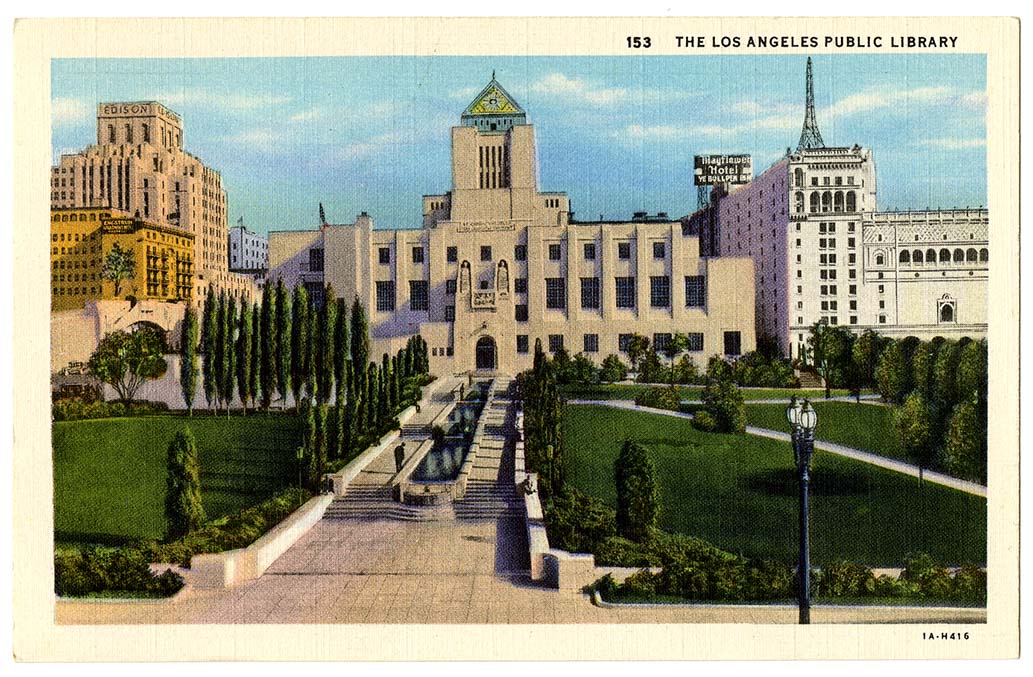

Though it would be difficult to convince anyone of it today, there actually was a time in American history where we as a society invested heavily in public works and social good; when the ultra-wealthy funneled their insatiable taste for admiration and praise into opulent architecture, social benevolence, and public benefit. The Central Library is an icon of that era – born of the same architectural wave that created the Carthay Circle Theater and the Chinese Theater, but older than both!
Designed by architect Bertram Goodhue, the building is something of a fusion of Mediterranean Revival, Spanish Colonial, Art Deco, and Egyptian motifs that so permeated L.A. architecture in the 1920s. (It’s no accident that the “DCA Model” Hollywood Tower Hotel uses a similar “Pueblo Deco” design with Egyptian iron work.) The Library is topped with a mosaic pyramid, each face containing a reflective tile work sun, capped by a hand gripping a fiery torch embodying the “Light of Learning.”
I look at that building and I think to myself: finally. We found a “disguise” for the former “Studio 1” that unshackles this park from not just beige soundstages, but Hollywood. We can actually pry back the entry experience that otherwise seems to require the park to be about “movies!!” and instead root it in something else entirely… As for what that thing is?
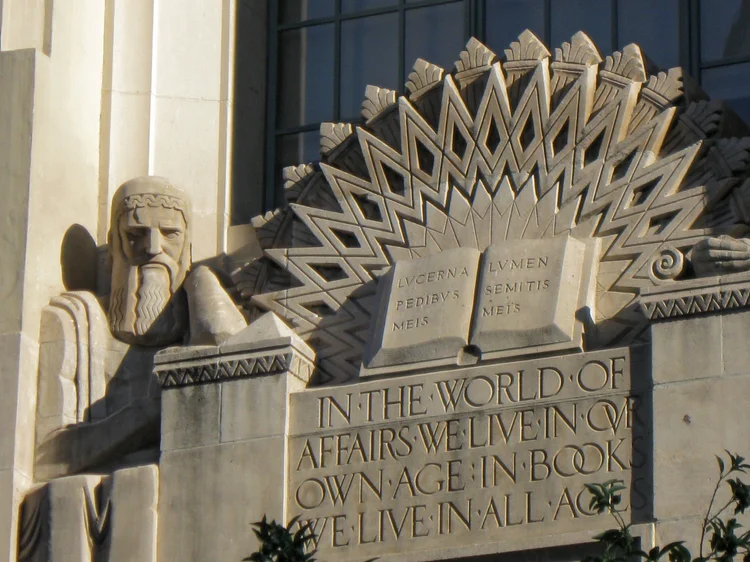
Above the real Library’s doors (and thus, shared with our portal into the Library’s interior) are carved this reborn parks’ equivalent of “Here you leave today…”:
In the world of affairs, we live in our own age. In books, we live in all ages.
Folks… we did it. I’m serious. When I finally fused “Studio 1” with my long-running desire to incorporate the LA Library into a park, everything else fell into place. Because with just that one single “switch,” we reframe this park just slightly enough to give it a capital-t Theme. Before we even step into the new Grand Library, the thesis has been spoken: in books, we live in all ages. Every spine on every shelf of every library is a portal to a new world – and by the way, source material for artists, songwriters, and storytellers who work to draw truth out from the pages.
Don’t you see?! I scream to you, who probably sees just fine. With this framing device, we can keep “The World of Frozen,” recognizing that it is an embodiment of this process; of artists, songwriters, and storytellers drawing from the work of Hans Christian Andersen. I recognize that you might find this flimsy, and that’s fair. But to me as an “armchair Imagineer,” this is revelatory, because it gives us what the real-life Disney Adventure World lacks: a bar-to-entry. Here, we will indeed see “Living Lands,” and yes, they’ll almost exclusively be stylized after Disney’s intellectual property… but every world we enter and every age we occupy will have begun as words printed on paper, glued and bound in a book.
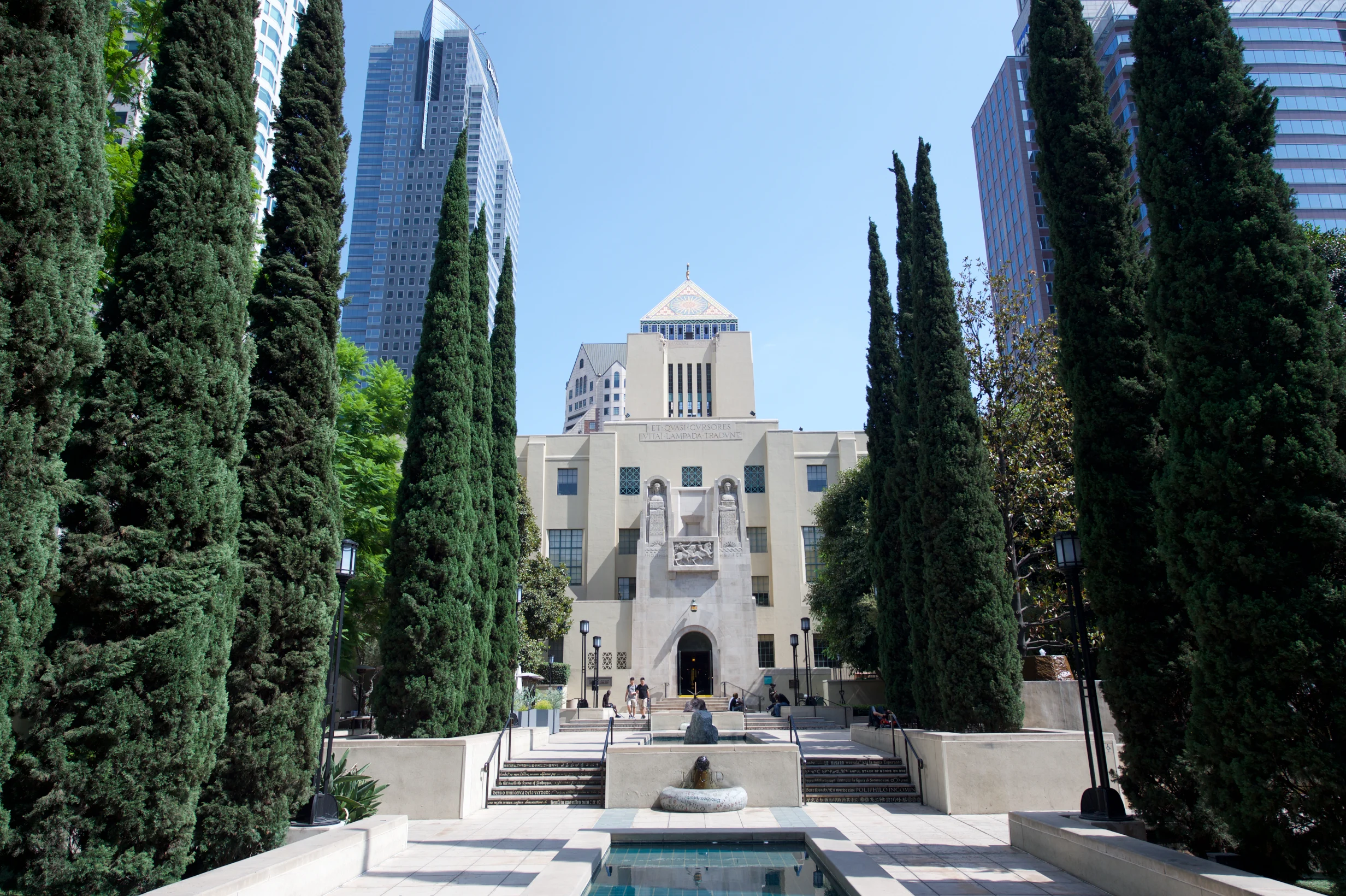
The Grand Library, to me, is a panacea. It solves so much of what ails this park. We end up with a disguise for the big soundstage, sure, but we also have an aesthetic to draw from for the forecourt outside where the park’s Guest Services and ticketing are; this plaza gains the terraced fountains and greenery of the real Library’s exterior, framing this already-central building as something of a park icon! Disneyland has the Castle, and this park has the Library!

And then, of course, it also solves (to some extent) the trouble with wedging a “Main Street” into a box. We resolve the disconnect by letting the building be on the inside what it is on the outside. Now, when we pull back the great brass doors of the Grand Library, there are no narrative hoops to jump through. Indeed, we pass into the ornate and extravagant interior of the Library itself.

Here, the real LA Central Library can certainly provide some proof of concept, even if our “Grand Library” will almost certainly be a work of fiction at the end of the day, exaggerated and romanticized and filled with bookshelves the way we expect Main Street to be filled with incandescence and balloons and popcorn. Still, we can use the real library to build our mood board – of grand lobbies and murals…
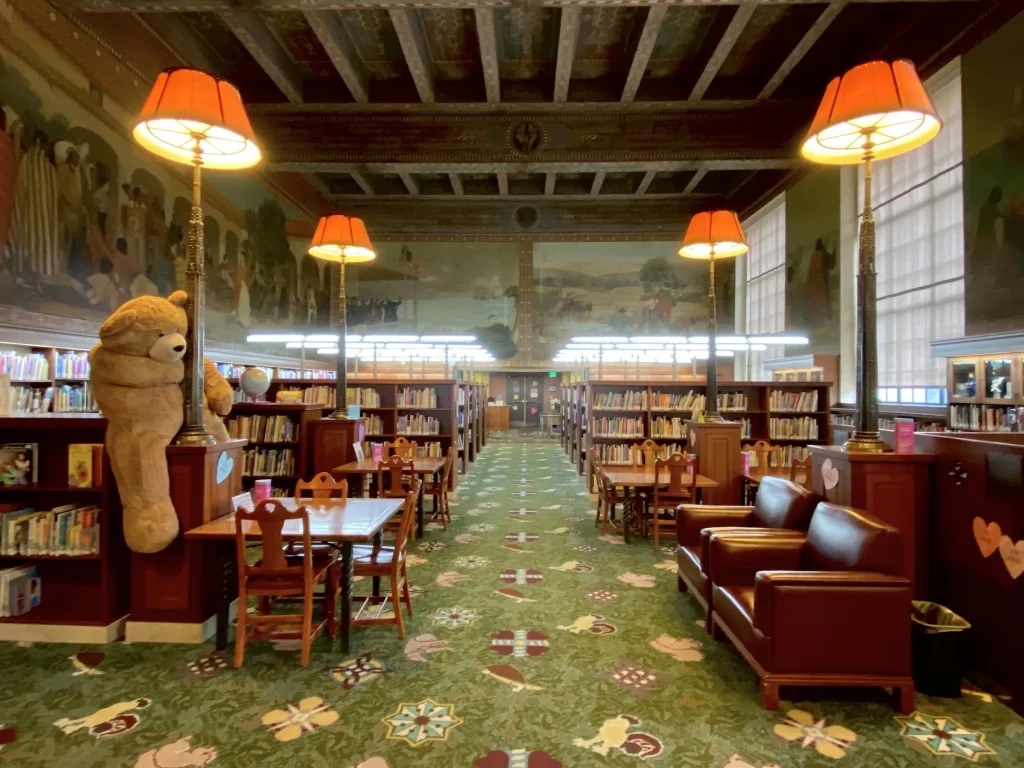
Of a warm and decadent BOOK LOFT table service eatery, with guests dining among the dark wood, soaring lamps, and grand windows…

… And at the center of the library, a recreation of the iconic zodiac chandelier designed for the actual Central Library by sculptor Lee Lawrie.
What this does, I think, is to acknowledge that this park actually doesn’t have a Main Street at all. Instead, it sequesters operational essentials to the plaza outside (Guest Relations, Lost and Found, Ticketing, etc.) and then use that big building for what it’d be good at being: a big building. Not a city inside of a building.

As part of this reorientation, I’ve also attached one of the two adjacent theaters (the southern “Studio Theater,” originally home to Cinémagique) to the Grand Library such that the rechristened ARCHIVES THEATER is accessed only from within the Library’s rotunda. That orients the 1,100 seat venue as a space for live stage shows based on iconic stories that spring to life, or home to jukebox productions like Hong Kong’s “Mickey and the Wondrous Book” as Mickey travels through Disney moments inspired by fairytales.
So now, having been surrounded in books, our course is clear. We will now live in all ages by seeing the ways that Disney storytellers have brought books to life. There will be no Zootopia; no Star Wars; no Avatar. For the first time in a long time, this park is actually About Something, and it might actually be something clever and timeless and good?!
We’ll certainly use that Something to measure each change we make in our Build-Out. But now that we’ve established it, we can also use it to jumpstart a new identity for the park…
“If a studio park is not a studio, what is it?”

In 2015, Disney CEO Bob Iger let slip at a routine shareholder Q&A session that the park then-known as Disney’s Hollywood Studios in Florida would be getting a name change. That made sense. Disney’s Hollywood Studios was unquestionably a stronger park than Walt Disney Studios had ever been, but it suffered from some of the same issues: Hollywood Blvd. and Sunset Blvd. as historic odes to Hollywood; Mickey Ave., Echo Lake, Animation Courtyard, and the Streets of America as vestigial remains of a failed production facility, hampered by drab “studio” aesthetics in a post-Wizarding-World industry…
And at that moment, over the horizon, the park’s obvious future: becoming Disney World’s showcase of “Living Lands” that would skip the behind-the-scenes and instead let guests step into the worlds of Toy Story and Star Wars. Naturally, that leads to the question: If a Studio park is not a studio… what is it?

In 2017, Disney began searching for an answer. A series of surveys sent to guests asked the public to rank several potential rebrands for Disney’s Hollywood Studios. If the question is what a post-studio studio park is, then options like “Disney Beyond Park,” “Disney Legends Park,” and “Disney XL Park” surely demonstrate that Disney’s answer was, “We don’t know, either.” Allegedly, “Disney Cinemagic Park” was the winner in evaluation, but Disney didn’t pull the trigger. Instead, they unveiled a new logo for Hollywood Studios, which reduced the word “Studios” to a modifier so small that it might one day shrink into oblivion.
Obviously it took a decade, but it’s safe to say that they’ve found their answer in “Disney Adventure World” – as we’ve already harped on, the hyper-flexible, mean-nothing answer to what a Theme-less theme park of interchangeable IPs will likely be called going forward. (If Hollywood Studios or California Adventure’s expansions were happening today, they would almost certainly become “Disney Adventure Worlds,” too, and may still be if you all don’t stop making it seem like a good idea!)

I desperately do not want any park – even this real life one in Paris, which certainly deserves a generic name – to be called “Disney Adventure World.” So you can bet that my Built-Out version centered on books that have inspired Disney stories surely won’t be called that. But now that we’ve found our angle and a Theme for it, what should its name be?
Actually, I started with some of those names tested for Disney’s Hollywood Studios back in 2015. Disney Storyverse Park, I think, could actually be somewhat nice. Verse (as in, part of poetry, song, recitation, or literature) has a French cognate in vers, which makes this name bilingual in a pleasant way. And I think if we use a soft, serif typeface, then we convey that we’re using “story” and “verse” in a bookish way, and not in the sort of techy, Fortnite, #metaverse context – even though that sort of works, too, and gives this park a modernity that differentiates it from Parc Disneyland.

The other name once tested for Hollywood Studios that I think kind of works is Disney Kaléidoscope Park. Of course, it means nothing, which is why it was in the running as a name for Hollywood Studios. I guess the connotation is that, like a kaleidoscope, this park is filled with color, light, and change. It doesn’t give us our grounding in literature or hit you over the head with “story,” but it’s also fully bilingual, which is nice. Plus, you could make it trademark-able by making it Disney Kaleidoscape Park, which draws in, maybe, an escape from the everyday, or landscapes, which are good impressions to leave.
I also had a shortlist of ideas like Disney Worlds of Wonder, Disney Inkwell Park, Disney Storyscape Park, Disney Story Springs Park (centering the lagoon as a “spring” from which these stories flow, a la Tokyo’s Fantasy Springs), and Disney Hyperion Park. None are necessarily great, but we know neither Walt Disney Studios Park or Disney Adventure World will do. A change must be made, so I settled on…

I’m not saying Disney Story Realms Park is perfect, but I think it’s a strong enough identity that communicates literature and fantasy and variety and timelessness in a nice way – even if none of that is necessarily distinct from Disneyland Park on the surface. Maybe the “Storyverse” name brings in the Disney+-adjacent modernity we need to convey “This is the new-ish and refreshed park with a sleek mindset!”. But for the purposes of this well-intentioned reimagining with a central love of books, Disney Story Realms it is.
Anyway, we left off pushing aside the great brass and oak doors of the Grand Library, emerging from its sunlit interior and stepping onto an overlook that provides panoramic views of the first story realm we’ll be a part of…
Just a small thing: There is a third derby racer in operation at Rye Playland in Rye, New York.
I’ve been kind of obsessed with Disney’s lack of creativity in naming their parks. Like you, I find “Adventure World” terribly generic–even for a generic park. Why wouldn’t they continue what they started with geographic names? Disneyland, DisneySea, Typhoon Lagoon, and even the “Kingdom” parks work nicely. Why not Disney Woods, Disney Bay, Disney Valley. Heck, bring back Disney Village! (Story Realms works, too–nice job!)
I absolutely love this. I really appreciate the time and effort you put into these build-outs. I love reading about them! I’d be thrilled if you would take a shot at Epcot (I’d really like to see a fully expanded World Showcase) and maybe even a brand new Universal theme park (similar to Fantastic Worlds)! I can’t wait for your next build-out!