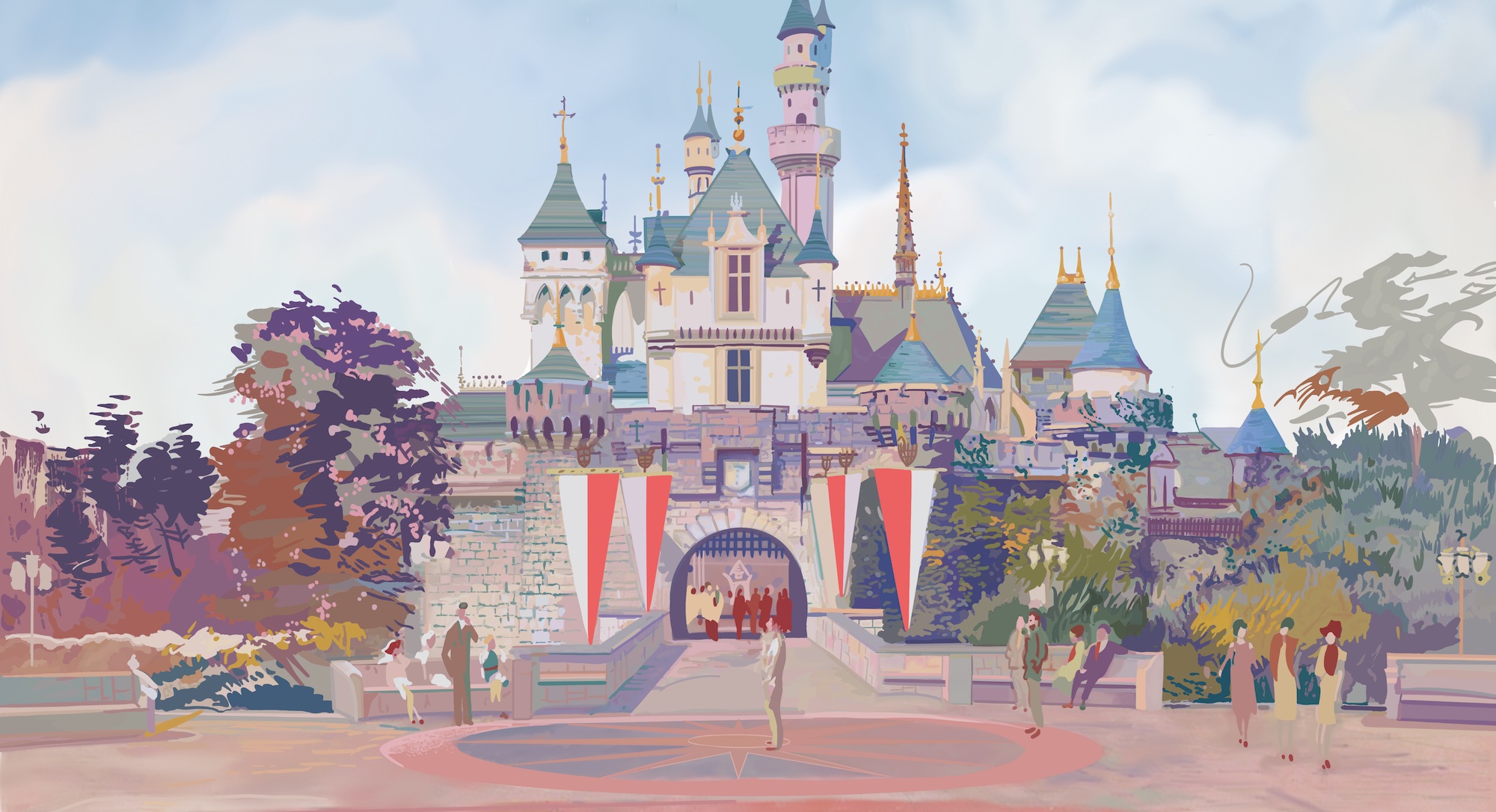


Before: The Worlds of Pixar
As we’ve touched on, the tumultuous and piecemeal evolution of Walt Disney Studios during its first quarter century hinged heavily on Pixar. That’s actually somewhat expected given that – like California Adventure – its Iger-initiated reinvestment in the 2000s aligned with the then-new CEO’s $7.4 billion buyout of Pixar, making sense of its heavy use in both parks’ stories as the company sought to leverage its enormous investment.

Happenstance, one-off expansions to Walt Disney Studios sequestered the Cars Quatre Roues Rallye flat ride, Crush’s Coaster, Toy Story Playland, Place de Rémy, and the Cars-themed remnants of the Studio Tram Tour in close enough quarters that the park’s rebranding saw fit to merge them into “Worlds of Pixar.” It’s still… messy. But more to the point, it won’t work for our purposes given that no Pixar film is based on a book or even broad “legend” or “mythology.” (That’s part of the studio’s appeal, even though it’ll essentially mean Pixar has no place in this park. Just a weird trade-off of having a bar-to-entry, I guess!)
More to the point, it gives us this space to really play with. We gobbled up the old “Toon Studio” (with the Cars flat ride and Crush’s Coaster) already as part of the Royal Forest, and obviously the Studio Tram Tour to “Cars-tastrophe Canyon” is a goner. So what we have to work with is pretty clean: Toy Story Playland and Place de Rémy. Between them, these two mini-lands offer three flat rides, a multimedia dark ride, and a table service restaurant. Broadly, I think all of that is worth salvaging… even if both Toy Story and Ratatouille as IPs are no longer welcome.
So given lingering thoughts about whether this park could integrate elements of a timeline, I think there’s a strong case for what we can do with this area of lightly-decorated, off-the-shelf Toy Story family rides existing alongside the more well-appointed Ratatouille cul-de-sac…
Chapter Two: WONDERLAND

By the far end of the Royal Forest, we were on to Disney’s 1950 adaptation of Cinderella and 1959’s Sleeping Beauty. I think that we can draw from this same Silver Age heyday to introduce the whimsical and trippy world of Wonderland.


First we can handle the sort of woodsy remains of Toy Story Playland. Luckily, we already have a blueprint for this aesthetic thanks to the queue of Disneyland’s Alice in Wonderland ride. That space is beautifully shaded by a giant ficus tree, but the queue itself is filled with “stained glass” flowers for streetlights, huge curling leaves and petals, giant fiberglass mushrooms, and of course, suspended paper lanterns that create a magical mix of a botanical garden party right inside of the Technicolor world of this 1950s animation masterpiece. Certainly at night – but even by day – this is such a pleasant place. So vivid and bright and colorful.
I think this aesthetic not only feels right at home in the already-wooded Toy Story Playland, but also lends itself well to the artificiality of those off-the-shelf flat rides. We’re able to lean into them as the wacky contents of Wonderland; devices that exist to elicit laughter and dizziness, with lots of swirling and swinging and tummy-turning. We can even imagine that we’re “shrunk,” which still gives us that sense of transportation and of a new perspective. I just think it works in a really pleasant way and allows these three flat rides to not just remain, but to be even richer.

For what it’s worth, I envisioned slightly relocating and transforming the Toy Solder Parachute Drop (above) into DANDELION BOUNCE, allowing us to ride the airborne puffs of a giant-sized wonder-dandelion (made so by a tipped “Drink Me” bottle that’s super-sized the flower). As they rise and fall over Wonderland, these floating seed pods would offer views out across the Royal Forest and the other Silver Age lands here. Then, the Music Express-style Slinky Dog Zig Zag Spin is reclad as CATERPILLAR CRAWL as we sit in segments of a caterpillar and circle around a mushroom.
Finally, we have the land’s Intamin Half-Pipe coaster – currently RC Racer. Even if it’s “off the shelf” and relatively low capacity, it is a thrill ride, and one we might compare to Disneyland’s Indiana Jones et le Temple du Péril in terms of its purpose in the park’s lineup.

Still, RC Racer was always an odd choice for a growing park given that under the best conditions, this launched roller coaster is looking at around 750 people per hour (versus Indy’s 2,100)… essentially, comparable to a tea cup ride and not very well positioned for a park aspiring to be “world class.” However, it’s worth salvaging if we can dilute its necessity with more to do across the park. So I kept it as JABBERWOCK JOUST, drawing from Lewis Carroll’s nonsense poem “The Jabberwocky.”
Then, we can wrap the small “Toy Story Land Boutique” retail space (currently housed in a blue “Monkeys in a Barrel” hut) as the CHESHIRE’S KEEP, complete with an adjoining meet-and-greet trail for character greetings with the striped cat.
Obviously, Toy Story Land has become the de facto “low-lift, capacity-boosting family land” for Disney Parks precisely because it tacitly permits off-the-shelf flat rides and embraces the kinetic, synthetic appearance of them. But I love that Wonderland can do that, too! The more saturated the better! Here, these oversized contraptions feel like the whimsical, musical, dizzying oddities you might expect to find in the overgrown woods of Wonderland, punctuating the landscape with pink, purple, and teal. I think it works! And actually, I think that this Alice aesthetic is strong enough to also make sense of the Place de Rémy next door…!

Place de Rémy is such a warm and lovely plaza that it feels awful to suggest that it be torn to the rivets to have its facades rebuilt. However, remember that Ratatouille won’t work in our literary park, and we said that such limitations would be good in that they’d force us to get clever. So the former Parisian courtyard, we now allow for Wonderland to be more than just an abstract garden and forest, and actually bring to life a physical place.
In this case, I envision turning the facades of Place de Rémy into a sort of concocted interpretation of the inner courtyard of the Queen of Hearts’ castle. It’s stylized and flat with lots of hedges, card panels, and geometric oddities, but this outdoor plaza is where the Queen conducts her kangaroo court and croquet. It’s no accident that I sort of envision this looking something like the facade of “it’s a small world” – the artwork above is by Mary Blair, whose heights Rolly Crump was clearly going for when he developed that geometric, hedgy exterior for the Disneyland ride.


That allows us to re-use the ride system and layout of the real-world Ratatouille dark ride as THE WONDROUS AND WHIMSICAL ADVENTURES OF ALICE. I think that this somewhat “wacky” ride system actually lends itself well to Wonderland, and that the projected dome elements within are well suited for it! Even the more claustrophobic elements of Ratatouille (like “crawling through the walls”) can be reinterpreted as dashing through a hedge maze, creating a really frantic and fun trip through this vibrant world, all in the style of the hand-drawn original.
By the way, the Bistro Chez Rémy restaurant that the ride’s exit looks into can become THE ROYAL SUITE RESTAURANT, a table service eatery wherein guests dine among the Queen’s elegant croquet garden. This is a natural home for character dining during special Tea Party events and perhaps even appearances by the Queen’s marching Card Soldiers.
Anyway, by “fusing” Toy Story Playland and Place de Rémy, I think we end up with a really strong land here! We get three flat rides, a trackless dark ride, and a table service restaurant all centered on this very timeless Silver Age classic film. That’s actually a tremendous treatment for a 70 year old movie, but I think that like Snow White and Cinderella, Alice deserves it in terms of its timelessness and intergenerational appeal.

And by the way, it’s worth considering what larger organizing principle(s) are at play here… Because yes, Wonderland nicely cements that we’ll be visiting worlds that began as books – that’s our substance and standard. But a second scheme is arising – that idea of a timeline of Disney films. That, I think, gives this park leeway that books alone wouldn’t earn. We could take this to management and go, “Huh, yeah, I guess they are all books! Who knew! But anyway, did you notice it’s a timeline of Disney’s eras?! By circumnavigating the park, we are stepping through the larger story of animation.”
NEW! WONDERLAND
RIDES
- REIMAGINED! Dandelion Drop (re-themed Toy Soldier Parachute Drop)
- REIMAGINED! Caterpillar Crawl (re-themed Slinky Dog Zig Zag Spin)
- REIMAGINED! Jabberwock Joust (re-themed RC Racer)
- NEW! The Wondrous and Whimsical Adventures of Alice (re-use of existing Ratatouille dark ride)
ATTRACTIONS
- Cheshire’s Keep (meet-and-greet)
RESTAURANTS
- REIMAGINED! The Royal Suite (table-service, retheme of Bistro Chez Remy)

Both organizing schemes hold up independently, and whichever lens you choose to view the park with is fantastic! So now as we continue to fill in, we want to stick to the “Silver Age” and the 1950s…
Before: Adventure Way, Part I

To just briefly clarify nomenclature here, at the real Disney Adventure World, Adventure Way is a land comprised of a long midway bridging the former “core” of the park (essentially, the plaza in front of Tower of Terror) to the new core of the park, which is the Adventure Bay lagoon. So the land Adventure Way is both the midway leading to the lagoon and the terraced gardens encircling the lagoon.
For now, let’s speak only of the midway part – the path (above) connecting old to new… A lovely pleasure garden of ivy, cherry blossoms, Edison bulbs, and art nouveau architecture, Adventure Way technically joins Animal Kingdom’s Tropical Americas as the first Disney Parks lands in years that are not dedicated to a single intellectual property. (Though worry not – like Tropical Americas, it is nominally original while being filled exclusively with Disney and Pixar.)

Imagineers use the narrow midway projecting straight between the branching arms of the former “Y-shaped” layout to nestle in two family flat rides – Rapionce Tangled Spin (a teacup ride placing guests in spin-able rowboats under glowing lanterns suspended beneath an art nouveau cupola) and a yet-unnamed Up-stylized yo-yo swing to come after the park’s official relaunch.
Aesthetically, Adventure Way is (intentionally) a complete antithesis to everything the park has contained for the quarter century prior. And while it’s logistically necessary to access the far-flung lagoon meant to serve as the park’s new portal to expansion, it’s also conveniently positioned in such a way that guests emerging from Studio 1 World Premiere immediately get the “long shot” (in this case, a very long shot) to the lagoon and the mountains of Arendelle beyond, which is clearly meant to be a signature vista of the park.
I actually think this is a good example of how Imagineers “turned lemons into lemonade.” To expand the park beyond its minuscule original footprint required a way to get guests out of the old and into the new, which de facto needs to wedged between the arms of the former “Y-shaped layout.” Adventure Way does that with great “invitation” by presenting the reward of The World of Frozen the second guests emerge from World Premiere. Immediately, Arendelle becomes our “weenie,” pulling visitors down Adventure Way and to the lagoon’s edge, which is exactly what it’s meant to do: to relocate this park’s center.

So naturally, I’m going to completely go against that very intuitive organizing idea. In a Build-Out, we benefit from the ability to be brave and bold in a way that real urban planners are rarely afforded; we’re able to envision an ideal guest – one who wants to “get lost” and “stumble upon” things, understanding that as a reflection of the park’s Theme.
In other words, only in this very silly medium of “armchair Imagineering” can we do what I’m about to, which is to totally conceal the lagoon by breaking the “long shot” view and using this space for something other than two pleasant but placid flat rides meant to fill the void…
Chapter Three: NEVERLAND

Again I say: kids, don’t try this at home. It defies logic that we’d break the straight line of sight between the Grand Library’s overlook and the long-shot view of the lagoon, essentially “hiding” what’s meant to be the park’s new Hub. But here, in our celebration of worlds brought to life on the page and then made incarnate through Disney artistry, is the right place to celebrate 1951’s Peter Pan.
In other words, our journey will begin in Royal Forest. From there, though, our next step is either Alice in Wonderland or Peter Pan as embodiments of Disney’s “Silver Age” of the 1950s. Accessed via a forest path between the Queen’s Tower and the mine train, then across a creek, is the world awaiting just past the Second Star to the Right.

Neverland is built around a small central lagoon with Hook’s docked Jolly Roger as something of a “weenie” with its masts rising beyond Royal Forest. We then get a second layer out of the fantastic “mountains” developed for the Peter Pan section of Tokyo DisneySea’s Fantasy Springs.
(Incidentally, that means that when standing on the back steps of the Grand Library, we get a pretty well-organized view even without the straightaway – the hills of the mine train on the right foreground, the Neverland mountains beyond on the left, and finally the far-off Arendelle in center background. I think that’s a compelling invitation to exploration in these Story Realms…)

Naturally, we here insert a copy of DisneySea’s PETER PAN’S NEVERLAND ADVENTURE. This ride is noteworthy for being Disney’s first application of (their version of) the “SCOOP” ride system, most famously used on the Modern Marvel: The Amazing Adventures of Spider-Man at Universal Islands of Adventure. By nature of relying heavily on screens, the ride is generally regarded as the least astounding of the three E-Tickets that debuted in Fantasy Springs on the same day, but it’s a very good ride (and a substantial one, at six minutes), which would help raise this park’s average ride quality and technological sophistication substantially.
Really the only drawback to Peter Pan’s Neverland Adventure on paper is the argument that we’ve “been there done that” with Peter Pan’s Flight, which continues to exist at the park next door. That’s true in Tokyo too, though. And aside from the IP, the rides really don’t have much in common at all. So given Peter Pan’s perfect position in a park celebrating books that have changed us and taken us far from home through the interpretation of Disney artists, I think it’s a perfect fit.

Luckily, the Neverland Adventure showbuilding comes pre-loaded with a wonderful quick service eatery, THE LOOKOUT COOKOUT, which we can keep here. (It was actually appropriate that Walt Disney Studios had so few restaurants for its small footprint back in the day. The problem is that restaurants are expensive to construct and not very “sexy” from a marketing perspective, so perilously few have been built as the park has grown such that World Premiere Plaza, Toon Studio, and Toy Story Playland have only snack stands.)

Likewise, it’s a no-brainer to port over a version of DisneySea’s TINKER BELL’S BUSY BUGGIES. We might call this an “outdoor dark ride,” or a sort of slightly-refined version of the beloved Heimlich’s Chew Chew Train from California Adventure. Shrinking to the size of a Disney Fairies™ character, guests board little woven basket carts and bumble through oversized scenes delivering parcels and packages to the little regions of Pixie Hollow (which are pleasantly split into autumn, winter, spring, and summer). It’s a harmless ride that adds variety to the land’s offerings!
Add in a few snack stands for in-universe treats, character meet-and-greets aboard the Jolly Roger, and a family playground in the roots of a towering, central Lost Boys’ Tree and I think this ends up being a really nice land in and of itself, even pulled out of the “Fantasy Springs” formula.
NEW! NEVERLAND
RIDES
- Peter Pan’s Neverland Adventure (SCOOP-based E-Ticket dark ride)
- Tinker Bell’s Busy Buggies (outdoor slow-moving family ride)
ATTRACTIONS
- Jolly Roger (meet-and-greet aboard Hook’s galleon)
- Lost Boys Tree (10-and-under playground in the roots of an artificial tree)
RESTAURANTS
- Lookout Cookout (quick service eatery in the Lost Boys’ hideout)

If you’re keeping score, all that remains of the “old” Walt Disney Studios is Avengers Campus, which we’ll certainly return to toward the end of our journey given that – in our timeline-oriented layout – it’ll be a post-Frozen property. But for now, let’s begin as Imagineers did – with that lagoon that’ll serve as our new “Hub” for the park’s expansions…
While I appreciate the thought and detail that went into this project, I can’t help but feel as if it’s a bit redundant to use stories which are already prevelant in the castle park. Wouldn’t it make more sense to use Winnie The Pooh, The Little Mermaid, Beauty and The Beast, and others that don’t have representation in the first gate?
Just a small thing: There is a third derby racer in operation at Rye Playland in Rye, New York.
I’ve been kind of obsessed with Disney’s lack of creativity in naming their parks. Like you, I find “Adventure World” terribly generic–even for a generic park. Why wouldn’t they continue what they started with geographic names? Disneyland, DisneySea, Typhoon Lagoon, and even the “Kingdom” parks work nicely. Why not Disney Woods, Disney Bay, Disney Valley. Heck, bring back Disney Village! (Story Realms works, too–nice job!)
I absolutely love this. I really appreciate the time and effort you put into these build-outs. I love reading about them! I’d be thrilled if you would take a shot at Epcot (I’d really like to see a fully expanded World Showcase) and maybe even a brand new Universal theme park (similar to Fantastic Worlds)! I can’t wait for your next build-out!