

Horizons (1983 – 1999)
On March 10, 1985, GE’s 10-year sponsorship deal expired, and the Carousel of Progress in Magic Kingdom’s Tomorrowland briefly closed to remove references to GE and its logos. In actuality, GE hadn’t abandoned their exploration into progress and optimism; they’d simply moved onward.

It’s ironic: Disney and GE had really gotten their start together at the New York World’s Fair in 1964, and in the tradition of the best carousels, things had come back around again. In 1982, Disney opened its own “permanent World’s Fair” as the second theme park at Walt Disney World – EPCOT Center.
Like the World’s Fair that so influenced Disney history, EPCOT Center was populated by pavilions dedicated to areas of science and industry, sponsored by corporations: communication (Spaceship Earth), innovation (Communicore), ocean exploration (The Living Seas), agriculture and nutrition (The Land), creativity (Imagination), transportation (World of Motion), health and wellness (Wonders of Life), and energy (Universe of Energy).

But one attraction was developed as the keystone: the “thesis” of EPCOT Center’s Future World, intentionally combining all of those areas of exploration into one single, epic dark ride into humanity’s future. General Electric swapped their sponsorship to the king of all Lost Legends: HORIZONS. Make the jump to that in-depth feature to pick up the story… literally. Because aboard Horizons, guests watched the family from Carousel of Progress adapt to expanding explorations of the seas, the land, and space…

In other words, while Carousel of Progress followed one family through the 20th century, Horizons picked up the story by tracing the same family in the 21st century… in the photograph above, you might recognize the mother, father, and even Rover! Horizons was a truly inspirational spiritual sequel that will forever live on as a shining example of EPCOT Center’s idealism and futurism.
And by the way, it isn’t the only way the Carousel of Progress lived on in EPCOT Center… After all, the park’s Japan pavilion was built with (and to this day, still contains) a revolving theater meant for a four-act Audio-Animatronic show; one that never opened… at least, in the United States. But that’s a story for later…
Believe it or not, Walt Disney’s Carousel of Progress outlived its own sequel.
A whole new Tomorrowland

Back at Magic Kingdom, when the look of the ‘70s-born future faded from interest in the 1990s, Orlando’s Tomorrowland was redesigned from scratch in one of the most intriguing original mythologies ever written by Imagineers.
Redeveloped as a “future that never was,” the land left its scientific roots behind. The sleek, white, geometric walls and white-and-red NASA rockets disappeared. Magic Kingdom’s Tomorrowland was recast as a metallic alien spacesport of landed UFOs, silver fins, technicolor interstellar antennas, mechanical palm trees, and pulp serial Buck Rogers rockets. In other words, the land once centered around science turned instead to science fiction, inviting the likes of Lost Legends: The ExtraTERRORestrial Alien Encounter and Timekeeper to wrap the entire land in one overarching story. Tomorrowland became a “living” alien spaceport as envisioned by 20th century comics.

The ride survived, albeit with a new “cogs and gears” exterior only loosely tying it to the rest of the new mechanical sci-fi land. Along with its gentle recasting in this New Tomorrowland ’94, the show was rescripted and re-recorded with a fresh voice cast – the one we know today.
But for Disney fans, this mid-90s update is most important for two other reasons. First, the ride was officially renamed Walt Disney’s Carousel of Progress – one of just two attractions in the world to bear his name as a mark of his approval. (Do you know the other?) Second, the ride was given a retro touch thanks to the grand, triumphant return of “There’s a Great, Big, Beautiful Tomorrow” – a song missing for over two decades.

Naturally, the other essential 1994 update was that the ride’s finale (still stuck in the ’80s) was upgraded again, to “Christmas, 1999,” leading our Carousel family right up to the dawn of the New Millennium (where Horizons will ostensibly pick up their story… never mind that Horizons would be closed by Christmas 1999… Oops). It also presented a very, very large jump in time betwen scenes, making the attraction’s new tempo 20 – 20 – 60 years between scenes.
And now, at last, we’re caught up. That positions us to sit back, relax, and enjoy this Walt Disney original from the comfort of our homes. Walt Disney’s Carousel of Progress is humorously (but accurately) celebrated as the longest running stage show (and with the most performances!) in the history of American theater… a pretty phenomenal label! We invite you to sit back and enjoy this spectacular point-of-view video of the entire show as it currently exists:
It’s often said that Walt declared the Carousel of Progress his personal favorite, decreeing that it should “never cease operation.” And aside from its transfer to Florida from 1973 – 1975 and a brief but perilous period of seasonal operation after the September 11, 2001 terrorist attacks halted tourism, it hasn’t.
But that doesn’t mean fans aren’t still worried…
Still turning….

In 2016, Carousel of Progress was given both a fresh, sleek, stylish paint job and a spectacularly classic new logo. It was an early step in an ongoing redesign of Tomorrowland, meant to remove the metallic fins, cogs, and sci-fi accoutrements the land had debuted two decades before in favor of a return to ’70s Space Age simplicity. It seems like a show of faith from Imagineers that Carousel will survive the ongoing renovation of Tomorrowland, even if fans are perpetually on edge over its place in the park.
And to their credit, who wouldn’t be worried? The ride’s finale – ostensibly meant to showcase the possibilities of the future – has been moored at “Christmas, 1999” for about twenty years too many, showcasing clunky VR as envisioned from the mid-90s, Christmas trees that adjust the brightness of their lights by voice command, and (gasp!) appliances that take verbal instructions!
Sure, a simple set rebuild, new costumes, and some new talking points would make the scene fresh once more (a simple update that tops the wish list for many Disney Parks fans). But given Walt’s love for Carousel, why not give it a proper reimagining? To our thinking, Disney has two copelling options…
1. Retro return

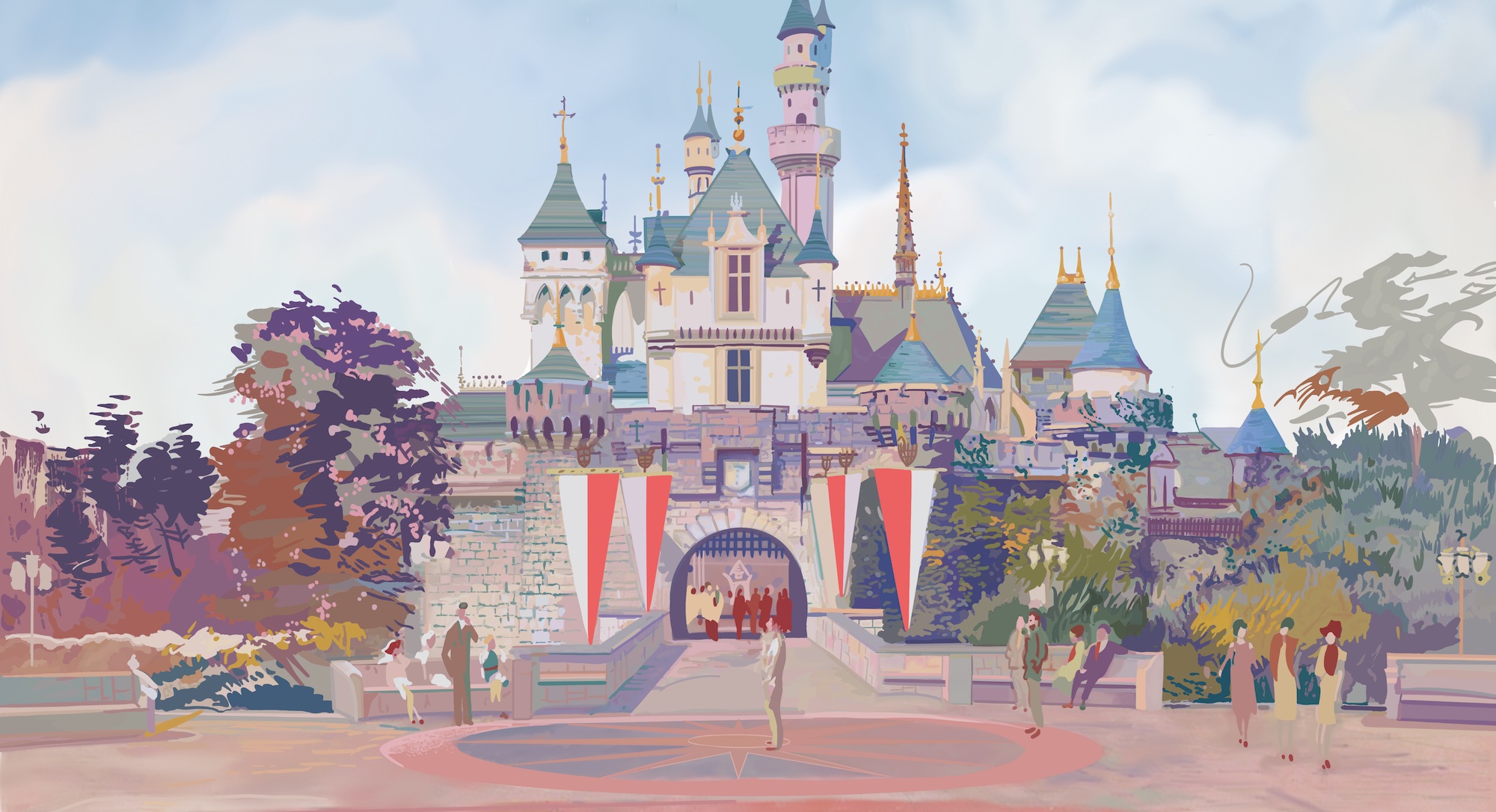
Imagine the Carousel of Progress returning to its original set-up of 20-year increments – 1900 / 1920/ 1940 / 1960 – with each scene lovingly stylized in the vein of Marc Davis’ scenic masterpiece. As the print above shows, a beautifully retro but fittingly-modern retelling of the ride’s original timeline and story would be a masterwork of Imagineering… as long as Disney references are left as mere cameos, like in the image above.
Though this loving look back is probably a better fit for EPCOT than Tomorrowland, it would be a full revival and reimagining of Walt’s classic, just with the artistry and wonder of modern Imagineering at its heart. It would also fit the land’s stylistic return to mid-century modern ease. Or…
2. Future focus

Disney has consistently seen fit to update the ride’s last scene to the “present” or the slightly-near future,” and that’s not a bad idea. However, it’s clear that Imagineers can’t keep up with a “future” showca. Besides, updating the ride’s final scene to 2020 would create an immense eighty year gap betweeen Act III (1940) and Act IV (2020).
Why not embrace that? Why not reimagine the ride to address technological and social progress with larger increments? Picture it: 1900, 1960, 2020, 2080! 60-60-60!This would not only allow the ride to explore three massively stylistically and technologically different times in recent American history, but to end with a Horizons-esque finale set in a truly-distant sci-fi future. It seems like this arrangement would not only revive Carousel and preserve the spirit of two of its scenes, but position it for success in the future.
Well, we can dream!
Just a dream away!

You can see why Walt Disney loved his Carousel of Progress. Deeply rooted in his own ideals of progress and optimism, the ride is a living, breathing reminder of Walt’s philosophy. And, steeped equally in nostalgia and futurism, the ride is perhaps the best reflection of Walt’s spirit, too.
That’s the reason the Sherman Brothers say their original song is the closest they’ve gotten to capturing a “theme song” for him.
And indeed, as long as the Carousel of Progress keeps turning, we can imagine that there truly may be a great, big, beautiful tomorrow shining at the end of every day.

Thank you so much for reading. Now, it’s your turn to join the story. If you enjoy spending time falling down the “rabbit hole” of Park Lore’s in-depth, ad-free, member-supported stories, consider becoming a Member for as little as $2 / month.
Members can unlock rare concept art in every tale, reveal attraction audio streams in select stories, gain access to over a hundred exclusive articles in our quick-read Extra Features and in-depth Special Features collections, gain exclusive podcast extras, and receive an annual member card and merch in the mail! (Plus, y’know, supporting research-based, ad-free, clickbait-free, in-depth theme park writing!)
It’s time to hear your thoughts. Use the comments below to share your experiences with the Carousel of Progress. Have you had the chance to experience this Walt Disney original? Does it capture a piece of Walt’s legacy and hopes for his parks that’s otherwise dwindling away? Or is it an antiquated remnant of yesteryear that represents fans’ misguided hopes of turning Disney Parks into “museums” of dated, stagnant attractions? How could, should, and will this classic evolve as Tomorrowland continues to shift around it?
I have to confess, my frame of reference for COP begins with the much-too-maligned “Now Is The Time” version since that’s the one I saw first and for many years after between 1975 and 1993. I was totally unfamiliar with the previous version of the show until the late 90s. I’ve learned to respect and appreciate the World’s Fair and Disneyland original but I am not a fan of the 1994 redo. I don’t like the fact that the father (as voiced by Jean Shepherd) became a doofus in contrast to the strong father-figures of Rex Allen (WF and DL) and Andrew Duggan (WDW). I may also be the only one who has pointed out the absurdity of how when Shepherd’s father makes dumb asides like “Lindbergh will never make it” he then closes Act 2 by saying “Things can’t get any better!” and then starts singing “Great Big Beautiful Tomorrow” when logically he should instead be singing “Now Is The Time!”
I hope the show will continue but it needs a massive redoing at this stage.
Haha – So funny to think about the juxtaposition of “Things can’t get any better! Anyway, there’s a great, big, beautiful tomorrow ahead!” As someone who first experienced the Jean Shepherd version, I’m feeling now what I imagine you would’ve felt when the “Now Is The Time” version came to a close. Like, uh oh… What a perfect script, a perfect voice cast, a perfect spirit. Obviously just because perfect = familiar, but still. Hard to imagine what’s to come now that we know the attraction will soon change to begin in the 1960s and maintain its 20 year jump from there. I’m anxious they’ll go the cheesy route with the ’80s and 2000s. In any case, it’s a little sad to lose what is ostensibly the last remnant of Walt’s version (the time periods).
I guess yet again, we’re torn between “Now is the time” and “There’s a great big beautiful tomorrow.” We’ll have to see!
There are also two pieces of soundtrack in the attraction that have endured in all versions of COP since the World’s Fair. Mel Blanc’s Cousin Orville, “No privacy at all in this place!” and the music cue in Act 2 when the appliances threaten to “blow a fuse”. We’ll likely lose the latter if the 20s are now out, but I have a feeling they’ll still try to make Orville make the transition. 🙂